Five Design Tradeoffs When Using Additive Manufacturing for Production
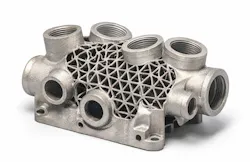
Additive manufacturing (or 3D printing) performs well in prototyping, where speed and flexibility outweigh cost and throughput constraints. Problems begin when those same designs move into production.
A part that is efficient to print at low volumes can become too slow or expensive to produce at scale. Throughput, unit cost and consistency impose limits that do not appear during development.
Engineers often assume that design freedom and tooling elimination automatically translate into production value. Reality is more complex. Additive manufacturing introduces specific tradeoffs that directly affect build speed, unit cost, material performance and long-term consistency.
The shift toward production use is trending, often before these constraints are fully understood. A 2024 Protolabs survey found that 21% of respondents now primarily use 3D printing for end-use parts. Forty-seven percent cited lead time as their primary reason for choosing additive over traditional methods. As cost pressures and supply chain constraints intensify, this trend will likely continue.
Understanding these five critical tradeoffs determines where additive manufacturing works for production components—and where it doesn’t.
1. Geometry Freedom vs. Production Throughput
Additive manufacturing creates internal channels, lattice structures and complex geometries impossible with traditional machining or molding. Engineers can consolidate multiple components into single, higher-performing designs.
But production demands throughput. Build time depends on layer-by-layer deposition and doesn’t compress with scale. Unlike conventional processes, where cycle time decreases through improved tooling or parallel operations, additive throughput stays relatively fixed for any given part and process. More printers increase output, but require additional capital, floor space and staffing.
Overlooking this tradeoff turns geometrically optimal designs into production bottlenecks. A part that justifies additive manufacturing at low volumes may become too slow or expensive when demand rises. The design still works, but the printing process no longer delivers the required output, cost or lead time.
Consider a manifold redesigned for additive manufacturing. Consolidating multiple drilled passages into one printed structure reduces assembly steps and potential leak paths. The same design may increase build time and constrain throughput compared to machined alternatives at higher volumes.
If geometric complexity does not eliminate enough parts, assembly steps or failure points to offset slower production, additive becomes a throughput constraint rather than an advantage.
2. Tooling Elimination vs. Unit Cost at Volume
Additive manufacturing eliminates molds, dies and dedicated fixtures. This reduces upfront investment and shortens time to first part. It also allows design changes without retooling—a significant advantage in early production or evolving products.
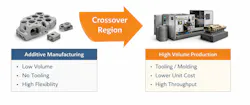
On the production scale, cost behaves differently. Traditional processes absorb tooling cost over volume and reduce unit cost as output increases. Additive manufacturing doesn’t follow this curve. Per-part cost remains relatively stable regardless of volume.
This creates a crossover point:
- Traditional: total cost = tooling cost ÷ volume + unit cost
- Additive: total cost = unit cost
The crossover occurs when: tooling cost ÷ volume = additive unit cost − traditional unit cost.
In practice, this crossover often occurs earlier than expected. At volumes in the tens or low hundreds, additive manufacturing can remain cost-competitive when tooling costs dominate. As volumes move into the high hundreds or thousands, the per-part cost advantage of traditional manufacturing typically overtakes additive, even when design complexity is high.
Misunderstanding this relationship leads to selecting additive for applications where volume ultimately drives cost decisions. Parts that are economical at low volumes can become cost-prohibitive compared to conventional alternatives as output increases.
Additive manufacturing is most effective at volumes in the tens to low hundreds, or where design changes, lead time or geometric complexity carry more value than minimizing unit cost.
3. Part Consolidation vs. Serviceability and Risk
Additive manufacturing combines multiple components into single integrated parts. This reduces assembly time, eliminates interfaces and removes the accumulation of small dimensional variations across multiple parts that affect final fit and performance.
That same integration concentrates failure risk. When several functions are built into one component, failure of a single feature requires replacing the entire part. Maintenance becomes less localized and failure costs increase.
Ignoring the tradeoff between part consolidation and serviceability means gains in assembly efficiency are offset by higher lifecycle costs. Systems that are simpler to build may be more difficult and expensive to maintain, particularly in applications with wear, damage or contamination risk.
If failure, wear or maintenance is expected, consolidating parts can increase lifecycle cost rather than reduce it.
4. Design Freedom vs. Process Constraints
Additive manufacturing expands design possibilities but introduces its own constraints. Geometry that’s easy to model may still be difficult to produce.
Part orientation influences accuracy, strength and surface quality. Support structures introduce additional steps and affect surface finish where they’re removed. Thermal effects during building can cause distortion or residual stress. Material properties vary with orientation and processing conditions.
When these factors aren’t considered, parts that appear optimized in design may require significant post-processing or fail to meet dimensional and surface requirements. The result: added labor, variability and reduced production efficiency.
Effective additive design requires alignment with process realities. Geometry, orientation and finishing requirements must be considered together to ensure that parts perform as intended when produced.
5. Rapid Iteration vs. Production Consistency
Additive manufacturing supports rapid design changes and short development cycles. Iteration occurs without tooling delays, allowing designs to evolve quickly.
Production places different demands on the process. Consistency across builds becomes critical. Variations in machine condition, material behavior and process parameters affect dimensional accuracy, surface finish and mechanical properties from part to part.
If the tradeoff between rapid iteration and production consistency is not addressed, designs that perform well in prototyping may not deliver consistent results in production. Variation appears across builds, requiring additional inspection, adjustment or rework.
Design flexibility doesn’t guarantee production consistency. Additive manufacturing is less suitable where tight tolerances and repeatability are critical across high production volumes. Successful production use requires controlled, repeatable processes, not just design flexibility.
Conclusion
Additive manufacturing succeeds in production only when its advantages outweigh the constraints imposed by throughput, cost and consistency.
As the technology has matured, it has expanded from prototyping into production use. Its production value, however, remains dependent on where its advantages outweigh its limitations relative to machining, molding and other established processes.
These tradeoffs define where additive manufacturing performs effectively and where conventional methods remain more appropriate. It is most effective when:
- Production volumes are in the tens to low hundreds
- Geometry replaces multiple components or assemblies
- Tooling cost or lead time is a primary constraint
- Design changes are expected over the product lifecycle
- Variability can be managed within process or quality limits
Outside these conditions, conventional manufacturing methods typically deliver better cost, throughput and consistency.
About the Author
Steve Sterling
Steve Sterling is a Minnesota-based freelance writer and editor.
Voice Your Opinion!
To join the conversation, and become an exclusive member of Machine Design, create an account today!
 Leaders Logo
Leaders relevant to this article: