A Novel Framework for Real-Time Carbon Intensity Measurement in MES-Driven Decarbonized Manufacturing
Powered by Veronika Furs
The Manufacturing Execution System (MES) has revolutionized the shop floor, providing millisecond-level precision on every metric, except the most critical one, carbon emissions. Despite the global MES market being projected to reach US $29.5B by 2030, manufacturers are still stuck using analog systems such as spreadsheets and manual quarterly aggregates to track carbon emissions.
This causes delay, ranging between 5 to 60 days for small and large companies, and forces operational decisions that are weeks too late. ESG teams are forced to report sustainability performance using lagged data, while plant managers lacking the granular visibility into when, why, where carbon emissions arise at the line, shift, or machine level, are unable to optimize performance.
Consequently, the gap between operational data and environmental accountability has crystallized into a strategic liability, jeopardizing compliance and preventing real-time Scope 1 and 2 optimizations necessary for decarbonization.
A novel framework developed by product leader and sustainability strategist, Lesia Yanytska, is addressing this specific operational blindspot. The framework reimagines the MES not only as a production tool but a live carbon tower that can track, alert, and mitigate carbon emissions at the shift, machine, and line level.
A Novel Innovative Framework for MES-Driven Decarbonization
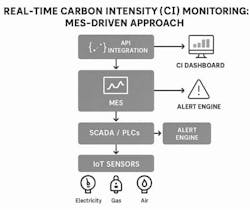
Yanytska’s patent-pending framework, (USPTO #63/808,207, filed May 2025), is built on a modular architecture and is based on five interconnected layers.
Layer I: The Sensor Level (Foundation)
Layer II: SCADA/PLC Integration (Routing)
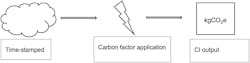
Supervisory Control and Data Acquisition (SCADA) and Programmable Logic Controllers (PLCs) manage equipment automation in the industrial setting. The framework routes the data through this existing infrastructure, leveraging these systems to ensure data integrity and synchronize time-stamps with active production events.
Layer III: MES Computation (Control)
Layer IV: Alert Engine (Intelligence)
• Ticket generation.
• Operator notification.
Layer V: ESG Platform Integration (Enterprise Synchronization)
Framework Significance – Compliance, Credibility, Competitiveness
Why this Framework is Unique
About the Author

Veronika Furs
Veronika Furs is a Wilmington, Del.–based writer covering engineering innovation, advanced manufacturing and the entrepreneurial forces accelerating the tech sector.
Voice Your Opinion!
To join the conversation, and become an exclusive member of Machine Design, create an account today!

Leaders relevant to this article: