How Modern Online Tools Are Transforming Motion Control System Design
Key Highlights:
- Online configuration tools now support a wide range of components, including complete assemblies like electric actuators and linear units, with real-time updates on dimensions, performance and compatibility.
- Visual interfaces and interactive layouts help engineers confirm fit, orientation and connection details early in the design process, reducing errors and rework.
- Guided selection features interpret application parameters to recommend suitable products, flag potential issues and facilitate detailed customization of components.
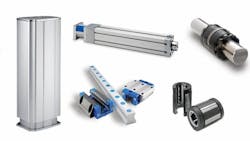
Designing motion control systems has traditionally required navigating catalogs, cross-referencing specifications and exchanging drawings or quote requests with vendors. Bearings, shafts, screws, actuators and linear units often come with enough interdependent variables that even selecting one part can take significant effort. When a machine design involves dozens of these components, time spent specifying, verifying and ordering them can extend into weeks.
Recent advances in online configuration and industrial e-commerce are changing this landscape, however. Engineers today can evaluate performance, configure accessories, validate manufacturability and place orders within the same online environment, compressing a once time-intensive workflow into a much shorter, predictable, accurate and efficient process.
These improvements are driven by the increasing complexity of machine design. Many applications now incorporate smart control, higher speeds, IoT integration or multi-axis motion. Engineers working under compressed schedules need tools that help them verify loads, speeds and mounting constraints without switching between catalogues or software programs.
READ MORE: Thomson Industries Offers Upgraded Actuator Selection Tool
Modern online platforms address these needs through visual configuration, built-in engineering logic and links to real-time manufacturing data. The result is a streamlined design path that begins with concept exploration and ends with a manufacturable, validated component or ready-to-order assembly.
Going Beyond Isolated Catalog Data into Integrated Digital Sizing and Selection
Several years ago, online tools for selecting motion components were limited in scope. Most covered only basic discrete parts and engineers still relied heavily on manuals or technical support to confirm dimensions, accessory compatibility or performance limits. Today, the range of components that can be configured online is far broader.
Platforms like Thomson Industries’ Linear Motioneering toolsets now support not only items like bearings and shafts but also complete assemblies such as electric actuators, ball and lead screws, screw jacks and linear units. Users can move through the selection process by filtering performance ranges, adjusting travel or load and comparing variations side by side.
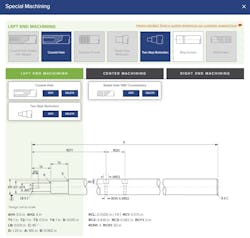
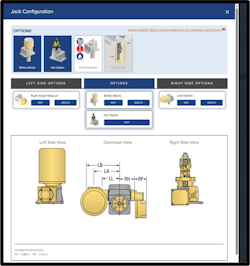
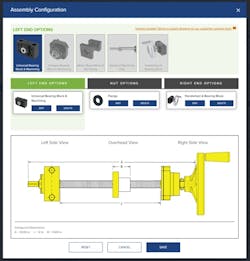
Real-time feedback plays a significant role in making these tools practical. A change in stroke length, for example, automatically updates dimensional values, allowable speed and projected lead times. Graphical previews show the component as it is being configured, whicFh helps identify potential fit issues early on. Accessory options that previously required reviewing separate catalogue sections now appear within the same workspace. Once a core product is chosen, compatible accessories become selectable and are displayed in context using images or diagrams.
These visuals help engineers confirm orientation, spacing and connection style before proceeding. One of the most significant advances is the ability to configure machining or specialized features directly online. For example, when specifying shafts, engineers can define reductions, holes, tapped ends, grooves or tolerance fits through an interactive layout.
The displayed dimensions, allowable ranges and tolerances update automatically according to the chosen shaft size and material. This eliminates the older workflow of creating a 2D print, sending it to a vendor and waiting for a manual quote. The system generates a validated configuration and provides pricing and lead times immediately.
From Trial and Error to Expert-Guided Product Selection
Not every engineer begins with a clear idea of which linear motion solution they need. For situations where load, speed or duty cycle are not yet matched to a particular component, modern sizing tools provide guided selection. These tools interpret a few basic application parameters and identify which product types meet the requirements. The designer enters values such as stroke, move time and carried load. The system calculates motion profiles, including maximum speed and acceleration, and displays which products fall within safe operating limits.
READ MORE: Custom Motor Design: SaaS Platform Brings Flexibility to PCB Stator Design
Visual cues help narrow choices quickly. Products that cannot support the required speed or load are marked as unsuitable. Others may be flagged to indicate that additional considerations apply, such as using dual carriages for stability when handling heavier loads. These indications make it easier for engineers to avoid selections that might appear adequate on paper but would fail to meet performance demands in practice.
Once a viable family is identified, the system presents a detailed results table. From this point, designers can refine the selection by configuring mounting options, travel specifications or motor interfaces. Built-in accessory workflows allow users to add brackets, couplings or motor adapters as needed. When motors are part of the application, some tools include compatibility matrices that highlight which motor models can be mounted using readymade adapters. This is particularly valuable in multi-vendor environments where system integrators need assurance that the components they choose will assemble correctly.
From Error-Prone Manual Processes to Digital Automation
Instant pricing and real-time lead times have become central features of modern design tools. Historically, engineers relied on quoted estimates or assumptions about availability, which sometimes led to unexpected delays. Today, configuration platforms connect directly to ERP systems that track production capacity, part availability and manufacturing schedules.
As users adjust design variables such as stroke, material or accessory options, ERP-linked data updates the cost and expected delivery without requiring a manual quote. Standard items may be available for next-day shipment, while customized assemblies display lead times based on current production loads.
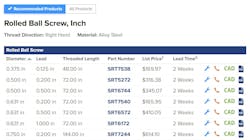
Automated validation also helps prevent configuration errors. Older workflows often required manually constructing long part numbers, which introduced room for error. Modern tools prevent incompatible combinations from being selected in the first place. All dimensional, material and accessory constraints are embedded within the system logic. Engineers can review fully populated specifications, 3D models and performance data in the same window, ensuring that the configured product aligns with application requirements before any order is placed.
These tools also reduce dependency on internal or vendor support for routine configuration questions. Although technical assistance is still available for complex applications, the intent of modern platforms is to enable users to complete most steps independently. This self-serve approach helps reduce email exchanges, quote revisions and manual review, which speeds up design cycles for both engineers and vendors.
A Connected Path from Specification to Procurement
The integration of configuration tools with e-commerce creates a continuous design to the purchase process. Once a component is fully defined, users can order directly from within the tool. The system captures the validated configuration, ensuring that the part entering production matches the specification created online. This reduces the chance of discrepancies caused by manual data entry or outdated information. Purchasers can access the same configuration link used by engineers, allowing them to verify specifications, pricing, quantities and delivery timing before proceeding.
Some platforms also allow users to generate shareable bills of materials that consolidate all selected components and accessories. These records support collaboration between design, purchasing and manufacturing teams. Instead of reviewing PDFs or spreadsheets, teams work from consistent, live configuration data that reflects the latest revisions.
The evolution of these tools represents a shift toward a more connected, transparent and efficient design process. As machine builders and system integrators continue to adopt digital workflows, online selection and configuration will play a growing role in reducing design time, improving accuracy and ensuring that motion components arrive ready to perform as intended.
READ MORE: Thomson Industries Offers Upgraded Actuator Selection Tool
READ MORE: Custom Motor Design: SaaS Platform Brings Flexibility to PCB Stator Design
About the Author
Walter Willis
Manager II, Software Engineering – Linear Motion Division, Thomson Industries, Inc.
Voice Your Opinion!
To join the conversation, and become an exclusive member of Machine Design, create an account today!
 Leaders Logo
Leaders relevant to this article: