Highlights from the Automation Quarter of MD&M West 2026

MD&M West 2026 showcased more than 1,700 exhibitors and highlighted the importance of solid data foundations for effective AI in manufacturing, emphasizing real results over hype.
Feb. 4, 2026
4 min read

Key Highlights

  • The MD&M West show floor demonstrated the convergence of AI, robotics and sensor technology to improve manufacturing efficiency and product quality.
  • Keynote speaker Lauren Dunford emphasized that AI effectiveness relies on a solid data foundation, warning against poor data quality leading to incorrect results.
  • Mecademic's compact robots offer high precision and easy programming, making them ideal for medical device manufacturing and other high-tech sectors.

Medical Design & Manufacturing (MD&M) West 2026 kicked off its first day yesterday, hosting more than 1,700 exhibitors spread over 319,000 sq.ft. of show floor space at the Anaheim Convention center in southern California. 

Guidewheel founder and CEO, Lauren Dunford, opened for the show with her keynote: AI Without the Hype: Real Results in Manufacturing. While her presentation touched a number of AI myths and realities, at the crux of her presentation lay the assertion that AI in manufacturing acts an amplifier of manufacturers’ operations. Whether that amplification produces a good or bad result, however, depends on the solidity of the company’s data foundation.

“For years, we’ve said garbage in, garbage out. With AI, it’s actually garbage in, poison out,” Dunford cautioned. “If you’re starting with bad information, AI will potentially come out with a very wrong but very confident direction for you to go in.”

Ultimately, she added, without a solid data strategy in place first, it doesn’t matter what AI strategy manufacturers adopt. With a solid strategy, Dunford said AI begins to live up to its full potential.

“If we want to avoid garbage in, poison out, then we want to think about what’s the opposite,” she said. “How can we think about carbon in, diamonds out; diamonds being the right insight and the right guidance at the right time.”

Moving away from garbage/poison and toward carbon/diamonds begins with starting from the desired end result, she said, and working backward to discover the data granularity required. In addition, she recommends that manufacturers collect data as close to the source as possible.

However, Dunford warned that an AI solution should never be plugged directly into a PLC. The only other component all industrial equipment share, no matter their age or sophistication, is the power they draw to operate.

That’s where Guidewheel enters the picture. The company’s non-invasive clip-on sensors wrap around the power cables of industrial equipment, like a smart watch, to monitor and collect electric current data in real time. From the fluctuations in power draw, combined with other sensor input (temperature, vibration, etc), Guidewheel’s FactorOps software catalogs downtime and spots patterns equipment availability and performance.

Beyond MedTech

At a show the size of MD&M West, it's impossible to provide an adequate overview of the technology on display without overlooking many of innovative exhibitors.

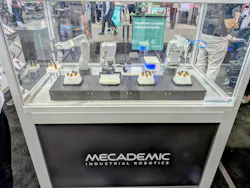
On the floor of any tradeshow, however, there are always natural clot points, booth displays that tend to accumulate a disproportionate number of attendees who linger, take pictures and ask questions. One of those points, within the automation sector of the show, is Mecademic.

The Montreal-based is best known for its diminutive six-axis robot, the Meca500. Weighing only 10 lb (including the controller in the base) and a maximum horizontal reach of 330mm, the robotic arm comfortably fits in your hand but sports some industry leading precision, namely resolution down to 1 micron and repeatability of 5 microns.

The company also offers a similarly compact and precise scara robot, the MSC500, with the same 500g rated payload, resolution and repeatability as its sibling, but at much a higher cycle speed (0.42s).

Under the hood, both models feature an uncommon willingness to play nice with others. Unlike many other industrial robots, for example, the Meca500 and MSC500 don’t require mastery of a proprietary programming language. Instead, developers are free to program in C++, C#, Python or Labview.

In addition, both robots integrate with the most widely adopted communication protocols, including EtherCat, EtherNet/IP and PROFINET. The company also offers function blocks to integrate and control the robots directly from popular PLCs from Rockwell, Beckhoff, Siemens and Omron.

According to the company, which won the HANNOVER MESSE Robotics Award last year, medical device manufacturing is a primary sector for Mecademic, along with electronics, photonics and other manufacturing sectors that require high precision. 

Check out more of our MD&M West 2026 coverage here.

About the Author

Mike McLeod

Mike McLeod

Senior Editor, Machine Design

Mike McLeod, senior editor of Machine Design, is an award-winning business and technology writer with more than 25 years of experience. He has covered the full spectrum of mechanical engineering, from industrial automation, aerospace and automotive, to CAD/CAE, additive manufacturing, linear motion and fluid power.

Sign up for our eNewsletters
Get the latest news and updates

Voice Your Opinion!

To join the conversation, and become an exclusive member of Machine Design, create an account today!