The Data Must Flow
This article was featured in Machine Design’s Automation & Robotics Takeover Week (July 13-17, 2026).
For more than a decade, IIoT proponents and vendors have mounted a concerted push for manufacturers to replace their traditional clipboards, spreadsheets and sneakernet USB drives with an efficient, fully digital network designed to connect, collect, store and channel operational data up and down the Purdue model. But building that infrastructure proved a daunting and expensive endeavor, especially when factoring in the challenges of connecting to multiple legacy systems. And, at the end of the day, no matter how useful plumbing is, it isn’t sexy.
In the last few years, however, the rise of AI has presented manufacturers with a compelling pull to digitally transform. Consequently, many, especially small to medium-sized enterprises, are looking to move past the pilot stage and seriously embark on an IIoT strategy. But, as much as industry would like to jump straight to all that industrial AI tantalizes, getting there still requires roughing in the necessary IIoT infrastructure first.
If the old computing adage was “garbage-in, garbage-out,” the new AI-era version is “garbage-in, reasonable-sounding-but erroneous-hallucination-out.” Without clean industrial data—standardized, contextualized and delivered to the right place at the right time—AI is potentially worse than useless.
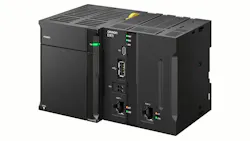
Against that backdrop, Omron released its DX100 Data Flow Edge Device (also branded as the DX1 in other markets) at the beginning of the year. As its name suggests, the IIoT controller functions as a router or bridge that connects to various sources of operational data, filters and refines the raw output, and directs it on to IT systems up the chain or out to cloud hosted services.
It’s a curious move for the automation company, considering the industrial market has no lack of IIoT edge devices already. So why this and why now?
According to Rajitha Dissanayake, senior field application engineer with Omron, the company approached the DX100’s development based on a clear set of guiding principles. First and foremost among those, he says the IIoT edge device is designed to play nice with others. As of the DX100’s most recent firmware update (May/June 2026), the DX100 includes drivers for most major PLCs and protocols beyond Omron’s own.
“The whole goal of designing the DX100 was to focus on open protocols, open connectivity and no licensing costs,” Dissanayake says. “For example, [the DX100] supports the major open protocols used by the vast majority of industry. In North America, Rockwell Automation is the biggest, so we support Ethernet/IP. In Europe, it’s Siemens and Profinet so the DX100 can collect data using the S7 protocol. In Asia, it’s going to be Japanese companies like Omron and Mitsubishi, so we support those protocols. Whatever the environment, we have the driver packages to connect and collect the data.”
In addition to brand specific protocols, the DX100 also supports Modbus TCP to connect and collect data from legacy devices. However, since the DX100 doesn’t include serial ports (e.g., RS-485, RS-232), connecting to a Modbus RTU source would require an additional Modbus gateway to translate serial data into Modbus TCP/IP packets.
The unit’s latest firmware update also added OPC UA read and write capabilities to its existing support for MQTT. The unit can also tap into and channel video feeds from local IP cameras via its support for Real-Time Streaming Protocol (RTSP).
True to its design philosophy, the edge device’s exterior is straightforward and uncomplicated. Paired with its companion AC or DC power supply, the DIN rail-mountable CPU unit sports one USB 2.0 port and two EtherNet ports: a 1 Gbps port for data collection and a 100 Mbps to transmit data to other layers of the organization.
Internally, the DX100 hosts 4.0 GB of RAM and 64GB of storage for the unit’s pre-installed software and its built in time-series database. That said, the DX100 is a “closed” or immutable system from an end-user’s point of view. The pre-installed software can’t be removed or other software installed.
SpeeDBee Synapse
To simplify the process of connecting, collecting and routing data, the DX100 comes with SpeeDBee Synapse, a node-based visual editor developed by SALTYSTER, Inc. (in which Omron bought a 48% stake back in 2023). Similar to popular open-source software NodeRed, SpeeDBee Synapse allows users to visually drag, drop and configure blocks or nodes that represent various data operations.
Collector nodes, for example, establish the connection to external devices, be they PLCs, drives, field devices or other data sources. Configuring a collector node is a matter of typing in the source’s IP address and network port, defining which registers to read and their data types, and the frequency at which the data should be collected.
“The whole point of the software is we don’t want anyone to have to learn a programming language just to use the DX100,” Dissanayake explains. “You should be able to just drag and drop a component, type in an IP address, connect to a device and collect the data.”
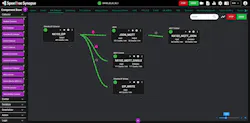
Once the raw data is received in the collector node, it can then be flowed by “drawing” lines between it and any number of other data processing nodes. Action nodes, for instance, can trigger a shell command, send an email based of data values, or write values to a ModBus, EtherNet/IP or other supported device.
Similarly, logic nodes compare data to a set condition to trigger an event. They can also be configured to perform other operations, such as tracking and storing a moving average of a data stream or the result of Fast Fourier Transform (FFT). In turn, serializer nodes package collected data into a database- or MQTT-friendly format like CSV or JSON, before an emitter node directs the packaged data to a cloud service like AWS or Azure, an FTP server, an MQTT broker or the DX100’s internal time-series SQL database. In addition to these pre-defined nodes, SpeeDBee Synapse also allows developers to program custom nodes in C/C++ or Python.
According to Dissanayake, Omron opted for its own software in the DX100 over the popular NodeRed, enabling the company to ensure code quality and cybersecurity of the device while simplifying its configuration.
“We own the SpeeDBee software, so we fix all the bugs and adhere to all the cybersecurity standards because we maintain the software,” he says. “Some could argue it’s a closed system, but it’s the only way we can totally control the quality.”
There is a point to be made there. In CodeRed, users can draw from a large library of community developed nodes to fit their needs. However, instead of one S7 protocol connector node, for example, NodeRed might offer 10 or more community developed options within its large node library.
It’s up to end-users, then, to test which of those 10 or more works reliably and optimally. Multiply that volume of choice across 10s of node types that an IIoT network might require, and that’s a lot of testing and fiddling before anything begins functioning. This also assumes the open-source developers who coded those nodes continue to maintain and update them in the future.
Taken from a different viewpoint, CodeRed’s library does offer support for a wide range of other protocols and devices that the DX100 may currently not. Being new, the DX100’s list of supported hardware and protocols will likely continue to expand, but users are restricted to what Omron decides to support sometime in the future. In the end, it’s a trade-off: NodeRed offers users near-limitless but potentially paralyzing choice, while SpeeDBee currently offers restrictive simplicity.
In addition to performing connect, collect, store and data flow functions, the DX100 also provides users with Grafana visualization software pre-installed. The popular open-source software helps users turn collected data into intuitive visualizations like charts, graphs and dashboards. In this case, Omron deemed an open-source application suitable over proprietary software.
Not Included
In contrast to what the DX100 does offer, there are two components purposely not included with Omron’s edge device. The first is on-board data analysis. According to Dissanayake, the state of industrial AI is currently in a state of rapid and volatile development. Including data analysis on the DX100, in the form of software or AI compute capabilities, risks locking end users into a solution that could become irrelevant or outdated in the near future. Better to let users evaluate and change analysis solutions as that layer matures.
The other component intentionally missing from the DX100, Dissanayake says, is recurring licensing costs.
“Omron isn’t in the software business; our foundation is hardware and we want to sell hardware,” he says. “For example, when you buy the software for our machine controllers, you own it for life, and we don’t charge for updates, and there is no annual software maintenance fee. The same goes for the DX100. When you buy the hardware, all the software and updates comes with it. It’s a one-time cost. You don’t have any software maintenance fees or any tech support agreements.”
With any bit of tech equipment, consumer or industrial, product developers typically lean toward one of two general philosophies. One is the sandbox approach: an open environment into which vendors or end-users install the software components that serve a specific purpose. It’s on the user then to figure out which combination of functionality is optimal, and how to engineering them together safely and reliably.
The other camp is the curated approach, a la Apple. The hardware is more or less locked down and software options are defined by the OEM. It’s restrictive, but the benefit is that users can quickly get on with using the device rather than figuring out how to make it work. Equally important, users are prevented from unintentionally mixing incompatible, unstable and/or insecure software.
It’s clear Omron has chosen the second path. For those who require more flexibility, more I/O ports or broader support of industrial protocols, an IIoT edge gateway such as Opto22’s Groov Rio line, Red Lion’s FlexEdge line or one of Advantech IIoT I/O gateways may be a better choice.
These, and other vendors of similar hardware, typically install a best-of-breed software stack; each component handling what it's best suited for (e.g. Kepware for connect, Litmus Edge for data collection and normalization, Node-Red for data flow, etc.) The trade-off is integration complexity and the potential of on-going subscription licensing costs.
Omron's monolithic approach (i.e. one software package to handle most IIoT objectives), however, may better suit users who want to get their IIoT infrastructure in place and working as quickly as possible with a minimum of engineering time and cost, plus the assurance of long term support from a single vendor.
In the final analysis, Omron’s DX100 meets much of the industrial market where it is now in its digital transformation process, rather than where many vendors would like them to be. The trick for Omron, then, will be to update and expand the DX100’s capabilities quickly enough to keep up with end-users’ evolving needs.
About the Author
 Mike McLeod
Mike McLeod
Senior Editor, Machine Design
Mike McLeod, senior editor of Machine Design, is an award-winning business and technology writer with more than 25 years of experience. He has covered the full spectrum of mechanical engineering, from industrial automation, aerospace and automotive, to CAD/CAE, additive manufacturing, linear motion and fluid power.
Voice Your Opinion!
To join the conversation, and become an exclusive member of Machine Design, create an account today!
 Leaders Logo
Leaders relevant to this article: