The Connection Point is the Bottleneck Nobody Designs Around
This article was featured in Machine Design’s Automation & Robotics Takeover Week (July 13-17, 2026).
Ask a panel builder where the hours disappear in a motor control assembly, and the answer is rarely the contactors, breakers or relays. It is the terminations: the hundreds of individual conductors that have to be stripped, sometimes ferruled, inserted and torqued by hand.
For decades, that manual connection step has been treated as a fixed cost of doing business. It no longer has to be, and that changes how original equipment manufacturers (OEMs) design and build machines.
A conventional screw terminal is a deceptively demanding interface. It asks the installer to strip to the right length; often crimp on a ferrule; insert the conductor and apply a specified torque; then re-check that torque after thermal cycling, because some screw connections can loosen under vibration.
READ MORE: The Future of Industrial Connectivity: Trends and Challenges at Weidmuller USA
Each step is a chance to introduce a loose strand, an under-torqued lug or an intermittent fault that surfaces months later as nuisance tripping or an overheated terminal. In a cabinet with several hundred connections, small per-termination variances compound into rework, warranty calls and field downtime.
That variability matters more now because the people who absorb it are getting scarcer. Deloitte and The Manufacturing Institute project that U.S. manufacturing could need as many as 3.8 million additional workers between 2024 and 2033, with up to 1.9 million of those jobs going unfilled if the skills gap holds.
The roles hardest to fill are precisely the ones that build and maintain equipment. A process that depends on an experienced hand getting every torque value right is a process built on a resource that is thinning out.
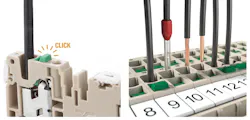
Spring-based connection technology attacks the problem at the terminal itself. Instead of a screw, the contact uses a preloaded spring held open at the clamping point. The installer strips the conductor and pushes it in; contact with the terminal releases the spring, which clamps the wire and signals the result through a green pusher that changes position, a tactile shift and an audible click. There is no ferrule to crimp, no torque wrench and no second pass.
Solid, stranded and ultrasonically compacted conductors all seat the same way, with or without wire-end ferrules. Because the clamp is spring-loaded rather than dependent on an installer’s applied torque, it resists the vibration-driven loosening that affects screw terminals, and it can be released and reused for maintenance or retrofit.
The numbers follow from the mechanics. A single termination takes about one second, and reported field data puts the reduction in motor control installation time at up to 75% for North American OEMs and panel builders.
For a design engineer, the interesting part is not the second saved on any one wire. It is what a repeatable, tool-free termination unlocks upstream. A connection that no longer requires a calibrated torque and a skilled hand is a connection a machine can make.
The first contactors built on this approach are explicitly engineered for automated assembly and wiring, which means the same panel that is faster for a person to build is also a candidate for robotic build cells, where consistency and cycle time decide the business case. Toolless termination also simplifies the bill of materials: no ferrules to stock, fewer accessory part numbers and no torque tooling to buy, calibrate and maintain.
SNAP IN, the precision-engineered spring mechanism for enhanced wire clamping connection system invented by Weidmuller, has been deployed across terminal blocks, industrial connectors and power supplies for years. Schneider Electric has now brought it into motor control with the TeSys Deca line of contactors, manual motor controllers, and control relays for the North American market, its first appearance in this product class for the region.
The takeaway for machine builders is bigger than any single product: toolless, ferrule-free, automation-ready termination has arrived in the motor control components they already specify and it is built for the vibration and temperature swings of real industrial duty.
Motor control has spent the past decade moving intelligence downward into the device layer, where networked drives and predictive diagnostics have replaced hardware that once did little more than react. Yet the point where those systems meet the physical world—the termination itself—has remained stubbornly analog. That mismatch is now becoming harder to ignore.
As the labor base capable of building panels by hand continues to thin, termination shifts from a finishing step to a design constraint. For OEMs, attention is shifting toward how tool-less connection can be integrated into industrial-duty designs and how far control architectures can evolve as manual assembly recedes from the center of production.
About the Author
Marta Asack
Senior Vice President of Power Products for North America, Schneider Electric
Marta Asack is the Senior Vice President of Power Products for North America at Schneider Electric, where she leads global strategy and innovation for energy management solutions. She brings extensive expertise in engineering, program management, product development, operations and manufacturing, with a strong track record of leadership within Schneider Electric.
Voice Your Opinion!
To join the conversation, and become an exclusive member of Machine Design, create an account today!
 Leaders Logo
Leaders relevant to this article: