Balancing the Trade-offs in Compact Stationary Thermography
Long-wave infrared (LWIR) thermography, based on uncooled microbolometer focal plane array (FPA) sensors, constitutes a fundamental pillar in contemporary industrial automation and machine vision. Their lower power consumption, structural robustness under challenging environments and cost-effectiveness make them the ideal solution for continuous 24/7 monitoring applications. Designing these systems, however, requires balancing a tight trade-off known as the optimization "triangle,” which links spatial resolution, thermal sensitivity and optical cost.
Unlike high-end infrared cameras, uncooled infrared cameras used in industrial applications generally do not offer the ability to store and process the acquired thermal data on the device itself. Instead, in process monitoring, they primarily function as contactless thermal sensors that measure surface temperature across a wide area.
Traditional uncooled sensors often demand large, complex and expensive lens assemblies to achieve high-resolution imaging. To overcome these constraints in space-critical applications, modern optoelectronic design must optimize detector architecture and high-speed data buses. This article examines how shrinking pixel dimensions and leveraging specialized communication interfaces enable high-performance, real-time thermography within highly compact physical footprints.
The Physics of Pixel Pitch and Optical Optimization
In microbolometer design, spatial resolution is historically limited by the physical size of each detector element on the FPA array. Reducing the pixel pitch is the primary mechanism for decoupling resolution from sensor size. From an engineering standpoint, smaller pixel dimensions inherently lower the thermal capacitance of the individual microbolometer structure, optimizing the thermal time constant and allowing for faster response times without losing effective active area.
Furthermore, pixel pitch reduction triggers a significant cost and design advantage in the optical subsystem. This is especially critical when cameras must be integrated into rugged protective housings, forcing the optical train to work with smaller detectors and lenses. A smaller overall FPA area requires a smaller image circle to achieve full illumination. This allows optical engineers to specify simpler, more compact lens configurations with lower f-stops while maintaining a high spatial resolution.
In practice, implementing a tight 12 µm pixel pitch on a standard 640 × 480 array allows system integrators to drastically reduce the bulk and cost of Germanium optics without sacrificing geometric performance. If target processes do not demand excessively high frame rates, these microbolometer cameras are often an excellent choice regarding their price-performance ratio.
Thermal Sensitivity Dynamics and Calibrated Radiometry
Achieving high geometric resolution is counterproductive if the sensor cannot discriminate between subtle thermal boundaries. A system’s ultimate thermal resolution is governed by its Noise Equivalent Temperature Difference (NETD).
In automated non-destructive testing (NDT), process monitoring or material fatigue analysis—such as measuring the surface temperature of a casting mold or a moving workpiece—detecting micro-gradient thermal stress requires an NETD down to the 20 mK–30 mK range, allowing the system to isolate temperature fluctuations as small as 0.02°C.
Operating within the 8 µm to 14 µm LWIR atmospheric window minimizes signal attenuation caused by ambient water vapor and carbon dioxide, making uncooled microbolometers highly reliable for industrial environments. However, uncooled sensors are susceptible to thermal drift caused by the host machine’s ambient operating temperature.
To maintain a standard radiometric measurement accuracy of ±2%, contemporary architectures do not rely on bulky active cooling; instead, they implement real-time, software-driven thermal compensation algorithms that dynamically correct detector drift. In practice, achieving this calibration requires balancing detector size, lenses, compactness and thermal sensitivity, which fundamentally depends on both pixel pitch and detector material.
Resolving Latency and Bandwidth Obstacles
Streaming raw, uncompressed radiometric data at full-frame rates (such as 50 Hz) generates significant bandwidth demands that can overwhelm standard embedded processors. The choice of communication interface dictates the deployment layout:
GigE vision and PoE. For stationary factory floor installations, utilizing a Gigabit Ethernet interface, compliant with GenICam standards, allows long-distance, lossless data transmission directly to a centralized computing station. Integrating Power over Ethernet (PoE) streamlines hardware deployment by consolidating power and high-speed data into a single twisted-pair cable. To ensure precise temporal synchronization with the industrial process, these compact cameras typically couple these data links with a dedicated hardware trigger interface.
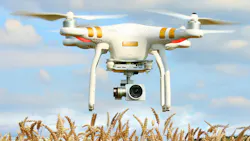
MIPI protocol. Conversely, space-constrained OEM environments and unmanned aerial vehicles (UAVs) cannot accommodate the overhead of Ethernet hardware. In these embedded architectures, leveraging the MIPI (Mobile Industry Processor Interface) video bus establishes a direct, low-latency, point-to-point link between the FPA sensor and the host Image Signal Processor (ISP). This design layout drastically minimizes board space and power consumption while preserving the necessary throughput for real-time edge processing.
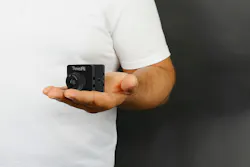
The miniaturization of modern thermographic subsystems proves that compact form factors do not require sacrificing the integrity of radiometric data. By combining a dense 12 µm pixel pitch with sub-30 mK thermal sensitivity, design engineers can integrate precise machine vision assets directly into existing production lines, automated machinery or robotic payloads.
Overcoming the resulting throughput and data bottlenecks relies entirely on a disciplined match between application demands and hardware interfaces—whether deploying ruggedized GigE configurations for industrial automation or streamlined MIPI architectures for compact OEM integration.
Diego de Azcuénaga is a technical writer specializing in electronics and industrial technology.
Have a question, comment or idea? Get in touch with the Machine Design editors at [email protected].