CAD Heading into Stormy Waters
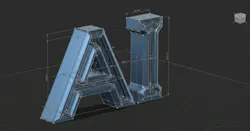
After decades of relative stability, the MCAD industry seems to be heading into stormy uncertainty due to AI. On the one hand, AI is the biggest game-changer MCAD has seen in years. On the other, the technology equally threatens to undermine the SaaS software model itself, allowing smaller competitors and vibe coders to potentially create their own CAD software using AI.
This is a change from the confident, heady, early-cloud days when traditional CAD vendors mimicked Adobe’s surefire formula. Step one: charge customers to rent software (i.e., subscription), so as to maintain predictably smooth quarterly income, as insisted upon by Wall Street. Step two: migrate software to the cloud to make installation effortless and updates invisible, as favored by IT departments.
If CAD vendors thought that following this two-step plan solved the issues rocking them from above (Wall Street, in my opinion, effectively runs the board room) and from below (customers seemingly gripping about one thing or another), they instead found their road to permanent success get craggy.
The SaaS-pocalypse that Wasn’t
The day CAD vendors rebranded themselves as software as a service (SaaS), Wall Street was pleased...until it wasn’t. Earnings hummed along predictably for a decade until AI cast its spell. In mid-2025, Anthropic CEO Dario Amodei told Axios, “I would not be surprised if somewhere between one and five years we start to see big effects [from AI] to wipe out half of all entry-level white-collar jobs.” Since then, firms have rejoiced, laid off staff and credited AI.
Then came a second prediction, ominous to the firms themselves: Software now would be written by AI agents. When Wall Street cottoned on to the idea that vibe-coding could let “anyone” write SaaS software, the share prices of such companies crashed. CAD vendors—all primarily SaaS firms except Siemens—got caught up in what industry watchers dubbed the SaaS-pocalypse, as their stock prices plunged in Q1 2026.
Ultimately, however, the projected fallout of the SaaS-pocalypse was largely overwrought. AI firms noticed the backlash and backtracked, claiming that AI would assist white-collar jobs, not replace them. Even so, SaaS CAD firms have so far only partially recovered from their year-to-date losses.
Nevermind Wall Street and private investors have poured all the money they have (and don’t have) into AI-linked firms. As a result, the stock market values the biggest AI firm, like five-year-old Anthropic, at 22 times that of the biggest CAD firm, 43-year-old Autodesk.
A Cloud is Not a Desktop
Long before the SaaS-pocalypse failed to fully manifest, the great cloud migration also didn’t conform to projected outcomes. For example, Solidworks’ 8.5 million users have collectively refused to migrate from desktop Solidworks to Dassault Systemes’ cloud-based 3DExperience MCAD. And why would they? The 3DExperience ecosystem is file- and add-on-incompatible with Solidworks—and more expensive, to boot.
Dassault saw that its giant customers wanted to offload IT work to the cloud; CATIA-using employees had no say in the matter. I think Dassault figured small Solidworks-using shops would also want the chance to offload IT.
As it turned out, small shops, usually having just a couple of designers, don’t have an IT problem and, in any case, couldn’t afford a paradigm shift they viewed as costly in time, money and incompatibility with customers. Year after year, the little guys resisted until Dassault gave up and gave in. For Autodesk, desktop Inventor users have shown similar disinterest in switching to the partially cloud-based Fusion.
Smaller CAD vendors, like Bricsys and the many programs based on IntelliCAD, saw an advantage in continuing to offer permanent licenses, albeit accompanied by strong suggestions customers also purchase subscription-like maintenance agreements.
In the end, MCAD vendors found they couldn’t move their legacy software to the cloud. It cost too much and would take too long to rewrite the aged, sprawling code. And even if a Solidworks or Inventor could be rewritten, it would take years to reach maturity.
In the meantime, intermediate releases might embarrass CAD firms by underperforming the desktop versions in terms of speed, functionality and reliability. That’s not to mention the incompatibilities it would create, as file formats would have to be changed to handle byte-level concurrency.
That leaves Onshape, which is the best of the pure cloud-based MCAD applications today. Its secret, the former CEO told me, was in programmers first working out a cloud-based database system, and then—and only then—putting a graphical CAD interface on top, which ran in Web browsers interactively.
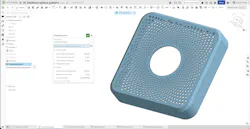
PTC inadvertently created a notable case history by spending half-a-billion dollars buying Onshape in 2019, not only for the browser-based modeler itself but as a means to accelerate the “SaaS-ification” of PTC’s other desktop applications. Dubbed the Atlas platform, PTC envisioned that it would become the cloud-based underpinning for all its heavyweight legacy software.
After a time, PTC changed the name from Atlas to “+,” with the release of Windchill+ in 2022 followed shortly by Creo+ the next year. While not a complete online-only transformation, the “+” denotes the addition of cloud-based functions to Creo. Even so, it doesn’t supplant the desktop behemoth.
Released in 2015, Onshape, and its apparent success, incentivized other MCAD vendors to make their programs at least appear to run on the cloud. (I say “apparent success,” because Onshape had just 5,000 paying customers at the time PTC rescued it financially seven years ago.)
To be fair, the cloud didn’t fail MCAD entirely. We have adjacent software, such as project coordination, that benefits from the cloud’s innate multi-user capability. Then there are the numerous small, pure cloud-based MCAD programs written from the ground up to run in Web browsers.
Besides Onshape, examples include AutoCAD Web and TinkerCAD from Autodesk and Shapr3D from Shapr. In addition, there are many free ones, such as WebCAD, CADfaber and SelfCAD. What mostnearly all have in common, however, is far fewer functions than MCAD running on the desktop.
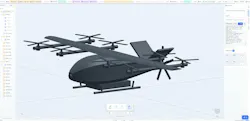
50 Years Old is Old
Then there is the “Where do we go from here?” problem from which MCAD suffers. The leaders are now 30 to 50 years old. They copy each others’ functions, so that by now everybody’s software does everything an MCAD system is expected to do. Revenue increases seem to come primarily from acquisitions and by raising prices.
The arrival of AI gave MCAD vendors a new hope in boosting income through new revenue sources, but progress is slow. This, despite some CAD vendors claiming to have been working on AI for more than a decade. For instance, Autodesk states that it has “invested in AI for more than 15 years.”
This 15-year head start, however, did not have its intended effect. These so-called “new AI” features seem to me sometimes hard-coded functions re-labeled as AI, such as generating 2D drawings from 3D models or searching documentation for answers. Other “new AI” features remind me of capabilities available a couple of decades ago, such as searching-and-replacing entities and creating specific selection sets.
Solidworks CEO and DS VP of R&D, Manish Kumar, demonstrates AI design assistant Leo, from Dassault Systemes, converting 2D drawings into a 3D model. IronCAD does something similar with templates and no AI.
If these CAD vendors actually did have a 15-year head start, then we wouldn’t be seeing them linking to upstart AI firms that were able to leap ahead of them technologically:
- Autodesk hooks up with Anthropic so that chatting with Claude creates and modifies 3D models in Fusion.
- Dassault Systemes and PTC link their CAD systems to NVIDIA Omniverse’s real-world simulator
- Siemens connects its CAD software to AI systems from Microsoft
(Programs connect to external AI systems through MCP [Model Context Protocol], the AI data connection standard. When linked to commercial AI models, MCP connections are not free, and can cost thousands of tokens to run.)
The Sorrow of Non-determinism
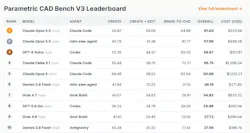
AI makes for great marketing; the results do not. Benchmarking shows dismal accuracy for AI systems in generating geometry, creating feature histories and adding constraints. In CAD Bench v3 benchmarking, Anthropic Claude Opus 5.5 recently gained the No. 1 position by successfully completing 61% of 100 complex 3D drawing and editing tasks at a total run cost of $574. Results for other AI systems varied all over the map, such as one with an overall accuracy of just 17% while another racked up run costs of over $1,000.
The more serious drawback to using LLM for engineering is that it can return hallucinations (flawed designs), because LLM AI lacks the determinism we expect of MCAD. Determinism means software returns an accurate result every single time—no bugs. LLM cannot because it has no clue what is correct and what is flawed, only what is most likely given the scope of the data and context its given.
If Not LLM, Then What?
None of the AI functions I’ve seen are market-shaking, must-have VisiCalc-like moments. What ought CAD vendors do instead? Long-time CAD observer Mark Burhop suggests our software must be re-oriented to let designers describe objectives, rather than launching commands, as we do now.
A new layer is needed above the CAD system that runs engineering agents, Burhop says. “It begins with an objective and works downward.” He describes how the process could work: “It may need to translate a natural-language requirement into dimensions; identify affected parts; select modeling operations; consult company standards; run simulations; compare alternatives; and prepare controlled changes.”
And so Microsoft, which had always taken pains to avoid the CAD market, nevertheless developed its own theoretical AI-run CAD system composed of a handful of research projects:
- FlexCAD does modeling.
- CADFusion understands geometric structures through renderings.
- CAD-Editor executes complex natural language instructions.
- CADMorph plans, generates and verifies models iteratively by combining parameter-to-shape latent diffusion models and masked-parameter-prediction models.
Microsoft has no desire to distribute this CAD system itself. Instead, the suggestion is that others could, who would link back to its Copilot AI running on its Azure servers, from which Microsoft makes a profit.
In the end, the most significant drawback to external AI systems for CAD is that AI vendors copy our intellectual property. Ostensibly, it’s for training their AI software better but that operation risks distributing confidential IP to others.
Even Microsoft CEO Satya Nadella warns against cozying up with hyperscalers, of which his company is one: “You essentially pay for [AI] intelligence twice: once with money, and again with something even more valuable, the proprietary knowledge you must reveal [to AI firms] to make that intelligence useful.”
Is Anything New?
In a world of old copycatting, there is a new approach to MCAD that I find refreshing. It’s retro, and it’s even kind of awkward: typing at the keyboard. It’s called “text to part,” where you use text to describe the parts you want.
In one approach, you type in programming code to describe the parts you want constructed. In another approach, you instead enter AI text prompts, which call upon AI that’s been trained on mechanical parts, which sends data to the geometric kernel, usually OpenSCAD, which executes the geometry.
These kinds of MCAD programs have a window in which you enter code, and another to view the graphical result. KittyCAD is an example that adopts both approaches in Zoo Design Studio. You make a request of AI, which generates KCL programming code, which calls the kernel, which models the part. To change the 3D model, you can edit the KCL code directly, or else adjust parametric values that were generated automatically.
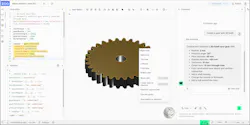
There’s a ton of new CAD stuff out there. You can find 895 new and newish MCAD projects on GitHub. The equivalent site for AI projects, Hugging Face, is unfortunately a bit of a hot mess when it comes to CAD apps.
The Alternative AI of World Models
As we have seen, LLM as a technology, so hot elsewhere else, is often unacceptable for our CAD world. Dassault Systemes CEO Pascal Daloz asserted as much earlier this year when he said, “The real world is not made of text and images; it’s made of physics, materials, energy, constraints.” So some AI and MCAD firms are looking to World Models, a form of AI that takes into account the laws of physics and the properties of materials.
Software engineer Nilushanan Kulasingham describes several kinds of World Models, from least to most general, and from most to least explicit:
- Render predicts the next group of pixels in an image, such as from Genie 3 from DeepMind.
- Simulate predicts the next actions like stresses and collisions, such as in Cosmos Predict from nVidia.
- Dynamics models the next state of actions, such as playing Go without knowing the rules.
- Representation takes one step and then plans several alternative next steps, such as with Jepa from Meta.
Implicit internalizes the world inside the AI program
CAD has had World Models all along; we call it computer-aided engineering (CAE), or simulation or analysis. Long-time PLM analyst Monica Schnitger reports that “ANSYS owner Synopsys said AI models and agents need Synopsys’ software to supply ground-truth physics to operate with confidence.” She adds, “I like that phrase ‘ground-truth physics.’ No hallucinations here.”
Conclusion
AI comes in waves, something it’s been doing since its conception in 1956. Large Language Model is one of several categories of AI, and the weakest I would argue, as it depends on stochastically assembling tokens (words and parts of words) into sentences, along with hard-coded responses to make it seem human, such as “Sure, I’m happy to help.”
LLM AI runs because of a trillion dollars of debt that keep it running. Market watcher Hedgie Markets reports, “Total debt across Alphabet, Amazon, Meta, Microsoft and Oracle is now around $700 billion, with another $1.2 trillion in [future data center] lease obligations on top of that.”
AI agents generally cannot work effectively with the patchwork that represents websites today. Management consultant Tom Goodwin explains that “There are a lot of industries and a lot of companies with really messed-up systems, and bad technology plumbing and vast amounts of technical debt. They are being sold on the idea: rather than redo the plumbing, we can just apply AI as a patch.”
LLM AI failed to destroy the value of CAD SaaS firms, just as it can’t replace us designers. Even OpenAI CEO Sam Altman finally came around to that point of view: “I think we’re all going to be much busier than we thought we were supposed to be in a post-superintelligence world.”
MCAD has taken some false turns over the last decade. I find CAD miserable on tablets and phones, but better in Web browsers. Best of all is deterministic CAD running locally on our desktop and laptop computers, something that originated in the 1980s and continues to be our future.
Disclosure: The author is a member in a successful class action copyright lawsuit against Anthropic AI.
Have a question, comment or idea? Get in touch with the Machine Design editors at [email protected].
About the Author
Ralph Grabowski
Ralph Grabowski has been writing about computer-aided design since 1985, and is the author of 240 books on the subject. He received his degree in engineering from the University of British Columbia.
Related
 Computer aided design
 dreamstime_xxl_59930504

Voice Your Opinion!
To join the conversation, and become an exclusive member of Machine Design, create an account today!
 Leaders Logo
Leaders relevant to this article: