Breaking the Director Ceiling: SheTO’s Mission to Empower Women Leaders
Key Highlights:
- Women in engineering experience a sharp decline in representation from entry-level to director roles, with only 9% reaching the director level despite starting at 15%.
- Isolation, unclear promotion paths and lack of sponsorship are key systemic barriers to advancement.
- SheTO's Leadership Accelerator program has helped nearly half of its participants secure promotions within a year.
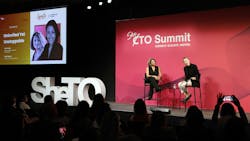
Women in engineering leadership face a critical barrier—the director ceiling—where the representation sharply declines moving from manager to director roles. SheTO, the world’s largest network of women and nonbinary engineering leaders, is driving change to break down these barriers. Machine Design spoke with Meagan Barakzai, SheTO’s head of growth, about how the organizations research and programs foster pathways for women engineers to advance, which is especially relevant in multidisciplinary fields like machine design.
Understanding SheTO and the Director Ceiling
SheTO connects more than 5,600 engineering leaders across 65 countries, offering mentorship opportunities, leadership development and curated events designed to empower its members to reach their career goals.
The “director ceiling” is a term the organization coined to describe a pivotal career barrier, revealed in its 2025 State of Women and Engineering Leadership report. Although women make up about 15% of entry-level engineers, their representation drops off sharply at the director level—down to just 9%. This stalled advancement is not just lost talent but a systemic issue rooted in organizational practices that must be addressed.
The report highlights how, despite growing awareness and initiatives to improve diversity, lack of visibility, clear promotion paths and leadership support continue to derail many promising careers at this stage.
Exploring Systemic Barriers to Women’s Advancement
Moving from engineering manager to director is notoriously difficult for women engineers for several interconnected reasons. Barakzai explains one major challenge is isolation; many women are the only ones in their team or department. “Today, only 15% of engineers identify as women or non-binary. So even at the very beginning, we are starting with a somewhat small number, but then you add in other factors, like…the isolation of…being the only woman on your team, in your field…in your group,” Barakzai said. “That’s a big challenge.”
This lack of peer support can be draining and inhibit confidence, especially when leadership roles also require robust networks to gain sponsorship or assignment to high-impact projects.
Clear onboarding and role clarity also play roles. “In addition, there is onboarding. The way that new hires are onboarded often doesn’t show a path to leadership,” Barakzai pointed out.
Companies often do not articulate a leadership advancement works, leaving women without a road map to success. Further, while mentorship helps, sponsorship—when a senior leader actively advocates for a person’s promotion—is frequently lacking for women.
Another often overlooked factor is the decline in executive coaching at senior levels for women, which normally would help develop strategic leadership skills and confidence when stakes are high. The report points out that many organizations still define “executive presence” in outdated terms that reward loud, assertive behavior over collaborative and technical excellence. This biases leadership selection against many women who may lead differently but effectively.
Understanding these layers of systemic bias is key for organizations that want to build truly inclusive leadership pipelines.
Representation Trends and DEI Beyond Hiring
SheTO’s research reveals a sharp decline in women’s representation as organizations grow larger. While about 17% of engineering leadership roles in companies with less than 1,000 employees are held by women, this falls drastically to less than 7% among enterprises with more than 10,000 employees. The more layers and formal structures that are in place, the more likely unconscious bias sneaks into hiring and promotion decisions.
However, Barakzai says that these disparities aren’t inevitable. Companies that embed diversity, equity and inclusion (DEI) deeply into their culture—not just their hiring practices—see measurable benefits. When flexible onboarding processes clearly articulate leadership paths for women, early expectations about growth are set and supported. Leadership coaching that focuses on future roles helps women prepare for senior responsibilities rather than just current tasks.
Sponsorship is a particularly critical part, Barakzai says. Senior leaders must proactively nominate and advocate for deserving women. “One of the things that our report uncovered is that oftentimes women don’t think they’re ready until someone tells them they’re ready…The reality is that that means you need a mentor or a sponsor that’s able to help push you into those roles, and that’s something that I think is not always surfaced when you think about diversity and equity and how to make sure that everyone’s getting a fair shot at the top.”
Supporting employee resource groups also provides essential community and combats isolation, creating spaces where women engineers and fields like machine design can collaborate and share experiences.
Not only is this investment ethical, but it also drives superior business outcomes. Companies with diverse leadership outperform peers by 39%, Barakzai says, showing that inclusion is a competitive advantage in addition to a moral imperative.
SheTO’s Leadership Accelerator and Its Impact
To directly address the barriers identified in the report, SheTO developed its Leadership Accelerator program, tailored by engineering leaders for engineering leaders. This seven-week intensive program combines practical workshops, role-playing scenarios, group discussions and ongoing mentoring to equip women engineers with the strategic skills, confidence and sponsorship access they need to break past the director ceiling.
The program’s success is tangible. Barakzai says that 47% of graduates report being promoted within a year, demonstrating the program’s impact on career advancement. Beyond the structured curriculum, participants benefit from a continued network of peers and mentors who sustain their growth long after the program ends.
For multidisciplinary machine design engineers, this leadership diversity translates into stronger teams and better products. Barakzai says that diverse groups bring different perspectives and questions to problem solving, resulting in more innovative designs and improved functionality in products that better serve diverse markets. Having women leaders shaping the future of complex machine design not only benefits inclusivity but drives a competitive advantage through creativity and collaboration.
Call to Action for Engineers, Organizations
As technology undergoes rapid and far-reaching change, empowering diverse leadership is essential. Barakzai invites all engineers to champion this cause in their workplaces by advocating for transparent career pathways, sponsoring emerging female leaders and fostering inclusive cultures where diverse voices can thrive.
SheTO’s community offers resources, mentorship and leadership development to support this mission. Reading the full 2025 report can help organizations identify where their leadership pipelines falter and stimulate the structural changes needed for a lasting impact. Learn more about SheTO and explore the leadership accelerator program at the organization’s website.
Editor’s Note: Machine Design’s WISE (Workers in Science and Engineering) hub compiles our coverage of workplace issues affecting the engineering field, in addition to contributions from equity seeking groups and subject matter experts within various subdisciplines.
About the Author
 Sharon Spielman
Sharon Spielman
Technical Editor, Machine Design
As Machine Design’s former technical editor, Sharon Spielman produced content for the brand’s focus audience—design and multidisciplinary engineers. Her beat included 3D printing/CAD; mechanical and motion systems, with an emphasis on pneumatics and linear motion; automation; robotics; and CNC machining.
Spielman has more than three decades of experience as a writer and editor for a range of B2B brands, including those that cover machine design; electrical design and manufacturing; interconnection technology; food and beverage manufacturing; process heating and cooling; finishing; and package converting.
Email: [email protected]
LinkedIn: @sharonspielman
Facebook: Machine Design
YouTube: @MachineDesign-EBM
Voice Your Opinion!
To join the conversation, and become an exclusive member of Machine Design, create an account today!
 Leaders Logo
Leaders relevant to this article: