Selecting Anti-Vandal Switches for Industrial Control Panels
Key Highlights
- Anti-vandal switches are designed with metal housings and environmental sealing to withstand moisture, dust, impact, and tampering in demanding environments.
- Selecting the right IP rating (e.g., IP65, IP67) is essential to protect against specific environmental ingress, depending on the operating conditions.
- Housing materials like stainless steel or metal alloys provide mechanical durability, resisting wear and impacts over time.
Push buttons and switches are among the simplest components on an industrial control panel, but they are also among the most exposed. Industrial controls require durable, easy-to-use interfaces between the operator and the panel. These interfaces must withstand repeated actuation and exposure to harsh operating conditions. They are frequently subjected to moisture, liquids, dust, and other particulates. Outdoor installations may also encounter temperature extremes, changing weather conditions, and tampering.
Because switches are mounted at the enclosure boundary, they must hold up to both repeated operator use and environmental exposure. Anti-vandal switches are panel-mounted push buttons designed for these demanding conditions, combining metal housings with environmental sealing to provide added protection.
Selecting an anti-vandal switch involves more than choosing a rugged push button. This blog explores how Ingress Protection (IP) ratings, housing construction, actuator style, illumination options, and switch behavior affect switch selection, helping designers match environmental protection, operator needs, and control functions to industrial control panel applications.
Protecting the Operator Interface in Harsh Environments
Front-panel industrial controls form the physical interface between operators and an industrial control system. These controls are subjected to physical contact, repeated actuation, and environmental exposure that can contribute to mechanical wear over time.
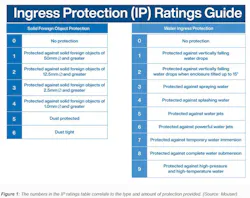
Environmental sealing helps protect switches from the dust and water they may encounter at the panel surface. The IP rating system (Figure 1) defined in IEC 60529 classifies protection against the ingress of solids and water under specific standardized test conditions. For example, an IP65 rating indicates a dust-tight enclosure protected against water jets, while an IP67 rating indicates a dust-tight enclosure with protection against temporary immersion in water.[1] Because IP ratings apply only to the specific test conditions defined by the standard, designers should select a rating that aligns with the switch’s expected operating environment.
Figure 1: The numbers in the IP ratings table correlate to the type and amount of protection provided. (Source: Mouser)
Proper sealing extends beyond the switch itself. Panel cutout dimensions, mounting hardware, gasket design, and installation quality all influence how effectively a switch maintains environmental protection at the enclosure boundary. Even small gaps or misaligned sealing components can reduce protection against moisture and particulate ingress.
In addition to environmental exposure, switches must also endure the mechanical demands of daily operation. Stainless steel and metal alloy housings can help resist the physical wear from repeated use while protecting the switch from accidental impacts and other physical stress commonly encountered in industrial environments.
Meeting the varying challenges of industrial settings requires designers to balance environmental protection and mechanical durability with usability and system integration.
Designing for Operator Interaction and Panel Integration
There has been a growing emphasis on ruggedized human-machine interfaces (HMIs), placing greater attention on the durability and reliability of front-panel controls.[2] As a result, switch selection is increasingly affected not only by environmental requirements but also by how the switch integrates into the overall control panel and operator interface.
Operators in modern industrial automation environments often need to quickly identify and engage the correct controls while working in demanding industrial environments. Actuator design can help support these tasks. For example, operators can benefit from flat actuators that reduce the risk of accidental activation. In contrast, raised actuators provide greater tactile feedback, making controls easier to locate and operate by touch. LED illumination and emblem markings offer additional visual cues, helping operators quickly distinguish between control functions and interact with equipment more confidently and efficiently.
Designers should consider the switch’s functionality in relation to the intended control behavior. A momentary switch returns to its normal state when released, while a maintained switch stays in its selected state until actuated again. Momentary off-(on) and maintained off-on configurations enable designers to select the behavior that is appropriate for the required control action within the overall system.
Matching Switch Features to Control Panel Requirements
Generally, selecting an anti-vandal switch comes down to matching its features to the application’s requirements. Designers should begin by evaluating the expected operating environment. The switch’s IP rating should align with the panel’s expected exposure to weather, liquids, dust, and particle ingress. From there, designers can consider the housing materials and design based on the application’s mechanical and operational requirements.
After deciding on the type of switch, designers must integrate it into the overall panel design. Selecting a switch with the appropriate cutout and mounting, along with the correct termination and electrical requirements, is necessary to ensure optimal panel integration. Designers should also verify that switch selection aligns with system-level safety and control logic to help ensure safe operation and reliable performance.
The Same Sky Anti-Vandal Switches product line illustrates how these considerations can be combined within a single product family. Available in stainless steel or black metal alloy housings, the switches offer IP65 or IP67-rated protection for rugged operation in harsh environments. Options include multiple voltage ratings and LED-illuminated colors, with optional power emblem markings for simpler operator differentiation and ease of use. The switches are available in 12mm, 16mm, 19mm, and 22mm cutout dimensions, offering flexible panel design and integration options and have an operating temperature range of -20°C to 85°C to provide reliable operation in extreme temperatures. They boast a typical operating force of 450gf to 600gf and offer SPST, SPDT, or SPST-NO circuits with momentary or maintained on/off switch functions, and come with flat or raised actuators.
Conclusion
Anti-vandal switches are a practical option for use in industrial control panels operating in rugged conditions, where durability and reliability are especially important at the point of user interaction. Matching the housing, cutout dimensions, and environmental sealing to the panel’s requirements can help reduce wear over the switch’s life while supporting reliable operation. Options such as different LED colors and actuator styles also give designers greater flexibility to match the interface to the application’s needs.
Author
Alex Pluemer is a senior technical writer for Wavefront Marketing specializing in advanced electronics, emerging technologies and responsible technology development.
Sources
[1] https://webstore.iec.ch/en/publication/2452
[2] https://pubmed.ncbi.nlm.nih.gov/27393326/