Evolving PLC Programming for Modern Automation
By Michael Parks, PE, for Mouser Electronics
Published May 27, 2026
Modern industrial automation owes much of its flexibility to programmable logic controllers. Before programmable logic controllers (PLCs) appeared in the 1970s, factory control was dominated by hard-wired electromechanical relays, timers, and contactor systems that were robust but notoriously difficult to modify when production requirements changed. Since the advent of the PLC, automation technology has increasingly shifted from hardware to software-configurable features, and features once only dreamed of have become a reality.
History of PLC Programming
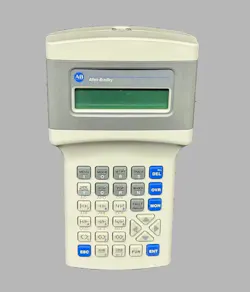
Early PLC programming techniques evolved from physically constrained, hardware-adjacent methods into more formalized software practices. Early PLCs of the 1970s were programmed directly on the factory floor using handheld keypads or dedicated terminals, where technicians entered numeric instructions and memory addresses that represented ladder logic derived from relay schematics (Figure 1).
In the 1980s, improved microprocessors and portable programming consoles enabled offline editing, better diagnostics, and more expressive vendor-specific languages, while ladder logic remained dominant due to its familiarity to electricians. The 1990s marked a significant transition as personal computers replaced proprietary terminals and networking became common, enabling richer development environments and versioned program storage. This era also saw the introduction of the IEC 61131-3 standard, which formalized multiple PLC programming languages, including Ladder Diagram, Function Block Diagram, and Structured Text. The standard cemented PLC programming as a disciplined form of industrial software engineering rather than merely an electronic replacement for relays.
Programming Modern PLCs
Over the last decade, PLC programming has evolved from isolated machine control into software-defined, networked automation systems. Modern PLCs are developed using full-featured integrated development environments (IDEs) that support simulation, live debugging, reusable libraries, and symbolic tag-based development, with Structured Text gaining wider adoption for complex logic alongside traditional Ladder Diagrams. Ethernet-based industrial networking, standardized data models, and protocols such as Open Platform Communications Unified Architecture (OPC UA) have blurred the boundary between operational technology (OT) and information technology (IT), allowing PLCs to publish data directly to historians, manufacturing execution system (MES) platforms, and cloud services. The emergence of safety-certified controllers, motion-integrated PLCs, and soft PLCs running on industrial PCs has further expanded the scope of PLC programming, pushing it closer to embedded and real-time software engineering. Standards bodies such as the IEC continue to anchor these advances to familiar execution models and languages that preserve determinism, readability, and long-term maintainability.
To read the entire article, visit Mouser Electronics, Inc.