Vector Control for BLDC Motors Using Advanced MCUs
Key Highlights
- DC motors are integral to countless household and automotive applications, with ongoing innovations improving their performance and efficiency.
- Brushless DC motors (BLDC) offer advantages over brushed motors, including higher efficiency and reliability, but require complex control methods like vector control (FOC).
- Recent processor and support function advancements have made high-precision vector control feasible for smaller, lower-power applications, expanding their use in power tools and appliances.
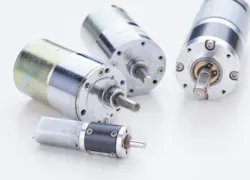
Smaller-scale applications can now use this advanced motor-control tech
(Source: Wire_man/stock.adobe.com)
The ubiquitous use of DC motors is a testament to ongoing technological advances and developments in specialties such as magnetics, materials science, processors, software, and power semiconductors. These motors are embedded in countless household products, from power tools to automobiles. In fact, the average car—whether ICE, hybrid, or electric—contains dozens of DC motors (Figure 1), not including the traction motors in hybrids and electric vehicles (EVs).
Figure 1: Small and medium motors surround us and are embedded in our daily lives. (Source: anantachat/stock.adobe.com)
DC motors come in three basic types: brushed, brushless (BLDC), and stepper. Brushed motors, powered directly from a DC rail, have been used since the late 1800s, and remain popular for their low cost and unique performance characteristics. BLDC motors offer higher efficiency, improved reliability, and greater control than brushed motors and are well-suited for continuous rotation, but they require more complex drive circuitry.
The brushless DC motor offers many operational advantages, but fully realizing these capabilities requires much more than the simple drive circuitry of the brushed motor. As a result, its use has traditionally been limited to applications using smaller fractional-horsepower motors, such as power tools and small appliances.
Among the various methods for controlling BLDC motors, one of the most advanced and widely used techniques is vector control, also known as field-oriented control (FOC). Vector control enables highly precise, efficient, and responsive motor operation, but requires complex algorithms to act on real-time current and voltage information. Now, advances in processors, combined with appropriate support functions, have made vector control a practical approach for BLDC motors in lower-power applications, including power tools, small appliances, and similar compact systems.
This blog examines the fundamentals of BLDC motor operation, breaks down the principles behind FOC, and highlights how modern, integrated motor-control MCUs enable designers to implement high-efficiency, high-precision solutions in compact, smaller-scale applications such as power tools.
>>Click to read the entire article at Mouser
Bill Schweber is a contributing writer for Mouser Electronics and an electronics engineer who has written three textbooks on electronic communications systems, as well as hundreds of technical articles, opinion columns, and product features. In past roles, he worked as a technical website manager for multiple topic-specific sites for EE Times, as well as both the Executive Editor and Analog Editor at EDN. At Analog Devices, Inc. (a leading vendor of analog and mixed-signal ICs), Bill was in marketing communications (public relations); as a result, he has been on both sides of the technical PR function, presenting company products, stories, and messages to the media and also as the recipient of these. Prior to the MarCom role at Analog, Bill was associate editor of their respected technical journal, and also worked in their product marketing and applications engineering groups. Before those roles, Bill was at Instron Corp., doing hands-on analog- and power-circuit design and systems integration for materials-testing machine controls. He has an MSEE (Univ. of Mass) and BSEE (Columbia Univ.), is a Registered Professional Engineer, and holds an Advanced Class amateur radio license. Bill has also planned, written, and presented online courses on a variety of engineering topics, including MOSFET basics, ADC selection, and driving LEDs.
Renesas Electronics is a semiconductor company with an outstanding portfolio of global market-leading products. Renesas has the technology and capabilities to deliver almost everything required in an age focusing on human needs, including security technologies, miniaturization and power-saving technologies, networking, and interface technologies. Renesas aims to stay one step ahead and to be the true intelligent chip solution provider—the world leader in its field.