Mobile Cobots for Flexible Industrial Automation
Key Highlights
- Mobile cobots integrate autonomous mobile robots (AMRs) with robotic arms to automate material handling across multiple production stations.
- They are ideal for workflows requiring periodic robotic part handling, especially when tasks are distributed and demand flexibility.
- Critical engineering factors include navigation accuracy, docking repeatability, payload capacity, battery management, and recovery protocols.
On October 5, 2026 in Automation, Industrial, Industrial Automation, Robotics by Abhishek Jadhav
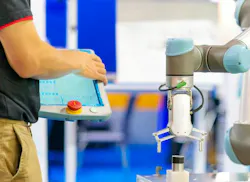
Mobile cobots combine autonomous transport with robotic handling across industrial workflows
Industrial manufacturers must constantly adapt to changing production schedules, batch sizes, and labor constraints. These conditions make it harder to justify fixed automation designed for a single product or workstation. Automation must move where work is needed and switch between tasks as demand changes.
For example, mobile collaborative robots (cobots) combine robotic arms that can handle and manipulate parts with autonomous mobile robots (AMRs) that can navigate between locations. This combination gives the cobot a facility-wide working area and enables it to connect production steps that depend on manual transfers.
In this first part of our blog series on cobots in automation, we look at how mobile cobots automate handoffs between operations and which workflows benefit from this mobility. We also examine the engineering work needed to make the complete system reliable.
Automating the Handoffs Between Operations
Combining mobility and part handling is useful for automating handoffs between separate production steps.
For example, consider a mobile cobot tending a computer numerical control (CNC) machine. Production software sends a service request once the machine finishes its cycle, and the cobot collects the correct blank from a staging area.
When the cobot reaches the CNC machine, it must establish the correct working position. The machine controller checks that the spindle has stopped and the door is open before giving access.
The cobot removes the finished part and places it in onboard storage. It loads the new blank and confirms the exchange. The CNC machine can then start its next cycle as the cobot takes the finished part to inspection.
This sequence has to operate as one mission. If a mission has 10 stages and each stage succeeds on 99 percent of attempts, only about 90 percent of missions will complete without any exceptions.
Retries also add time and require clear rules. A mobile cobot’s main value comes from automating these handoffs and ensuring that automation is reliable.
Choosing Workflows That Benefit from Mobility
In effective industrial environments, tasks should be spread across several stations and each should require robotic part handling only at intervals. The cobot must have enough time to travel to the station and complete the exchange before production is delayed.
Total service time includes arm movement, travel, and docking time, while traffic or routine retries add variation. Engineers need to compare the complete service time with the rate at which stations request the cobot.
In the case of several CNC machines sharing one mobile cobot, each time a machine finishes a cycle, it requests a part exchange. The cobot may need about two minutes to travel to the machine, dock, and complete the exchange.
If the requests are spaced apart, the cobot can move from one machine to the next without affecting production. But if two machines request service at the same time, one has to wait while the cobot finishes the first task. Engineers need to make sure these waiting times do not become long enough to delay production.
This timing model helps identify suitable applications. In production flow, a mobile cobot can move works in progress between cells and place them at the next assembly stage. Material supply tasks can include preparing kits or replenishing line-side bins. Beneficial to these scenarios is that the cobot’s arm removes the need for a transfer mechanism at every destination.
Inspection and logistics are also examples where the task moves between locations. The cobot can carry an inspection instrument to a large workpiece, avoiding the need to move the part. In a warehouse, the cobot can transfer totes from storage to packing and bring items from the same order.
Software-based routes make it easier to reassign the platform when products or layouts change. When this occurs, engineers can update the map and task program without installing a new conveyor. However, each new task must be tested because the workstation and operating conditions have changed.
Mobile cobots make sense when the value of sharing a single arm across multiple locations outweighs the time lost to travel and docking.
Considerations for Reliable Deployment
Engineers must address several key factors when designing mobile cobots into an automation environment. AMRs can arrive close enough to identify the correct station yet be too far for the cobot to place a part into a fixture. Most industrial systems solve this in two stages: Navigation brings the platform into the station area, and docking establishes the working frame for the arm.
The final tool position can be affected by errors throughout the entire system. The AMR may not stop at the same point on every visit. Docking has a repeatability limit. Movement in the chassis changes the cobot’s base position, while arm repeatability and fixture position add further error.
Robot repeatability data assume that the arm is attached to a fixed base. It does not include movement from tires, suspension, or docking. Engineers have to work backward from the process tolerance and decide how much error each part of the system might contribute.
Mechanical integration also changes the working limits. The mobile base must be able to support the arm and its controller before any production payload is added. Tooling and onboard storage use more of the available capacity. The remaining payload availability must cover every part carried during the mission.
Battery state affects which missions the cobot accepts. The cobot needs to reserve the battery for picking up the part, completing the delivery, and reaching the charger. Time spent waiting for machines also reduces availability, with traffic holds and docking further reducing it.
Recovery logic is just as important as normal operation. Blocked routes can change arrival time and cause a station reservation to expire. If a workstation becomes unavailable after pickup, the cobot needs a safe place to wait or hold the part. These responses should be defined before deployment because an operator cannot safely improvise every recovery.
Conclusion
Mobile cobots bridge the gap between material transport and robotic handling, enabling a single automation platform to connect multiple production processes. Their strongest use case lies in environments where work is distributed across several stations and automation needs to adapt as production demands change.
However, successful deployment depends on more than combining an AMR with a robotic arm. Engineers must account for travel time, docking accuracy, payload limits, battery management, and recovery logic to ensure reliable operation across the entire workflow. When these factors are addressed, mobile cobots can reduce manual handoffs, improve resource utilization, and provide a flexible alternative to fixed automation infrastructure.
In the next installation of our cobot blog series, we turn our attention toward the advanced vision systems giving cobots enhanced depth perception and more precise object recognition.
Abhishek Jadhav received his M.S. in Electrical and Computer Engineering and started his career as a technical writer. He has over five years’ experience working as a freelance technical writer, with key interests in power electronics and embedded systems. His work has appeared in EE Times, embedded.com, and Power Electronics News, among others.
About the Author
Abhishek Jadhav
Product Manager
Abhishek Jadhav received his M.S. in Electrical and Computer Engineering and started his career as a technical writer. He has over five years’ experience working as a freelance technical writer, with key interests in power electronics and embedded systems. His work has appeared in EE Times, embedded.com, and Power Electronics News, among others.
Voice Your Opinion!
To join the conversation, and become an exclusive member of Machine Design, create an account today!
 Leaders Logo
Leaders relevant to this article: