AGVs or AMRs for Material Handling
Key Highlights
- AGVs follow fixed guidance systems like magnetic tape or wires, making them ideal for stable, repetitive tasks with predictable routes.
- AMRs utilize onboard sensors and SLAM technology to dynamically navigate and adapt to changing environments, enhancing flexibility in complex workflows.
- System integration varies: AGVs require physical guidance infrastructure, while AMRs depend on robust wireless networks and high-performance computing.
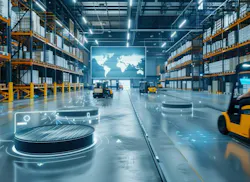
Automated guided vehicles (AGVs) and autonomous mobile robots (AMRs) are both important technologies in industrial automation, but they address operational challenges in fundamentally different ways. Each brings its own set of strengths, weaknesses, and design choices that influence how it integrates into a facility.
For decision-makers, choosing the right platform affects everything from infrastructure investment to long-term scalability. In this article, we examine the key differences between AGVs and AMRs and the factors that engineers and operations managers should consider when selecting a platform to meet both current and future operational requirements.
Navigational Differences Between AGVs and AMRs
One core difference between AGVs and AMRs is their navigation. AGVs generally follow fixed guidance systems, such as magnetic tape, floor-embedded wires, optical markers, laser reflectors, or other facility-based references, to move materials along predetermined routes. Vehicle movement typically follows predetermined paths, and fleet coordination is often managed by a centralized control system. AGVs use sensors for functions such as localization, motion control, obstacle detection, docking, and safety monitoring, but navigation typically follows predetermined routes rather than relying on dynamic path planning.
An AMR, on the other hand, uses onboard sensing and processing to localize itself and navigate within its operating environment. Using lidar, stereo or depth cameras, ultrasonic sensors, and sensor-fusion algorithms, it localizes itself and dynamically plans routes. AMRs also use simultaneous localization and mapping (SLAM) to adapt in real time, rerouting around unexpected obstacles without operator input.
Differences in Architecture and Integration
The different navigation models lead to significant differences in system architecture and in facility integration.
In an AGV system, route planning typically begins during facility design, and vehicles operate on predefined routes and guidance methods. Depending on the navigation technology, route changes may require physical modifications, software updates, or both, which can disrupt planning and operation. System integration focuses on ensuring the supervisory control system can reliably monitor vehicle status, manage start/stop commands, and coordinate with production schedules.
AMRs replace much of this physical guidance infrastructure with digital mapping and wireless communication. Rather than requiring changes to the physical floor layout, AMRs can often accommodate route and workflow changes by updating maps, mission parameters, or system configuration. Because they operate dynamically, they require reliable edge computing resources and tight integration with warehouse management or enterprise resource planning systems.
However, AMR sensor arrays and navigation software generate and process large volumes of data, so system designers must plan for sufficient bandwidth and processing power to support real-time decision-making. AMRs can also read pick lists from boxes and determine their destination (e.g., the shipping area, a specific cell, or a warehouse) based on the box’s contents.
How Navigation Architecture Shapes Safety
Navigation architecture directly affects safety-system design. Because AGVs follow predictable routes at controlled speeds, engineers can define fixed safety zones and focus obstacle detection on immediate path clearance and emergency stopping.
AMRs, by contrast, select routes dynamically, so their safety systems must account for a broader range of operating conditions. Their sensors must detect obstacles, respond proportionally, and coordinate with other autonomous systems in the area. Although these demands increase the complexity of both hardware validation and software safety protocols, they also enable AMRs to operate in dynamic environments.
Regardless of the platform, safety measures must comply with applicable industry standards. For example, ANSI/ITSDF B56.5 addresses safety requirements for driverless, automated guided industrial vehicles and the automated functions of manned industrial vehicles, while ISO 3691-4 addresses safety requirements for driverless industrial trucks, including AGVs and AMRs. ISO 10218-2 provides safety requirements for industrial robot applications and robot cells. RIA R15.08 addresses safety considerations for industrial mobile robots. Additionally, guidance on capabilities such as dynamic obstacle avoidance and artificial intelligence (AI)-based control continues to evolve.
Where AGVs Are a Better Fit
While AMRs attract attention for their flexibility, AGVs remain well-suited to stable, highly structured environments. Manufacturing lines with fixed routes and repetitive material-handling tasks benefit from AGVs’ predictable operation. Once installed, AGVs operate with consistent timing and minimal variability. Their simpler electronics and lower computational demands also reduce maintenance complexity and, under stable operating conditions, contribute to a longer service life.
Facilities that rarely need to implement route changes can benefit significantly from this predictability. Because AGVs follow predefined routes, they can often operate for extended periods with routine maintenance and consistent performance. In applications where efficiency depends more on repetition than adaptability, the guided model is a practical material-handling solution.
Where AMRs Deliver Greater Operational Flexibility
AGVs’ predictability becomes less advantageous when routes, obstacles, and workflows change frequently. AMRs excel in more dynamic environments, such as distribution centers and fulfillment hubs. Because they navigate using real-time perception and route planning, route modifications and layout changes can often be implemented more easily than in fixed-path systems, although broader workflow changes may still require configuration, validation, and integration. For example, if a pallet blocks an aisle, an AMR can calculate an alternative path instead of stopping until the obstruction is removed. This flexibility makes AMRs well-suited for environments where routes, layouts, and traffic patterns change frequently.
AMRs’ strength comes from advanced sensing and processing capabilities. They can identify moving objects, track their trajectories, and adjust to maintain safe, efficient travel. Their ability to operate without halting for minor obstructions significantly improves throughput in fast-paced facilities. However, this capability depends on advanced sensing hardware and high-performance computing to make decisions quickly enough to avoid collisions and maintain workflow efficiency.
A Decision Framework for Selecting AGVs or AMRs
Deciding between AGVs and AMRs ultimately comes down to balancing current operational requirements with anticipated workflow changes (Table 1). For facilities with fixed, repetitive material-handling tasks and stable layouts, AGVs can offer a lower total cost of ownership and reliable long-term performance. Operations that prioritize adaptability may benefit from AMRs, which provide the flexibility to respond to changing production demands, facility layouts, or order-fulfillment patterns without physical reconfiguration.
Table 1:Decision factors for AGVs vs. AMRs
|
Decision Factor |
AGVs |
AMRs |
|---|---|---|
|
Navigation |
Fixed guidance infrastructure |
Dynamic navigation using maps and sensors |
|
Route changes |
Usually require physical modifications |
Usually handled through software or digital mapping |
|
Obstacle response |
Detect and stop |
Detect, evaluate, and reroute |
|
Computing requirements |
Lower |
Higher |
|
Best fit |
Stable, repetitive workflows |
Dynamic, frequently changing workflows |
|
Primary infrastructure needs |
Tape, wires, markers, or similar guidance |
Wireless networking, charging infrastructure, maps, fleet-management systems, workstation interfaces, and facility integration |
The decision also has implications for integration and support infrastructure. AGVs require less data handling but more physical guidance infrastructure. AMRs reduce physical installation requirements but place greater demands on networking, computing, and IT integration.
Emerging Trends in Mobile Robotics
Emerging technologies are narrowing the gap between AGVs and AMRs. For example, advances in low-power processing, AI navigation algorithms, and sensor miniaturization are making AMRs more cost-effective. Meanwhile, AGVs are adopting enhanced perception systems that provide limited autonomy while retaining their guided model.
Moving forward, advances in connectivity will enhance both platforms by enabling faster data exchange and more robust sensor integration. As mobile robotics evolves, AMRs are likely to remain well-suited to operations that prioritize adaptability, while AGVs will continue to support high-throughput, predictable workflows that rely on fixed infrastructure. Hybrid approaches may enable facilities to combine predictable transport on stable routes with autonomous navigation in dynamic environments.
Conclusion
The choice between AGVs and AMRs is not simply a matter of fixed versus flexible navigation. Rather, it reflects decisions about how a facility invests in physical infrastructure, sensing, computing, networking, safety, and system integration.
AGVs deliver the greatest value when routes and workflows remain stable, while AMRs are better suited to environments that require frequent operational changes. As these technologies continue to evolve, hybrid systems may offer a third option by applying each navigation model where it provides the greatest operational benefit.
Hector Barresi is an award-winning Industrial Technology Advisor, Consultant, and Public Speaker specialized in Industrial Automation, Smart Manufacturing, and Digitalization. He has held executive positions at Honeywell, Danaher, IDEX and General Electric, and he is renowned for shaping top-tier Product Innovation organizations globally. Notably, he pioneered the Honeywell XYR5000, the first industrial wireless sensor family on the market, and the groundbreaking Tintelligence smart tinting platform, revolutionizing the paint industry.