Designing Comfort and Trust in Caregiving Robots
Key Highlights
- Robotics are increasingly supporting healthcare tasks, from surgery to patient rehabilitation, with a focus on safety and trust.
- Lipson highlights the importance of emotional signals, like facial expressions, in building trust between humans and caregiving robots.
- Physical caregiving tasks, such as lifting and transfers, are complex and will likely be addressed after establishing emotional comfort.
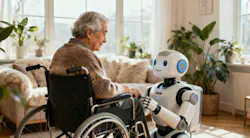
The path to physical assistance runs through something unexpected: a reassuring face
Based on an interview with Hod Lipson
Robotics is increasingly transforming healthcare, supporting everything from minimally invasive surgery and hospital logistics to diagnostics and rehabilitation as intelligent machines assist medical professionals across diverse clinical settings. As the design and functionality of robots continues to evolve, new robot models are serving as healthcare assistants, helping to augment the work of overburdened human caregivers.
To understand where caregiving robots are headed, we spoke with someone who’s spent his career exploring what makes machines feel human. Hod Lipson, a Columbia University robotics and artificial intelligence (AI) researcher known for his groundbreaking work in soft robotics and expressive machines, argues that the future of caregiving will not hinge on strength or dexterity alone. Instead, it will depend on whether robots can earn our trust through subtle, deeply human signals—like a smile delivered at the right moment. In this blog, we explore how Lipson’s perspective reframes the entire caregiving roadmap and reveals why emotional comfort may be the real frontier of robot design.
Robotics’ Moving Target
Lipson runs a robotics lab that has spent years developing compliant materials, adaptive actuators, and force-sensing systems that would let robots safely lift, steady, and assist humans in need. The most physically demanding caregiving tasks, such as lifting someone from a wheelchair, helping them bathe, or steadying them through transfers, are also among the most technically complex. They require exactly the kind of soft, compliant bodies roboticists have spent years trying to build.
But those tasks also require extraordinary trust. And trust, Lipson has concluded, doesn’t start with a gentle touch. It starts with whether a robot’s face makes you feel safe enough to let it stay in the room.
“For 10 years, we were thinking soft robots are going to be soft hands, arms like an elephant trunk,” Lipson says. “But if you look around, you don't see any of that. Faces are the soft robot that we did not see coming.” The potential reason for this comes from an observation that emerged from Lipson’s research: “When people talk, we measured about 50 percent of the time they are staring at the [speaker’s] lips.”
Why Lifting Comes Last—Not First
It’s a common assumption that caregiver robots step in for the most physically demanding moments: lifting a person, steadying them down steps, helping with transfers, and assisting with bathing. Tasks that strain human caregivers and carry real risk when something goes wrong.
At first, Lipson also expected soft robots to tackle physical caregiving first. Now, he believes those tasks will come last.
"Originally, that's what I thought soft robots would do," he says. "But I think that's actually going to be the hardest thing."
This is not because the technology is impossible, but because the stakes are too high to rush. "It's dangerous because it has to lift the whole body," Lipson explains. "It requires a lot of force and a lot of trust."
One mistake during a transfer could lead to a serious fall. One misstep in shifting weight on a staircase could lead to an injury. Even if engineers perfect the mechanics, society will need time to accept robots performing personal, high-risk care. Lipson estimates that it could take a decade for this trust and comfort to develop.
The path to that future begins with something simpler than physical labor.
>>Click to read the entire article at Mouser
Hod Lipson is a Columbia University professor who works in the areas of robotics and AI. He is an award-winning researcher, teacher, and communicator. He has received many recognitions, including Esquire magazine’s “Best & Brightest,” Popular Science’s “25 Most Awesome Labs in the US,” and Forbes “Top 7 Data Scientists in the World,” to name a few. His TED talk is one of the most viewed on AI, and he was centrally featured by the New York Times in their 2023 piece, “What’s Ahead for A.I.”