Semiconductor Design for Scalable Humanoid Robots
What You’ll Learn:
- From autonomous mobile robots in warehouses to humanoid robots in factories and service settings, these machines are transforming the way we work and live.
- In addition to precise, real-time awareness of the forces acting upon them, to achieve human-like motion—such as grasping delicate objects, maintaining balance while standing or walking, and interacting safely in any given environment—these systems require solving complex design challenges across movement, sensing, communication and power architectures.
- Every subsystem, from motor control systems to sensors that mimic human awareness, must work together seamlessly to ensure a safe and dependable operation.
- TI offers a range of electronic components, materials and enabling technologies to support the demanding requirement of humanoid robot applications. The company harnesses generative artificial intelligence (AI) to simplify embedded development, empowering engineers to build smarter applications faster with free, intuitive tools and open-source frameworks.
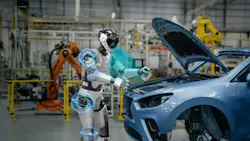
Introducing a game-changing technology is a bit like golfer hitting a hole-in-one. Both events happen relatively infrequently, yet everyone knows there’s another one coming, but not exactly when or by whom. Consider humanoid robot development. In terms of capabilities, mechanical structures and electrical complexity, humanoid robotics—machines designed to resemble the human body and operate within spaces built for people—is progressing very quickly.
From autonomous mobile robots in warehouses to humanoid robots in factories and service settings, these machines are transforming the way we work and live.
In addition to precise, real-time awareness of the forces acting upon them, to achieve human-like motion, such as grasping delicate objects, maintaining balance while standing or walking, and interacting safely in any given environment, these systems require solving complex design challenges across movement, sensing, communication and power architectures.
Every subsystem—from motor control systems to sensors that mimic human awareness—must work together seamlessly to ensure a safe and dependable operation.
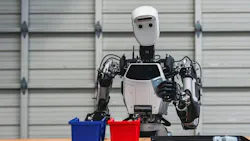
A Practical Engineer’s Guide to Humanoid Robots
Designing smarter, more responsive mobile and humanoid robots starts with high-performance embedded processors and intuitive software that enables real-time control, perception and decision-making at the network edge. Building a practical humanoid robot requires balancing mechanical design, actuation, control systems and AI integration. TI’s engineering expertise in robotic applications, combined with the right product selection for any robot design type, can help engineers accelerate the design process.
To get you started Texas Instruments provides a free engineering resource titled An Engineer’s Guide to Humanoids & Mobile Robots. Read how highly integrated devices help analyze and respond to the growing amount of sensor data robots use for perception, navigation and motion control.
The guide provides system-level design strategies including sensing, real-time control, motor drives, connectivity, processing and power, and discusses component selections and architectural frameworks for building humanoid and autonomous mobile robots,
As this Guide shows, by leveraging advanced gallium nitride (GaN) -based gate drivers to reduce power stage footprint by up to 50%, and employing precision sensing devices that incorporate sensor fusion that combines cameras, LiDAR and mmWave radar sensors, it delivers 360-deg. environmental awareness. Engineers are driving progress across industries to increase productivity, enhance safety, and improve daily living, all while meeting cost and performance requirements.
Enable Precise Motion with Torque Sensing
Torque and force sensing plays a central role in defining the performance of humanoid robots as well as enabling safe interaction and reliable performance, smoother, refined, controlled motion; and accurate, real-time motor feedback. A torque sensor (or torque transducer) is a device that measures the rotational force (torque) applied to a shaft, joint or mechanical component and converts it into an electrical signal.
Torque is a real-time control variable for precise movement and operational stability. Torque and force sensors work using resistive strain gauges in a Wheatstone bridge configuration to detect material deformation, converting mechanical strain into small electrical signals. Multiaxis torque and force sensors in humanoid robots enable precise grip control, load handling, balance maintenance and safe environmental interaction.
Compare sensing architectures and key design considerations for responsive, coordinated motion.
Navigation and Sensing
Modern robotics, including humanoid robots, autonomous mobile platforms and industrial automation systems, must perceive their environments with high accuracy, low latency and consistent reliability across a wide range of operating conditions. Current technology, such as vision sensors alone, often degrades in performance when exposed to fog, glare, dust, rain or low-light environments, and single-modality depth sensors frequently struggle to deliver stable measurements in cluttered or dynamic scenes.
In humanoid robots navigation and sensing involves real-time data acquisition gathered from many sensors to perceive elements of the environment including visual systems (cameras), radar, LiDAR and tactile sensors.
Humanoid robots use algorithms to process sensor input for obstacle detection, path planning and precise movement for autonomous navigation of complex environments. They integrate Inertial Measurement Units (IMUs) for balance feedback, alongside cameras, LiDAR and tactile multi-fingered arrays for spatial mapping and manipulation.
Motion control and perception sensing interface standards such as Ethernet and FPD-Link camera SerDes reduces system size while optimizing high-speed data transfer in camera designs for advanced driver assistance systems and autonomous vehicles. This enables real-time data transfer, allowing for greater mobility and control as well as transmission of high-resolution, uncompressed video in vision-based applications.
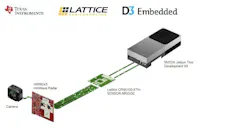
TI’s mmWave radar technology provides a fundamentally different sensing modality that is intrinsically robust to environmental challenges. The IWR6243 mmWave radar sensor, for example, delivers precise range, velocity, and angle measurements independent of lighting conditions and with strong resilience to environmental interferences. When raw data is combined with camera-based perception and AI-driven sensor fusion, this capability enables robust and reliable perception of the surrounding environment with much higher fidelity than a radar-only or vision-only approach.
See how mmWave radar and camera data integrate on NVIDIA Holoscan to strengthen robotic perception. And explore a low-latency sensor-fusion pipeline designed to improve detection, tracking and decision-making in complex, dynamic environments.
In Summary
From interactive reference diagrams with subsystem product recommendations to technical white papers and trending blog posts, TI offers a range of electronic components, materials, and enabling technologies to support the demanding requirement of humanoid robot applications.
TI harnesses generative artificial intelligence (AI) to simplify embedded development, empowering engineers to build smarter applications faster with free, intuitive tools and open-source frameworks. From Arm-based application processors and TI mmWave radar sensors to industrial communications and on-demand functional safety data and documents, TI can help you bring your design to life.
Related
About the Author
Voice Your Opinion!
To join the conversation, and become an exclusive member of Machine Design, create an account today!
 Leaders Logo
Leaders relevant to this article: