Designing a Portable PEMF Device for Human Recovery and Wellness
Key Highlights:
- The Nova HD+ was developed by integrating interdisciplinary engineering, focusing on portability, safety and ease of use for everyday consumers.
- AuraWell transitioned PEMF technology from large equine devices to compact, FDA-compliant human wellness devices through strategic partnerships and in-house engineering.
- Design challenges such as weight reduction, fire-rated casing, and custom power supplies were addressed to meet regulatory standards and user needs.
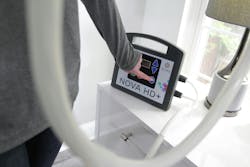
Designing and manufacturing medical devices that balance cutting-edge technology, regulatory compliance and user-friendly practicality can be a challenge. AuraWell’s Nova HD+ is a compelling case study in harnessing interdisciplinary engineering to transform complex pulsed electromagnetic field (PEMF) technology into a portable, reliable device for wearable wellness.
Machine design engineers understand the complexities of converting advanced medical technology into accessible, FDA-compliant devices without compromising usability of manufacturability. AuraWell’s Nova HD+ device challenges conventional engineering leadership narratives—driven not by an engineer, but by a former television producer named Alane Paulley. “If you would have told me even 10 years ago that I was going to be in manufacturing and machine design, I would have laughed,” she admits to Machine Design.
From Horse to Human Health
PEMF technology has a strong foundation in performance enhancement for racehorses, with early devices being large, heavy and specifically designed for equine physiology. Around 2003, Paulley says her father began distributing these heavy PEMF units for horses, recognizing the impressive physical responses—such as faster run times and quicker recovery—that they exhibited.
From 2006 to 2008 the business rapidly grew, selling from 4 to 50 units monthly, and Paulley says she joined her father to help scale operations. “He was getting busy selling a lot of machines,” she recalls. “So I joined him to kind of help him sell more machines and grow.”
The transition to human use was sparked by acquiring intellectual property from one of NASA’s original PEMF design scientists, Paulley explains. This enabled control over manufacturing and the design of a device tailored for human safety, portability and everyday usability.
“By 2017, I realized that we needed a little bit more control, and I ended up buying the intellectual property of the manufacturing process from one of the original NASA design scientists,” she says.
Engineering Partnerships and Design Development
Initially, the design process required outside help, Paulley recounts. AuraWell partnered with Occam, a local engineering firm, to help design the first rounds of the equine machines. As the transition to human devices began, in-house engineering resources expanded, including hiring recent graduates. Among these were Cameron Onan, who Paulley says oversaw manufacturing troubleshooting and iteration.
Early prototypes of the human-use models involved innovative approaches, like shaping cases at a car-maker’s facility for metal casings. Addressing FDA regulatory requirements was essential, Paulley says. The team worked closely with Borderless MedDev to navigate 510(k) submissions and safety testing, iterating design to meet stringent FDA standards on power output, safety and efficacy.
User-centered Simplicity and Manufacturing Challenges
Paulley says she prioritized simplicity and ease of use above complex functionality. “I wanted as [few] buttons as possible, so it is start, stop, up, down…super-simple, so that anybody in their home could quickly start using it.”
Weight and portability were key design challenges, she said. Moving away from heavy 50-60 lb. equine machines to something light enough for air travel was necessary. The casing had to be fire-rated while allowing sufficient power delivery without overheating. Paulley says the power supply was developed and licensed specifically to meet pulsing requirements—an important custom element due to the lack of off-the-shelf solutions at the required specifications.
Static electricity challenges during PCB assembly underscored the importance of manufacturing discipline and environmental controls. The team sourced a mix of off the shelf and customize components, carefully managing the supply chain EM-A challenge amplified by the COVID-19 pandemic. Long warranty periods and durable design emphasized building machines to last, contrasting the industry trend toward consumables. “We are made in the United States,” Pauley affirms. “My machines have a 10-year warranty as well, and are manufactured to stand up to the test of time.”
The magnetic field is produced via an easily connectable attachment, designed to adapt for various bodyparts. Safety mechanisms ensure the device only energizes when the attachment is securely connected, using coil sensing and firmware checks.
Mechanical, electrical and software engineering teams worked in tandem to simplify the user interface while extending reliability and durability, Paulley says. For example, the original continuous “smooth” nob for power control was replaced with an incremental control faceplate—providing user feedback, reducing wear on internal components and ensuring precise reporting for clinical trial consistency.
“We had to sit down with different engineers and say, ‘how can we control the strength without the knob?’ It was a big decision...they did not agree at first,” Paulley recalls.
Data Collection and HIPAA Considerations
While the Nova HD+ itself does not collect user data, AuraWell engages in multiple clinical trials on animals and humans, measuring mitochondrial function, prostate cancer response and other outcomes, Paulley notes. Plans for future connectivity and data-driven machine learning features are being evaluated carefully regarding privacy and regulatory compliance, particularly HIPAA.
“We have capabilities for connectivity,” Paulley confirms, “but I wanted to avoid HIPAA and keep it an over-the-counter Class 2 device that does not require a doctor's care.”
The pandemic highlighted the necessity of diversified and resilient supply chains, as well. Paulley says that the company’s commitment to U.S. design and manufacturing allowed business continuity when many global supply chains faltered.
She adds that the company distinguishes itself by building durable, serviceable machines backed by long warranties, aiming to disrupt healthcare economics that profit from chronic sickness by providing accessible, noninvasive alternatives.
About the Author
 Sharon Spielman
Sharon Spielman
Technical Editor, Machine Design
As Machine Design’s former technical editor, Sharon Spielman produced content for the brand’s focus audience—design and multidisciplinary engineers. Her beat included 3D printing/CAD; mechanical and motion systems, with an emphasis on pneumatics and linear motion; automation; robotics; and CNC machining.
Spielman has more than three decades of experience as a writer and editor for a range of B2B brands, including those that cover machine design; electrical design and manufacturing; interconnection technology; food and beverage manufacturing; process heating and cooling; finishing; and package converting.
Email: [email protected]
LinkedIn: @sharonspielman
Facebook: Machine Design
YouTube: @MachineDesign-EBM
Voice Your Opinion!
To join the conversation, and become an exclusive member of Machine Design, create an account today!
 Leaders Logo
Leaders relevant to this article: