Quick, Seamless Integration at the Heart of Novel Electric, Belt-Driven Hydraulic-Replacing System
Key Highlights
- RISE Robotics introduces Beltdraulic, a fluid-free actuator leveraging high-torque electric motors and belt-driven architecture to surpass hydraulic performance.
- By integrating advanced electric motors and inverters from EVR Motors and Turntide Technologies, the Beltdraulic system offers precise, responsive control for heavy equipment.
- Early deployments of Beltdraulic demonstrate its potential to replace traditional hydraulics across various demanding applications.
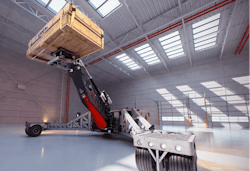
While hydraulics are workhorses when it comes to providing power and durability in heavy machinery, their inefficiencies, leaks and outdated coarse controls limit innovation. RISE Robotics, with partners EVR Motors and Turntide Technologies, are demonstrating how high-torque electric drives and a novel belt-driven architecture can unlock hydraulic-class performance without oil, pumps or valves.
Heavy Machines Still Rely on Hydraulics, but Technology Has Stalled
For nearly a century, hydraulic cylinders have been the muscle in heavy-duty machines. Excavators, material handlers, forestry equipment and mining platforms all depend on them because they deliver the power density required to move literal tons with authority. Their reliability was good enough, their dominance well-earned.
However, hydraulics were built for the diesel era, not the electrified one. While they excel at brute-force work, they struggle when machines need responsive control, broad operating ranges or meaningful energy efficiency. Most of the power generated by pumps never becomes motion.
Oak Ridge National Labs, in collaboration with the National Fluid Power Association, reports that mobile hydraulic systems average just 21.1% efficiency. Nearly 80% of input energy is burned off as heat in the engine, pump, hoses, valves and cylinders instead of doing useful work.
Alternatives exist. Ball- and roller-screw linear actuators have gained traction in automation and robotics where duty cycles are moderate and load ranges are manageable. In light-duty classes, they offer good control and adequate force generation without fluids. However, as load requirements rise into the ton-class range typical of mobile equipment, screw mechanisms become inadequate. They require heavier hardware, operate at lower speeds and experience higher internal stresses to maintain output power. This compromises durability and scalability.
Hydraulics are not disappearing, but they are no longer advancing quickly enough to meet the demands of the industries. As machines move toward electrification, autonomy and lower lifecycle costs, the actuator must evolve along with the drive systems that power it.
As Kyle Dell’Aquila of RISE Robotics said, “Delivering better than hydraulic-class power with Beltdraulic requires more than a new actuator alone. It requires a family of electric systems working together in unison. It requires the right motor and inverter technology, tightly integrated and tuned to achieve performance traditional fluid-power systems simply can’t reach. That is where EVR Motors and Turntide Technologies became essential partners.”

High-Force Linear Motion Built for Electric Control
RISE Robotics developed Beltdraulic to make existing machines better and new machines possible by addressing the gaps left by both hydraulics and conventional electric actuators. Instead of adapting fluid-era motion to electric power, Beltdraulic was designed from the start to translate torque from high-performance motors into linear force with efficiency and precision.
At its core, Beltdraulic uses wire-reinforced belts arranged in a block-and-tackle architecture. This approach relies on rolling contact rather than sliding friction or throttled flow. The result is a fluid-free actuator that delivers hydraulic-class force with more than 90% efficiency from the motor shaft and roughly 85% system efficiency across a broad operating range.
Just as important as efficiency is how the motion is controlled. Beltdraulic is directly coupled to the motor, allowing torque to be commanded and adjusted through motor current with minimal latency. Speed, position and force are governed by control algorithms rather than pressure drops and oil flow, enabling smooth, low-speed positioning, rapid acceleration and repeatable behavior across operating conditions.
Integrating motion systems is one of the biggest pain points in electrifying heavy machinery. The fact that EVR built a controls team to close this gap—and brought Turntide into the fold—shows a real understanding of where the industry struggles. It’s the kind of alignment that makes innovation scalable.
- Kyle Dell’Aquila, Head of Industrial Design and Customer Experience, Rise Robotics
Beltdraulic also provides continuous insight into system state and performance. Position, force and current data are available in real time, supporting precise closed-loop control and visibility into system health and usage. This data-rich foundation enables proactive maintenance, early fault detection and integration with advanced software tools, including AI-based motion control and optimization frameworks that rely on high-quality, real-time feedback.
Eliminating hydraulic oil removes many of the practical burdens associated with fluid power. No leaks need to be managed, no hoses must be routed, no pumps require maintenance, and no radiators have to be sized for worst-case throttling losses. Maintenance requirements are reduced, uptime improves, and machines operate more quietly and cleanly. For original equipment manufacturers (OEMs) and fleet operators, those advantages translate directly into lower lifecycle costs and simpler system integration.
The belt-driven architecture is also well-suited for applications that demand speed under load. Beltdraulic enables fast extension and retraction over long strokes without the resonance limits that constrain screw-based systems, opening the door to machine architectures that were previously impractical.
Precision and Power Depend on the Drive System
Beltdraulic’s performance envelope is defined as much by its drive system as by its mechanical architecture. High-force, high-speed linear motion demands more than raw motor power; it requires torque density, fast current control and stable operation across a wide range of speeds and loads. In short, the actuator can only be as precise and responsive as the motor and inverter driving it.
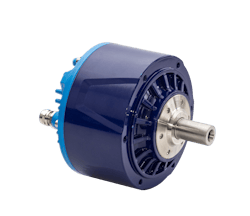
To realize that capability, RISE partnered with EVR Motors and Turntide Technologies. EVR’s motor designs deliver unusually high torque density in compact packages, well suited to traction-style duty cycles where both peak output and continuous performance matter. Turntide’s inverters complement that hardware with fast, high-bandwidth current control and a software architecture designed for rapid tuning and validation.
Together, the motor and inverter operate as a tightly integrated drive system, enabling Beltdraulic to command force and motion directly through electrical signals rather than indirect hydraulic regulation. Torque can be applied, adjusted and reversed quickly and predictably, supporting everything from delicate positioning to aggressive, high-speed motion. That responsiveness is critical for applications where cycle time, precision and repeatability matter.
Just as important, the EVR and Turntide platforms provide a stable foundation for scaling. As Beltdraulic systems grow in force, speed and stroke length, the drive system must scale in power without sacrificing controllability. The combination of high-torque motors and robust inverter control allows RISE to extend the same motion principles into larger, more demanding machine classes while maintaining consistent behavior.
For RISE, the value of the partnership goes beyond component selection. Delivering better-than-hydraulic performance requires a family of systems working together in unison, with motors and inverters tuned to the actuator and the application. That level of integration and partnership are what enables Beltdraulic to move beyond a novel mechanism and function as a practical, production-ready motion system.
Integrated Electric Drives Accelerate Development, Enable Faster Innovation
One of the less visible challenges in electrifying heavy machinery is integration time. Even when motors and inverters meet performance requirements on paper, bringing them together into a stable, tuned system can take months. Control loops must be calibrated, fault behavior validated and performance verified across operating conditions. For OEMs, that effort often becomes the bottleneck that slows innovation.
RISE’s collaboration with EVR Motors and Turntide Technologies approached this problem differently. Rather than treating the motor, inverter and actuator as loosely coupled components, the teams worked toward delivering a cohesive drive package tuned specifically for a 2-ton Beltdraulic cylinder. The result was a system that could be brought online and performing as intended in days rather than months.
That rapid integration proved critical as RISE prepared to demonstrate Beltdraulic publicly, including live operation at bauma 2025, a global trade fair for construction machinery. Fast turnaround allowed the team to focus less on low-level drive debugging and more on validating performance, refining motion profiles and engaging directly with customers. For emerging actuation technologies, that feedback loop is essential.
Beyond Beltdraulic, the same integration approach benefits more conventional applications. EVR Motors and Turntide inverters are designed to support a wide range of rotary electric drive systems, not just this specific actuator. That breadth allows original equipment manufacturers (OEMs) to standardize on proven electric platforms while selectively adopting new motion architectures where they deliver the most value.
By reducing integration friction, tightly coordinated electric drive systems lower the barrier to experimentation. New machine concepts can be evaluated quickly, design iterations move faster and advanced control strategies become easier to deploy. In that way, integration speed becomes more than a schedule advantage—it becomes an enabler for innovation.
From Proven Deployments to a Fluid-Free Future
Beltdraulic is not a concept waiting for validation. RISE is piloting the technology across a range of demanding applications, from high-force robotic systems to commercial liftgates and industrial equipment operating in harsh environments. In each case, the value proposition has been consistent: precise electric control, reduced maintenance, and performance that meets or exceeds expectations set by hydraulic systems.
These early deployments demonstrate that fluid-free actuation is not limited to niche use cases. With the right combination of mechanical architecture and electric drive technology, it can scale into the core functions of heavy machinery. As EVR Motors expands its portfolio toward higher-power motor platforms and Turntide continues to advance inverter performance and control software, that scalability extends naturally into larger machines and more demanding applications.
Hybrid approaches will continue to play a role as the industry transitions. They allow manufacturers to electrify incrementally while retaining familiar hydraulic subsystems. But hybrids also preserve many of the inefficiencies, maintenance burdens and control limitations that have constrained machine performance for decades.
The next leap comes from eliminating those constraints altogether. Fluid-free, electrically controlled actuation unlocks new levels of efficiency, responsiveness and system intelligence. It simplifies machine design, enables advanced software-driven control and creates the foundation for automation and autonomy.
By combining RISE’s novel actuation architecture with high-performance electric motors and inverters from EVR and Turntide, the partners are demonstrating what that future looks like in practice. Not by replacing one component at a time, but by rethinking how motion itself is generated and controlled.
Hydraulics defined heavy machinery for the last century. All-electric, fluid-free motion will define the next.
About the Author
Ryan Grodzki
Vice President – Strategic Partnerships, Turntide Technologies
Voice Your Opinion!
To join the conversation, and become an exclusive member of Machine Design, create an account today!
 Leaders Logo
Leaders relevant to this article: