Physical AI Hype vs Reality: Kung Fu Robots are Cool...But Should You Hire One?
Key Highlights:
- Some humanoid robots have reached an impressive level of dexterity, but integrating AI-enabled robots on to the shop floor requires overcoming reliability and safety hurdles.
- Recent advances in compute hardware and physical AI models have sparked development of practical autonomous industrial robots.
- End effectors equipped with tactile sensors enhance robotic grasping, manipulation and proprioception, especially in applications where visual sensors are obstructed.
- Continuous data collection from operational robots will fuel ongoing AI model improvements, creating a virtuous cycle of increasing capability and utility.
Enjoying Machine Design’s Motion Control content? Be sure to check out the rest of our Takeover Week coverage here.
As generative AI heads toward the disillusionment phase of the hype cycle, physical AI has taken its place at the pinnacle this year. The impressive martial arts performance Unitree’s G1 robots put on during China Media Group’s Spring Festival Gala in February was the latest in a line of similar AI-enabled robotics demos intended to show off just how dexterous these systems have become. The implicit message: If physical AI has progressed to the point where robots can do back flips and roundhouse kicks, then more mundane applications must be child’s play.
Turns out, not so much. Or rather, it’s a false comparison, similar to conflating a high performance stunt plane with a C-17 Globemaster cargo jet. The design of both aircraft draw on roughly the same technology and underlying principles, but they serve very different purposes. One wows a crowd; the other gets work done, but the performance of each requires that distinct engineering design challenges and technical hurdles be cleared.
“Demos are fun, but making a video isn’t the hard part,” says Agility CTO Pras Velagapudi. “The bar for commercial deployment is so much higher than for a demonstration. In logistics and manufacturing, even a 99% success rate can be considered a failure if the remaining 1% constantly requires human intervention. The real breakthrough isn’t a robot doing something spectacular once; it’s a robot quietly performing the same task thousands of times per shift, day after day, with production-grade reliability.”
Humanoid Robotics
For companies that can clear those hurdles for the industrial sector, the payoff is potentially massive. According to a 2025 Morgan Stanley forecast, the market for humanoid AI-enabled robots alone could surpass $5 trillion by 2050. It’s not surprising, then, that according to Gartner, nearly 200 companies are currently at some stage of developing a humanoid robot. However, the research firm predicts only 20 of those will last long enough to scale by 2028.
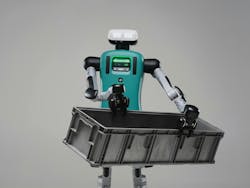
One of the embodied AI/robotics companies taking an early lead is Agility (formerly Agility Robotics). The company’s Digit became the first humanoid robot to find a paying customer when logistics provider GXO signed the first multi-year Robotics-as-a-Service (RaaS) deal with Agility in June 2024. Since then, the company has added German industrial component manufacturer Schaeffler, Latin American e-commerce firm MercadoLibre and, most recently, Toyota Motor Manufacturing Canada (TMMC) for use in the automaker’s largest facility outside Japan.
To date, the Digit has been largely employed in logistics and warehousing duties such as palletizing/de-palletizing, container transportation and tote stacking. Weighing 205 lbs with a top walking speed of 1.2m/s, the Digit can carry up to 35 lbs. The robot’s 4 degrees-of-freedom arms integrate force sensors that allow its claw-like end effectors to hold payloads tight enough without crushing them.
READ MORE: Physical AI in Motion: How Machine Learning Drives Next-Gen Industrial Automation
It maintains a 360-deg. field of view out to 100 meters via its head-mounted lidar for collision avoidance and navigation, plus two depth cameras to facilitate close-up manipulation tasks. To enable off-line AI autonomy, the Digit incorporates Nvidia’s Jetson AGX Thor System on Module (SoM) for local inference acceleration. However, it also communicates wirelessly with the company’s cloud-based Agility Arc fleet management system. Hosted on AWS, the system collects real-world telemetry data from Digit robots in the field to continuously train and refine its physical AI models by leveraging the cloud-provider’s high-end computing capacity.
Specs aside, the Digit has a few distinctive characteristics that makes it stand out. First, the robot’s whole body control foundational AI model is based on a trial-and-error reinforcement learning (RL) approach. Characterized by extensive training in a physics-based simulated environment (e.g., NVIDIA’s Isaac Sim), RL models are known for their ability to generalize, or adapt, to dynamic environments and tasks not explicitly included in its training data.
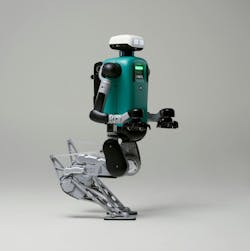
In addition, unlike other humanoid robots, the Digit walks on digitiform (i.e., bird-like) legs that bend backward. From a practical standpoint, the company says, this design allows the Digit to squat down without having human-like knees jutting forward and restricting how close it can get to container racks.
“Digit’s digitigrade leg design mirrors the biomechanics seen in fast and agile animals and offers advantages in energy efficiency, shock absorption and dynamic balance,” Velagapudi says. “By combining digitigrade locomotion with whole-body balance and reach, Digit can move materials between workstations and interact with existing infrastructure without requiring companies to redesign their facilities.”
Beyond Digit’s distinctive legs, Agility says it approached the robot’s development not as a showpiece, but like any other industrial equipment operating in close quarters with people. For example, the robot features on-board E-stop button that initiates a CAT1 stop function. It also sports a PLd-rated safety PLC that communicates safety data (e.g., E-stop signals, sensor feedback) via the real-time FailSafe over EtherCAT (FSoE) protocol.
Taken together, these measures won the Digit approval from the OSHA-accredited Nationally Recognized Test Lab (NRTL), in addition to meeting a string of machinery safety standards (among them ANSI B11.0, ISO 12100 and ISO 13849).
“The real barrier to scaling this technology isn’t AI or battery technology; it will be building a robot that can safely work side-by-side with humans,” Velagapudi says. “That’s why, of equal importance, has been our focus on safety certification and international standards. Humanoid robots are dynamic machines that move through spaces shared with people, so building a certifiable safety architecture is essential.”
Technologies Enabling Physical AI’s Advance
Focusing solely on the Digit’s design, or that of other physical AI products, risks glossing over two pivotal technologies released in the last five years that have accelerated development of AI robotic systems suited for industrial uses.
The first is hardware. Introduced in 2021, NVIDIA’s Jetson line of System on Module boards are energy efficient, small form factor mini-computers—analogous to a Raspberry Pi—but specifically designed to run generative and physical AI models locally (i.e., not dependent on a potentially slow or intermittent cloud connection). The lineup ranges from the diminutive Jetson Orin Nano up to the brawny Jetson AGX Thor, which drives the Digit. However, the Jetson AGX Orin module is the most common unit currently making its way into industrial equipment.
In some ways, the Jetson line mirrors the introduction of the first GPU-driven graphics card, the NVIDIA 256, released in 1999. Before it, 3D graphics acceleration was largely limited to texture mapping while the CPU slowly processed the complex math behind rendering polygons as pixels. Anything beyond that required bulky workstations from Silicon Graphics (SGI) that cost between $8K and $250K. By comparison, the Nvidia 256 cost $250 at launch and slotted into most desktop computers of the time.
In addition to hardware, the release of NVIDIA’s CUDA software stack in 2007 greatly simplified multi-threaded programming and made GPUs useful for computing tasks beyond graphics, most notably for early AI research.
READ MORE: AI Gains Physical Intelligence and Transforms Robotics & Automation Design
Today, the Jetson SoM line has done for inference (i.e., running an AI model rather than training one) what the NVIDIA 256 card did for 3D graphics: offloading and accelerating the complex AI number crunching to dedicated processors that make physical AI applications at the edge technically and financially practical.
For example, a modern graphics card, like an RTX 4090, can out perform a Jetson AGX Orin at a comparable price point. However, it isn’t stand-alone, takes up roughly three times more space, consumes significantly more power (~450W TDP vs 15-60W) and doesn’t offer the large amounts of on-board VRAM needed to run complex AI models. Graphics cards also lack the Jetson line’s NVDLA architecture, circuity purpose built to accelerate the mathematical operations involved in deep learning inference.
The other crucial component is improvements in the physical AI models that give robotic systems the ability to perceive, assess and react to dynamic tasks. Historically, the challenge has been the relatively limited maturity of physical AI models.
Unlike generative AI, trained on an Internet’s worth of textual and graphic information, physical AI developers have struggled to collect similarly vast amounts of real-world motion and manipulation data. To compensate, physical AI machine learning is often augmented with synthetic data generated via a 3D simulator coupled with a physics engine, like NVIDIA’s PhysX or the open-source Newton.

Robotic Arm Workcell
One approach to this limitation is utilizing a foundational Vision-Language-Action (VLA) model. This AI model approach leverages the robustness of LLMs to understand plain language and diffusion models to interpret machine vision inputs. These are combined with datasets of robot trajectories. The strength of VLAs, such as Physical Intelligence’s Pi Zero and Google DeepMind’s RT-2, lies their ability to generalize. That is, they use their semantic and reasoning capabilities to adapt to novel situations and tasks without requiring additional training.
Despite their capabilities, monolithic VLA models do have limitations, says Vention CEO Etienne Lacroix. “In the world of physical AI, there are really two approaches to creating an autonomous robot cell: the end-to-end VLA model or the pipeline model,” he explains. “[VLA models] generalize well, but they tend to be a bit slow and are not really suited for manufacturers in terms of placement precision. The pace and throughput of those models is simply too heavy, too slow, for manufacturing use cases.”
READ MORE: A3’s Insights from the Congressional Robotics Caucus
Given the needs of its target market, Vention has embraced the pipeline approach. With it, the company looks to do for physical AI and robotics what it does for the custom machine design process: namely, making the integration of an AI-enabled robotic work cell with a larger automation system as straightforward as designing and building automation systems from an array of third-party industrial components.
To achieve that, Vention announced its Rapid AI Operator solution at the NVIDIA GTC 2026 AI conference in mid-March. The culmination of prior work, it provides the complete package, Vention says, integrating a motion and AI controller, machine vision, a choice of 6-axis robotic arms and a user-friendly AI software stack. The end result is a turnkey solution with the speed and reliability end-users expect from any other piece of industrial equipment.
At its core is the company’s MachineMotion AI, an all-in-one logic, motion and AI controller that includes one of the range of Nvidia Jetson SoMs, depending on computation demands of the system it controls. To that, Vention last year added its AI Operator software—a handful of physical AI agents, each trained to perform a specific industrial task such as bin picking. While a capable first step, Lacroix says the initial AI Operator was more proof-of-concept than end product, requiring robotics and AI expertise to implement.

So, in February 2026, the company released the next evolution, called GRIIP (Generalized Robotic Industrial Intelligence Pipeline), that the company bills as an end-to-end physical AI pipeline. According to the Vention, GRIIP integrates foundation models with Vention’s robotics and control hardware to create a generalized AI backbone that is re-usable and scalable. As such, it presents users with an intuitive interface while internally taking care of complex integration processes, as well as configuration tasks like adapting the system to new part SKUs, that previously required AI and robotics expertise.
As the name suggests, pipeline AI models adopt a modular and sequential approach, compared to a VLA’s holistic model, analogous to a string of work cells on a manufacturing line. In this architecture, autonomous robot tasks, like bin picking, are broken down into mini-skills, each facilitated by one or more foundational AI models.
To illustrate, take the steps involved in bin picking. Presented with a container filled with identical parts, the system first needs to discern which are closest to the top of the pile. To accomplish this, a video feed from one or more RGBD cameras is fed to a foundation model, such as NVIDIA’s FoundationStereo or Meta’s Dino2, to facilitate depth perception. Similarly, these models also assist with the next step, differentiating one part from another—an AI process called segmentation masking—during which the shape and boundaries of each object are defined and highlighted.
READ MORE: Robotics in 2026: Software-Led Machine Design, Practical AI & Market Demand
Then, for the AI to decide how best to approach and grasp a single part, the pipeline might tap into a foundational model like FoundationPose, a component of NVIDIA’s Isaac for Manipulation framework, to estimate the 6-DoF orientation (or pose) of the object. With the part geometry and orientation determined, the AI pipeline can then infer one or more promising ways to approach and grasp the part.
Finally, with the part “in hand,” an AI pipeline could then turn to NVIDIA’s cuMotion motion generation library, for example, to plan the robot arm’s optimal path to its destination and calculate the inverse kinematics needed to execute that path, all the while avoiding collisions with the environment.
It’s important to note that the above description is an oversimplification of what’s involved; creating a finished end-product requires substantially more than stringing together AI models with Python code. According to Lacroix, foundational models make up a key but relatively small portion of the overall system Vention built in-house to make its pipeline AI production-ready. In total, Lacroix estimates GRIIP adds roughly 60+ services beyond the handful of foundation models AI Operator was built on.
“To do physical AI, an AI model like FoundationPose is a fantastic tool for pose estimation, but it doesn’t do the filtering or ranking,” he explains. “[These foundation AI models] also don’t talk to firmware or communicate with multiple robot brands; there are so many other layers and services that are needed to create a fully maintainable and robust industrial application.”
With Vention’s latest release, Rapid AI Operator represents the final polish on the company’s physical AI evolution, resulting in what the company calls “zero-shot automation,” a play on the AI term zero-shot learning. Both denote an AI-enabled system that adapts to novel situations without requiring new training data.
In testing, the company says its Rapid AI Operator deep bin picking system achieved a 99% first-pick success rate, with adaptive retries to cover the occasional missed attempt, in containers up to 24 in. deep. It also supports opaque, translucent and transparent part materials and performs in lighting conditions ranging from bright light to darkness. In addition, the system maintained a persistent rate of 5 parts per minute over three months of continual operation.
Robotic End Effector
As reliable as robotic arms may be, they still depend on a single sensory input, sight. However, there are applications, like blind picking, that a 3D camera can’t handle. There are also times when, in operation, a robotic arm or end effector may block a camera’s view, leaving the physical AI temporarily “blind.”
In addition, a video feed doesn’t necessarily allow an AI model to discern between a slippery and textured surface, detect if a gripper has a solid or tenuous hold on something or perceive if a picked object is about to slip out of the end effector’s grasp.
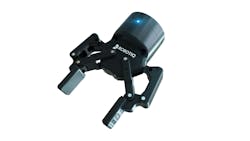
Quebec, Canada-based Robotiq, a robotics firm specializing in adaptive grippers, looks to address both physical AI challenges. In January, the company announced its TSF-85 tactile sensor fingertips designed for the company’s 2F-85 adaptive gripper.
Each sensor pad incorporates 28 taxels (tactile pixels), laid out in a 4×7 grid, that individually measure grip force on a scale from 0 to 225N. Interpreting the feedback from this array could allow an AI to discern an object’s shape, where it is gripping the object and how force is distributed across the object’s surface, says Robotiq AI Specialist Jennifer Kwiatkowski.
In addition, she says the pads can also detect vibration up to 1,000Hz, allowing for the real-time detection of the micro-slips that proceed dropping an object. In turn, this could trigger a physical AI model to dynamically re-establish a stable grasp.
“And then there’s proprioception, or getting the actual orientation of the fingertips,” Kwiatkowski says, whose Ph.D. research focused on robotic perception and machine learning. “For the 2F-85 gripper, since it has one actuator and there is a mechanical element that causes the fingers to pinch or encircle an object, you don’t have any way to know where those fingers are exactly. So our tactile sensors include an IMU [Inertial Measurement Unit] that signals where the fingertips are, relative to the robot arm and its surroundings.”
“With these tactile sensor capabilities, we try to provide the tools that humans use for grasping, and make them available for robotic models to learn what is a ‘good’ grasp, what is a ‘bad’ grasp, what is slip, etc.,” she adds.
For all the sophistication of the TSF-85 tactile sensor, Kwiatkowski is quick to affirm the value of the common two-fingered gripper. She says that while anthropomorphic mechanical “hands” are impressive, their multiple finger joints may introduce a fragility, and resulting maintenance burden, ill-suited to industrial applications.
Added to this, she points out that training a physical AI model to autonomously manipulate a robotic arm’s six degrees of freedom is challenging enough; adding 15 more from the collective finger joints in an anthropomorphic robot hand only kicks the level of difficulty that much higher.
“The whole goal of physical AI is to have robots that are adaptable, as well as easy to program, use and deploy,” she says. “The thing that’s getting highlighted right now is the software, but Robotiq’s ethos is to offer a mechanical design intelligent enough to enable adaptive gripping.”
“A parallel gripper is robust and easy to control, but as soon as you’re dealing with a logistics application with 700 different objects you want a robot to pick and place, you’ll need a gripper that can encompass and establish a stable grasp,” she adds. “Having the ability to do that mechanically, without having to develop software to do it, gives a huge advantage that reduces all of those downstream costs of using a robot.”
As close as AI robotic systems are to matching the reliability and utility of other industrial components, they differ in one significant respect: A servo motor’s or a PLC’s features and performance remain largely static over time; meanwhile, physical AI models, by their nature, tend to get faster and more capable.
In a sense, the factory floor becomes an AI research lab. Each cycle of an industrial AI’s operation adds another chunk to the data set. Collecting those chunks, from multiple installations, produces a continuous stream of fresh training data that fuels the next physical AI model upgrade. This virtuous cycle suggests that while industrial AI robots may be just crossing into production-readiness now, their utility and capability could compound faster than forecasts predict.
About the Author
 Mike McLeod
Mike McLeod
Senior Editor, Machine Design
Mike McLeod, senior editor of Machine Design, is an award-winning business and technology writer with more than 25 years of experience. He has covered the full spectrum of mechanical engineering, from industrial automation, aerospace and automotive, to CAD/CAE, additive manufacturing, linear motion and fluid power.
Voice Your Opinion!
To join the conversation, and become an exclusive member of Machine Design, create an account today!
 Leaders Logo
Leaders relevant to this article: