Robotic Hands: Translating Neural Impulses into Precise Movements
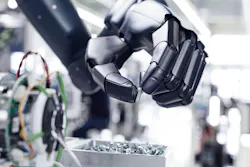
Hands are remarkable tools, translating thought into action by allowing us to grasp, feel and manipulate objects. They also connect the body to the environment, converting neural signals into precise movements.
In robotics, the same idea applies. The end effector (or gripper) is the robot’s point of contact with the world, critical for tasks that require dexterity and precision. As such, their design and construction requires significant attention and precision, especially in manufacturing applications that often entail a wide variety of specific jobs.
However, the limited adaptability of traditional grippers often introduces inefficiencies, especially when robots must switch tools to perform different tasks. Two-finger grippers, for example, are ideal for small objects but struggle with large or irregularly shaped objects. Similarly, suction grippers are adept with large items but require smooth, flat surfaces to function effectively; jaw grippers need enough clearance to fully handle an item.
These constraints force robots to rely on multiple grippers to complete different tasks. Each tool change slows operations, reduces productivity and prevents manufacturing systems from reaching their full performance potential.
The Adaptable End Effector
To address these challenges, manufacturers are seeking more universal and adaptable end effector designs. Among them, the human-like, or anthropomorphic, gripper stands out for its dexterity and ability to perform a wide variety of tasks.
The human hand can interact with a range of different objects—an advantage that combines flexibility, sensory perception and strength within a single tool. Human hands also take in real-time information about pressure, texture and weight to make adjustments on the spot. Fingers and thumbs discover ways to grasp, rotate and precisely position objects of any size, texture or shape.
Replicating the human hand’s natural versatility greatly enhances the functionality and adaptability of an anthropomorphic end effector compared to a traditional gripper. With them, robots will be able to perform tasks at higher speeds and with greater sensory control. Robots will also gain greater reliability in grasping, rotating and positioning different objects while dynamically adjusting to each task.
Additionally, their fingers will most likely be integrated with sensors that measure pressure, force and touch. This allows real-time feedback to fine-tune its grip, handle components gently and maintain stable control of heavier or irregularly shaped items.
Creating an anthropomorphic hand requires real-time control and a physical AI model that enables the hand to properly perform a task. To train that model, two types of machine learning (ML) techniques are commonly employed—reinforcement learning (RL) and imitation learning (IL). These ML approaches allow an anthropomorphic hand to learn coordinated behaviors rather than relying on hand-coded motion for every joint.
Reinforcement Learning
In the same way large language models (LLMs) improve through continual training, robotic hands refine their performance by interacting with the environment and evaluating outcomes over time.
As the AI system improves, reinforcement learning allows the anthropomorphic hand to become more efficient at completing assigned tasks. It uses continuous streams of sensory feedback such as pressure, force, shape, texture, images and weight to automatically adjust finger motions, joint coordination and grasp. This enables the hand to self-adjust instead of depending on rigid, predefined routines.
When it comes to addressing the dexterity of the hand, manufacturers no longer have to program every single joint individually; the system learns joint hand coordination as a single behavior. Human-like dexterity in the anthropomorphic hand comes from its ability to control multiple joints based on what it’s learning from the sensory feedback. As the system practices grasping and manipulating tasks, it collects experience data that helps it improve coordination, efficiency and reliability over time.
Using RL, the hand performs repeated grasping motions and receives real-time feedback about whether the action was successful. During each try, the system records the data pertaining to joint angles, fingertip pressure distribution, contact points and object movement. The controller then analyzes this data and is able to refine and optimize future movements.
Because the hand operates in a loop, it can make on-the-fly adjustments, such as tightening grip strength, shifting contact points or changing joint trajectories without needing new commands. This gives the hand a degree of autonomous problem-solving, enabling it to adapt to changes.
Through continuous practice and learning strategies like RL, the hand steadily improves its manipulation abilities. The result is human-like dexterity built from precise joint control, constant feedback and real-time adaptation.
Imitation Learning
The physical AI model that controls the robotic hand doesn’t solely rely on RL and fingertip touch sensors. While those components are essential for the hand’s AI to learn about adjusting grip forces, additional sensing technologies are often required to achieve reliable, human-like manipulation.
In IL, human motion is captured using various methods, including sensor-embedded gloves, to help robots learn real, human-like movements. These recordings become training data that the hand control algorithms are able to learn, replicate and refine.
By combining tactile feedback with data gathered from these external sensing systems, the hand can learn motions like grasping and manipulation without needing to use trial-and-error alone to discover the correct behavior. This integration of tactile sensing and external sensing technologies allows the hand to benefit from both its own experience (i.e., RL) and human demonstrations (i.e., IL), significantly improving its adaptability and dexterity.
The more adaptable the end effector is, the wider its range of applications becomes. While conventional grippers are limited to predefined tasks, the anthropomorphic hand enables flexible handling, automation of complex assembly processes and precise grasping of delicate or irregularly shaped objects.
An anthropomorphic hand working as a universal gripper can reduce workload, increase precision and accelerate production. By continually refining its sensors and motion algorithms in the AI system, this technology remains at the forefront of robotics innovation to combine flexibility, precision and adaptability.
About the Author
 Shomit Manapure
 Shomit Manapure
General Manager, Agile Robots North America
Voice Your Opinion!
To join the conversation, and become an exclusive member of Machine Design, create an account today!
 Leaders Logo
Leaders relevant to this article: