Beyond the Collision: Why Dynamic Stability is the Next Frontier in Humanoid Safety
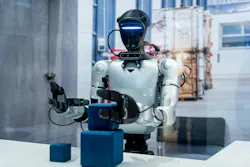
The transition of humanoid robots from the laboratory to the industrial floor represents a fundamental change in physics. As we prepare to deploy these systems at scale, we must address a growing gap between 20th Century safety standards and the realities of 21st Century mobile robotics.
Current standards, such as ISO 10218, were primarily designed for stationary industrial arms. These systems are typically bolted to the floor, where safety is a matter of defining a fixed work zone, managing discrete pinch points and placing a fence around the robot. But when you detach a 150-lb system from the floor and give it 20+ degrees of freedom, the traditional approaches to functional safety reach their limit.
The Physics of Motion: Momentum vs. Torque
With traditional robots, a safety event is usually a collision. We can reduce this risk through power and force limiting (PFL) or geofencing. But for a high-mass humanoid, a loss of stability is a far more complex event than a simple contact incident.
When a humanoid is no longer upright and controlled, its safety profile changes. A stationary arm can typically be brought to a safe state by simply cutting power. A humanoid, on the other hand, is often dynamically unstable except during locomotion. This means that cutting power to the motors will cause a dangerous fall, potentially more dangerous than the hazard that originally required the stop.
This is a critical distinction for mechanical engineers. In a fixed-base robot, the mass is anchored; in a mobile humanoid, the center of gravity (CoG) is always moving.
If we execute a standard Category 0 E-stop on a walking humanoid, we may actually make the situation worse. By cutting power, we take away the robot’s ability to catch itself or execute a controlled descent. In this scenario, the engineering objective shifts from stopping the motors to managing momentum in three-dimensional space. We need to account for the robot’s orientation and deceleration to maintain the safety of the surrounding workplace.
Degrees of Freedom vs. Deterministic Safety
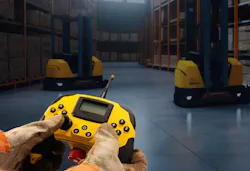
Mechanical engineers are accustomed to managing pinch points on machines with predictable paths. However, a humanoid with a high degree of freedom (DoF) offers a near-infinite array of potential configurations. Traditional safeguarding methods, such as physical barriers or light curtains, are impractical for a mobile robot intended to traverse a dynamic facility.
The industry has long relied on deterministic safety: if X happens, perform Y. But humanoids operate in a probabilistic world. Because these robots often leverage physical AI and machine learning for navigation and motion planning, their movements can be non-deterministic. If a robot pivots its torso while navigating an obstacle, its stability envelope changes instantly.
This demands a shift from reactive safety to proactive, distributed safety. We need standards that account for the robot’s stability envelope in real time, moving toward a model where safety is a continuous conversation between the machine and its environment rather than just a static, physical fence.
Context-Aware Safety
One of the most pressing technical hurdles in robotics remains the friction between high-level autonomy and low-level safety. In a complex, dynamic machine, the limitations of traditional functional safety are glaring.
Currently, most safety layers lack a sophisticated understanding of the state of the robot, its environment and its goals. This lack of nuance forces the system to default to an assumption of the worst case, a reality that rarely exists but results in an overly conservative system that constantly restricts safe, productive behavior.
To solve this, we must move beyond the binary safety models of the past. The challenge isn’t merely separating safety from navigation, which is already common practice, but rather addressing the fact that current safety systems are too simplistic for the complexities of modern physical AI. We must adopt an architecture of layered criticality.
This context-aware approach introduces a sophisticated middle layer that understands environmental intent. By establishing multiple levels of safety response, we reduce the reliance on the simplest and most brutal stop conditions. The result is a mechanical nervous system that doesn’t just shut down when it’s confused, but instead maintains a safe state through nuanced, real-time risk determination, allowing the robot to keep moving without compromising on-site safety.
Closing the Regulatory Lag
As a member of the US TC299, the official body of American experts that advises ISO in the development of robotics safety standards, I see the gap between innovation and regulation directly. From that vantage point, the friction is undeniable: we are currently asking 21st Century physical AI to comply with safety philosophies designed decades ago for static, caged machines. To unlock the true potential of autonomous systems, we must evolve our protocols beyond binary hardware stops and toward a dynamic safety fabric.
This architecture replaces all-or-nothing responses with a layered approach to risk, prioritizing both human safety and operational continuity through three core pillars:
Multi-layered and mixed criticality. Modern safety architectures must scale with the complexity of the system. We are moving away from static halos and toward safety zones that calculate risk mathematically in real time. By factoring in instantaneous velocity, floor friction and the center of gravity (CoG) height, the safety fabric creates a predictive buffer. This allows the machine to modulate its gait or path, shifting into a slow-approach mode before a hazard becomes a crisis, rather than triggering a jarring, high-inertia E-stop that risks mechanical strain or downtime.
Contextual awareness and API-first orchestration. Safety systems require a sophisticated understanding of the dynamic environments in which they operate. We are advancing toward an API-first safety architecture where the machine checks in with a site-wide controller for context-aware authorization.
This allows a robot to be granted access to specific zones based on real-time human density and task criticality. If a zone becomes crowded, the safety fabric automatically throttles performance to a collaborative level, maintaining productivity without requiring a manual reset or a total system shutdown.
Modularity—safety as a networked utility. The future belongs to multi-role, multi-mission humanoids, which demand modularity in both payload and AI. Safety can no longer be an isolated hardware function; it must be a networked utility.
Through deterministic wireless links, the robot maintains a constant heartbeat with its environment. This allows the machine to signal stability warnings to human wearables or neighboring units milliseconds before an instability occurs. By communicating intent, we replace sudden, blind stops with coordinated, aware transitions.

The Road Ahead
Humanoids offer a real path to flexible automation, but they won’t move past the pilot phase without a different approach to safety. We’ve already seen these robots walk, lift, run and jump. The next challenge is making sure they are predictable. We need to build the reliability required for a high-mass machine to operate in a busy environment without becoming a productivity obstacle.
As we look toward 2027, the industry must pivot from basic collision avoidance toward inherent dynamic stability. High-mass, high-velocity robots are no longer experimental—they are operational realities. To scale these systems, our safety protocols must evolve into a safety fabric that scales proportionally with the risk and the complex capabilities of physical AI.
We must move beyond the brutal stop conditions of legacy hardware. By adopting mixed-criticality architectures, we allow the safety system to distinguish between a minor course correction and a life-critical intervention. This shift treats stability as a real-time engineering variable rather than a binary state.
Only by prioritizing this level of nuanced, context-aware safety can we transform high-mass autonomous units into the reliable, high-uptime assets the global supply chain demands.
About the Author
 Nathan Bivans
Nathan Bivans
Chief Technology Officer, FORT Robotics
Voice Your Opinion!
To join the conversation, and become an exclusive member of Machine Design, create an account today!
 Leaders Logo
Leaders relevant to this article: