Integrated Actuation is Key to Affordable Humanoids—Schaeffler's Hermes Award Win Shows Why
An unexpected player in the race to make humanoids affordable has earned one of the industry’s top honors by winning the Hermes Award at Hannover Messe 2026.
Shaeffler’s rotary actuator platform featuring planetary gear sets was recognized for outstanding innovation at the intersection of mechanical engineering and artificial intelligence. The win points to a shift in the way humanoids are manufactured.
For years, humanoids have shown what is possible in demos. But high costs have stalled scaling. And the limiting factor is neither vision nor software. It comes down to the joints.
More precisely, actuators give robotic limbs their motion and dexterity. According to Schaeffler’s estimation, actuators account for about 50% of a humanoid robot’s total bill of materials. That single figure explains why capable machines have remained prototypes rather than production floor assets.
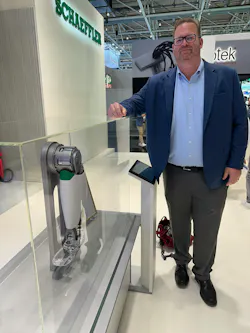
Humanoid Robot Drive Systems Designed for Replication at Industrial Scale
“Our Hermes award-winning actuator platform is extremely relevant and important for the humanoid industry,” said Dave Kehr, President of Humanoid Robotics at Schaeffler. “Actuators are really the muscles of humanoids and there are different types—rotary and linear.”
The actuator platform is built with a modular design approach. Instead of developing unique parts for each joint, a shared platform can be adapted across different applications, helping to reduce development time and unit cost, explained Kehr.
The design uses rotary actuators to deliver precise, high-torque motion in key joints such as shoulders, elbows and knees, enabling more natural movement in humanoid systems. It is based on efficient electric motors with integrated power electronics and encoders and can be configured with either two-stage planetary gears or shaft-mounted gear units depending on application requirements.
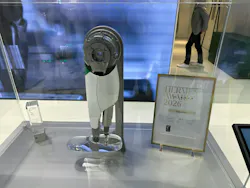
A Compact, Torque-Dense Rotary Actuator for Humanoid Applications
As humanoid systems move toward higher production volumes, capacity and scalability are emerging as key constraints. To this end, Kehr noted that Schaeffler has refined its methods by replacing traditional machining with metal forming in suitable components.
Schaeffler, a motion technology company, has been working with metal forming for over 80 years. It can shape metal parts directly instead of producing them through traditional machining processes. Typically, making parts requires expensive machining equipment that remove material step by step, but Kehr explained that Schaeffler’s forming process instead reshapes metal into the final part, reducing reliance on costly machines.
What stands out about this approach is that it reduces equipment costs without compromising part performance. “Machining processes often involve long cycle times, taking minutes to produce a part,” Kehr said. “In contrast, forming reduces cycle times to seconds. That’s where Schaeffler can add real value to the industry.”
The actuator platform is highly relevant to the humanoid industry, where actuators function as the system’s muscles, noted Kehr, adding that the platform spans both rotary and linear architectures and harnesses an approach built on Schaeffler's decades of cross-domain expertise. “That experience is consolidated into a compact, torque-dense actuator solution tailored for humanoid applications,” he said.
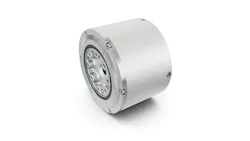
A Compact, Torque-Dense Rotary Actuator for Humanoid Applications
As humanoid systems move toward higher production volumes, capacity and scalability are emerging as key constraints. To this end, Kehr noted that Schaeffler has refined its methods by replacing traditional machining with metal forming in suitable components.
Schaeffler, a motion technology company, has been working with metal forming for over 80 years. It can shape metal parts directly instead of producing them through traditional machining processes. Typically, making parts requires expensive machining equipment that remove material step by step, but Kehr explained that Schaeffler’s forming process instead reshapes metal into the final part, reducing reliance on costly machines.
What stands out about this approach is that it reduces equipment costs without compromising part performance. “Machining processes often involve long cycle times, taking minutes to produce a part,” Kehr said. “In contrast, forming reduces cycle times to seconds. That’s where Schaeffler can add real value to the industry.”
The actuator platform is highly relevant to the humanoid industry, where actuators function as the system’s muscles, noted Kehr, adding that the platform spans both rotary and linear architectures and harnesses an approach built on Schaeffler's decades of cross-domain expertise. “That experience is consolidated into a compact, torque-dense actuator solution tailored for humanoid applications,” he said.
Vertical integration plays a significant role as a differentiator. The integration of bearings into the rotor reduces installation space by around 20% and cuts weight by up to 500 grams. As a result, the actuator is up to 10 millimeters more compact than comparable solutions, while still delivering high continuous torque. By reducing and combining these interfaces, the design minimizes packaging constraints while improving system cohesion across mechanical and electronic subsystems, according to Schaeffler’s press notes.
Replicated across a humanoid’s full set of joints, these specifications translate into meaningful gains in payload capacity and energy efficiency. In mobile, battery-powered systems, actuator weight directly increases energy consumption. Reducing both size and mass improves efficiency.
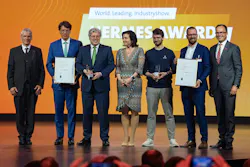
Presenting the Hermes Award Winners at Hannover Messe 2026
An independent jury chaired by Prof. Dr.-Ing. Holger Hanselka, President of the Fraunhofer Society, chose Schaeffler as the winner from three nominated companies. The award was presented by Dorothee Bär, Federal Minister for Research, Technology and Space, during the opening ceremony of Hannover Messe on April 19, 2026, attended by Federal Chancellor Friedrich Merz.
The runners-up were Festo and Ziehl-Abegg. Festo developed integrated multi-layer plastic manifolds for controlling, dispensing and mixing liquids. The solution combines active functions (mixing, dosing, valve control) and embedded sensors (flow, pressure, temperature, pH, color) in a highly compact system.
Ziehl-Abegg developed a high-performance synchronous elevator motor that eliminates the need for rare-earth magnets. The motor uses ferrite magnets instead of materials such as neodymium or dysprosium for a more sustainable and widely available material approach.