Flipping Cooling Tower Design
Key Highlights:
- Harold Curtis's practical experience identified key shortcomings in traditional cooling tower designs, inspiring innovative solutions.
- The self-cleaning Spin-Free nozzle reduces clogging and maintenance, improving operational efficiency.
- The FlowThru Basin design minimizes algae and Legionella growth by suspending solids and utilizing external filtration.
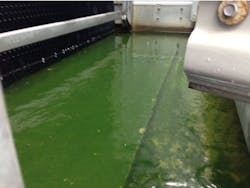
Harold Curtis knows cooling towers. His hands-on experience from the bottom up working on them—first as a laborer, then a field foreman and lead superintendent for major cooling tower companies in the 60s and 70s—gave him direct experience with the many opportunities for improvement in conventional counterflow and crossflow designs.
This led Curtis to develop the Tower Tech modular cooling tower, which turned the cooling tower industry very literally upside-down. Here’s how this tower design came to be and how it improves on conventional designs.
Tower Development
By the late 1980s, Curtis had spent many hundreds of hours using bent coat hangers to unclog the scale from tower nozzles and wading into tower sediment basins to clear out the muck, sludge and mud. He even survived a 30-foot fall from the top of a tower—an unfortunately common occurrence for cooling tower maintenance workers.
Why were these unpleasant, even hazardous, conditions considered “business as usual” for cooling towers? Curtis was determined to find a design solution that could raise the bar for common tower shortcomings.
He started with the clogged nozzles. Cooling tower designs rely on nozzles that spray water over the tower fill media, maximizing heat transfer for the air passing through the tower. Efficient nozzles can mean faster, more efficient cooling, while clogged nozzles can reduce cooling efficiency or stop it altogether. And clogged nozzles are a very common problem in cooling towers: Scale build-up or debris in the water can partially or completely block the nozzle aperture.
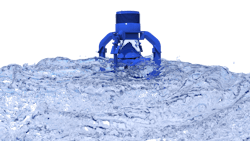
The solution was a self-cleaning nozzle that delivers complete fill media coverage. Decades before 3D printing, prototyping was a painstaking, handheld process. With his pocketknife, Curtis would carve blocks of plastic in search of the perfect angles to use the energy of the water to rotate a small turbine/disk that would fling away, rather than gather, debris from the nozzle.
He would take the prototype out in a rowboat on the pond behind his home and watch the nozzle work, looking for the perfect square spray pattern on the pond surface. After countless iterations, the Spin-Free spray nozzle was born.
The basin was his next challenge. The residual solids left behind in a tower’s sediment basin make the perfect environment for Legionella growth and algae build-up, presenting a painstaking, hazardous expense. Curtis rejected the “necessary evil” of sediment basins, founding his new design on the premise that filters and separators were a much better approach to isolate solids before water enters the tower.
By incorporating a double-walled basin as an integral part of the tower bottom basin wall, water could move rapidly around the cooling tower perimeter at a high velocity (5 to 7 fps), keeping solids in suspension rather than letting them settle out as they do in a traditional stagnant sediment design. Getting rid of the external basin altogether, the design would use just enough water to ensure appropriate cooling, keep the solids suspended and use external filtration and or separation to remove solids.
The resulting FlowThru Basin was perfected in the early 2000s. This design effectively reduces algae and Legionella growth potential to zero and has an ultra-low debris entrapment rate compared to conventional crossflow and counterflow tower designs.
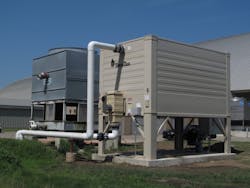
Next was a safety-first design. Cooling towers are very tall, sometimes 30 or more feet off the ground, and essential tower components like fans are located at the very top. This creates very dangerous conditions for maintenance workers, as Curtis knew firsthand. The top-mounted fans also maximize drift, the water-and-chemical mist expelled from cooling tower operations, which is inefficient and can cause damage to cars, buildings and vegetation near the towers.
Curtis’s solution seemed impossible: flipping the tower upside-down. Locating the fans on the bottom of the tower would enable a shorter overall tower height and would relocate essential maintenance to the tower’s grade level. This would make maintenance significantly safer and would eliminate the need to use large cranes to swap out motors or fans from the top of the tower.
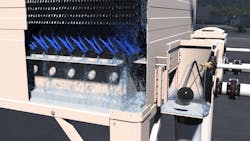
To mount the fans on the tower’s bottom—underneath the water flow—required careful engineering and precision to create the water collector that operates over the fan in a vertical configuration. He developed an overlapping chevron-type channel that goes over the top of the fan motor across the tower. This would capture the vertically falling water, allowing it to fall into the FlowThru basin while also allowing air to pass through into the fill media above the water collector.
The result was a wet/dry barrier: wet stayed above the collector, and below, the motor operated in the cool, dry air stream. In addition to capturing 100% of the water and diverting it to the side of the fans/motors the design allows air to pass simultaneously up into the fill media, maximizing heat rejection.
Noteworthy Design Improvements
Tower Tech’s upside-down design has created significant design improvements over conventional crossflow and counterflow tower models, including:
An industry-leading drift rate. The Cooling Technology Institute is the certifying body for cooling towers. They demand cooling tower technologies at lease meet a drift rate of 0.005% maximum drift per total circulated water flow. The upside-down design goes far beyond this rate, delivering a 0.0004% drift rate.
A lower vertical profile. The design reduces the tower height to 12 feet without legs (plus a minimum air opening of four feet up to 12 feet underneath the tower, depending on customer preference). Nearly all maintenance can be performed from grade level, but in the event a technician must scale the tower, it’s substantially closer to the ground than conventional towers. The smaller “box” of the design also maximizes heat exchange.
More, smaller, bottom-mounted fans. Whereas conventional towers rely on one to three very large, top-mounted fans, this design uses up to 12 much smaller, bottom-mounted fans. This delivers greater redundancy in the event a motor or fan goes offline or requires service, and reduces the overall weight of each individual fan, making maintenance and replacement simpler and safer.
A smaller overall width. The bottom-mounted fan design eliminates side louvers for air intake, cutting the required freeboard space by 6-12 feet per tower. This means more Tower Tech units can fit in the same footprint as fewer conventional design towers.
Corrosion-resistant design. Made of fiber reinforced polymer (FRP) instead of metal, the towers inherently resist corrosion, both inside and out, maximizing service life and avoiding unsightly rust.
Lighter overall weight. The FRP design also significantly reduces the overall tower weight. This enables the tower to be factory-preassembled and delivered to the site in one piece and lifted into place with a crane—versus metal towers that require on-site assembly. The lighter weight also means less rooftop reinforcement is needed to support the tower.
The Lessons of Upside-Down Innovation
A lot has changed since Harold Curtis sat with his pocketknife in hand, whittling his hundredth nozzle prototype. The talented design engineers have taken these innovations and continued to improve them to make these towers the very picture of sustainable efficiency. Even with all these advancements, the story behind the original design exemplifies some important lessons for machine designers:
- Work backward from lived experience to define opportunities for design improvements.
- Be patient as you work through design iterations. As the saying goes: “Rome wasn’t built in a day.”
- Don’t be limited by “it is what it is” thinking.
By turning our biases on their head and with good engineering, the “impossible” becomes just a matter of time.
About the Author
 Micah Curtis
Micah Curtis
Sales Director, Tower Tech
With more than 24 years of experience in the evaporative cooling tower industry, Micah Curtis, son of Tower Tech Founder Harold Curtis, has built a career defined by sales leadership, market development and a deep commitment to advancing cooling technologies. He began in frontline sales, progressed to regional sales manager and has spent the last decade as sales director for Tower Tech cooling tower products. His work has had a significant impact across HVAC, industrial and power markets, and in recent years, he has helped drive growth in emerging sectors such as data center and geothermal cooling.
Voice Your Opinion!
To join the conversation, and become an exclusive member of Machine Design, create an account today!
 Leaders Logo
Leaders relevant to this article: