Laser Welding at the Edge of the World
What You’ll Learn:
- The deployment of laser technology in Antarctica required specialized design adaptations, including low-temperature cooling systems and additional insulation to withstand subzero temperatures.
- Laser systems at Bellinghausen Station reduce dependence on consumables like electrodes and inert gases, offering resource savings and logistical advantages in remote environments.
- Rigorous testing in temperature-controlled chambers confirmed the laser equipment's stability and reliability under Antarctic conditions, ensuring minimal downtime and maintenance needs.
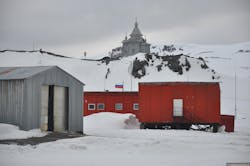
Operating laser and welding equipment in Antarctica pushes the boundaries of machine design, demanding innovations that ensure reliability, precision and ease of maintenance in one of the harshest environments.
Deploying advanced laser technology in Antarctica—a land with sustained subzero temperatures, power instability and logistical isolation—poses unique and unforgiving challenges to equipment operation and maintenance. Perhaps that is why, until now, laser welding hadn’t yet made its way to all seven continents. The deployment of Wattsan’s 30W MOPA laser marker alongside the 4in1 3000W multifunctional laser welding and cleaning system at Bellinghausen Station is a fusion of advanced laser technology and environment-specific engineering and is the first system of its kind to reach this part of the world.
The laser marker and multifunctional laser welding and cleaning system have been deployed as a testbed for how advanced technology can transform remote metal working and scientific support operations. This collaboration offers insights into overcoming extreme climate challenges, customizing critical subsystems and optimizing user training to offer practical lessons for engineers tasked with designing robust machinery for similarly unforgiving settings.
Machine Design reached out to two key players in the machines’ deployment—Viktor Evstigneev, Wattsan’s regional development engineer and its dealer Lasercut’s head of research and development, and Andrey Voevodin, the head of the Antarctic station Bellinghausen—to learn more about the adaptations, operational realities and forward-looking vision behind this novel installation.
Technical Infrastructure, Operational Environment
Machine Design learned that the station operates much like a small, self-sufficient town, housing 15-30 people through the Antarctic winters. Its infrastructure includes diesel and emergency generators that provide critical electrical power; maintaining consistent power is vital, as any shutdown risks rapid freezing throughout the facility. Some buildings have central water supply and heating systems maintained by boilers, along with sewage, ventilation and electricity networks. A range of machinery is used regularly for transport of people and cargo between locations.
Given the harsh conditions, we also learned that equipment failures are frequent and inevitable. The station team must meticulously plan to bring sufficient tools and repair materials each year, anticipating possible points of failure well in advance to ensure uninterrupted operations.
The Role and Potential of Laser Welding in the Extreme
Metal construction at Bellinghausen faces aggressive corrosion due to the maritime Antarctic climate. Corrugated metal from porch railings to fuel storage roofs demand constant upkeep. Historically, welding repairs rely heavily on consumables like electrodes and inert gases, which require careful management and can be depleted unexpectedly or complicated by shipping challenges.
Laser welding is advantageous by reducing reliance on consumables, preserving resources and minimizing the logistical burden. “Just this year, we saw that technology has advanced significantly, and laser welding will save us time and resources on electrodes that can run out at any moment or on protective circuits,” Voevodin told Evstigneev in a separate one-on-one interview that they shared with Machine Design. “Sometimes, it happens that the cargo wasn’t loaded properly, a container falls and breaks or we lose something. It's necessary to have duplicate tools, and laser welding will help us a lot in this regard.
“We need to maintain stations like Bellingshausen, where much of the construction is made of metal,” he continued. In addition to repairs, “Sometimes sledges or mechanical machines break down, and we have to make them from scratch. But mostly, it's repair work.”
As for the laser marker’s usefulness, Voevodin explained: “We are a state-funded organization. At the Bellingshausen station, due to corrosion, the paint on inventory numbers constantly peels off all our equipment. Any cargo arriving in a container needs to have proper marking. This is the main purpose of where we will use the [laser] marker,” he said, adding, “Despite our best efforts to apply proper labeling, it doesn't last long. Within a year or two, when the composition of the expedition changes, people start losing track of what’s what and which equipment is marked. If there is proper labeling everywhere, we believe it will be useful for a long time.”
Design Adaptations and Validation
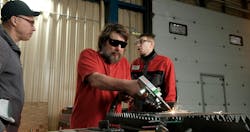
Developing equipment that is robust enough to operate reliably in Antarctica’s hostile conditions demanded extensive research and environmental testing. According to Evstigneev, the results dictated several design modifications. “The cooling circuit was adapted and filled with a low‑temperature coolant to prevent freezing, and additional insulation was applied to protect sensitive components from sudden temperature changes,” he said, noting that these improvements allow the system to operate stably outdoors in subzero conditions without the risk of performance loss.
The standard water-based coolant was replaced with a low-temperature antifreeze fluid engineered to resist freezing and corrosion over prolonged subzero exposure. The cooling circuit’s operating mode was fine-tuned to maintain stable thermal regulation, preventing both freezing and overheating. This was important for protecting the laser source and sensitive optical components from thermal stresses that could impair function or damage parts, Evstigneev said.
Additional insulation measures were applied to shield electronic components from rapid temperature fluctuations. This multi-pronged approach ensured consistent performance during sustained outdoor use in subzero conditions, a marked departure from standard industrial environments.
The laser marker, on the other hand, is intended for indoor use in a controlled environment, “so no additional modifications were necessary, as its standard configuration already ensures precise and stable operation,” Evstigneev said.
Testing protocols were exhaustive. The system was subjected to prolonged operation in temperature-controlled chambers simulating Antarctic conditions, Evstigneev noted. Parameters such as welding stability, laser power output, coolant efficiency and cold start-up performance were closely monitored.
“No performance degradation or component failures were observed,” he said. “These results confirmed that the system is capable of functioning reliably in harsh polar environments without risk of unplanned downtime.”
Operational Realities and Challenges
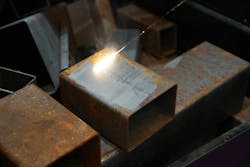
At Bellinghausen Station, metalwork such as welding, cutting and cleaning is necessary for maintaining research infrastructure, according to Voevodin. The decision to deploy Wattsan’s laser-based equipment was driven by the need to improve precision metalworking capabilities while improving working conditions for expedition personnel, he told Machine Design. The installation—including necessary voltage stabilizers and inert gases—was a foundational upgrade to support ongoing maintenance and future operational expansion.
Voevodin identified some key challenges such as the already-mentioned unstable power supply, which was characterized by frequency and voltage fluctuations within the station diesel power network. He said another significant constraint was the limited mobility of the equipment due to its size and the ancillary components (stabilizers, gas cylinders) which complicate outdoor and offsite tasks.
As a result, they are considering developing specialized mobile platforms of trailers adapted for Antarctic terrain to facilitate more convenient field operations. At the time of our interview, precision work remained limited, pending fuller integration and user familiarity with the equipment’s capabilities.
About the Author
 Sharon Spielman
Sharon Spielman
Technical Editor, Machine Design
As Machine Design’s former technical editor, Sharon Spielman produced content for the brand’s focus audience—design and multidisciplinary engineers. Her beat included 3D printing/CAD; mechanical and motion systems, with an emphasis on pneumatics and linear motion; automation; robotics; and CNC machining.
Spielman has more than three decades of experience as a writer and editor for a range of B2B brands, including those that cover machine design; electrical design and manufacturing; interconnection technology; food and beverage manufacturing; process heating and cooling; finishing; and package converting.
Email: [email protected]
LinkedIn: @sharonspielman
Facebook: Machine Design
YouTube: @MachineDesign-EBM
Voice Your Opinion!
To join the conversation, and become an exclusive member of Machine Design, create an account today!
 Leaders Logo
Leaders relevant to this article: