Choosing the Right Actuator for Press Applications: Technologies, Tradeoffs & Challenges
Key Highlights
- Hydraulic systems pose safety, environmental and maintenance challenges due to leaks, high operating costs, and energy inefficiencies.
- Electro-mechanical screw-driven actuators provide precise control but are limited by mechanical wear, stroke length and harsh environment restrictions.
- Pneumatic actuators are cost-effective and simple but suffer from air leaks, lower force capacity, and less precise control.
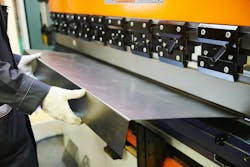
Pressing applications are at the center of countless manufacturing processes, including metal forming, component assembly, laminating & die cutting, extruding and many others. Choosing the right actuation technology for your specific pressing application is not always straightforward, and selecting the right technology can be the difference between reliable performance and constant maintenance headaches and downtime.
This technical article explores common actuation challenges engineers face in pressing applications and compares the various actuation technologies available and their tradeoffs.
A Look at Common Challenges Engineers Face in Pressing Applications
Manufacturers and engineers often face challenges in their pressing applications. The following is a non-comprehensive list; these challenges are dependent upon the actuator technology being utilized:
- Hydraulic leaks and contamination. Hydraulic fluid leaks can create safety hazards, pose environmental risks and cause product spoilage and downtime.
- Maintenance downtime and operating costs. Traditional hydraulic systems require regular maintenance as pumps, hoses and seals wear down, resulting in unplanned downtime and higher operating costs.
- Safety and ergonomic concerns. Safety risks can be caused by inconsistent force control, noisy hydraulic systems, leaks, etc.
- Energy inefficiencies. Traditional hydraulic systems run continuously at high speeds and high pressures, wasting energy.
- Shock-loading (on mechanical actuators). Screw-type actuators are highly susceptible to damage from high-impact forces in pressing applications, accelerating actuator wear, reducing accuracy and shortening the actuator life.
- Fluid and filter replacement/disposal costs. Both hydraulic and air-over-oil systems require ongoing oil changes, filter replacements and proper waste fluid disposal, leading to labor and environmental costs.
- Control challenges. Tighter process control requires more precise position and force measurement and data capture.
- Life limitations. Mechanical actuators have a finite life due to mechanical L10 wear. Once the end of life is experienced, the actuator often cannot be repaired, resulting in a costly replacement. Other actuation technologies can be repaired, extending the life.
- Oversizing force requirements. Many actuation systems are over-specified for force, resulting in wasted energy and costly actuation solutions.
Actuation Technology Options Compared
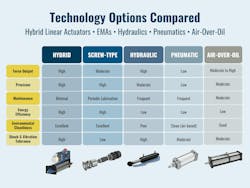
Electro-Mechanical Screw-Driven Actuators (EMAs)
Screw-type electromechanical actuators use a motor that rotates a lead screw, ball screw or roller screw. As the screw turns, it moves the nut or rod linearly to produce motion. In some EMA designs, a gearbox or belt drive is used between the motor and the screw in order to modify speed and torque.
Screw-driven actuators are an electric solution resulting in energy efficiency with power-on-demand and clean operation. Electro-mechanical actuators provide precise positioning, speed and torque, and are easily integrated with control systems. While EMAs can produce a consistent torque, they are challenged to produce a precise force with variable speeds.
While mechanical actuators offer precision and programmability, their lifespan is load-dependent (L10 life) and often must be oversized at higher costs to prolong life. Configurations of EMAs are limited by their mechanical components (screws, bearings, belts) as they wear over time due to friction and metal-to-metal contact. These mechanical components can also transfer sudden forces, known as shock loads, through the actuator, stressing components, causing position errors and accelerating wear. As a result, EMAs require regular lubrication and replacement schedules or are subject to a decreased life.
Electro-mechanical actuators are restricted even further by stroke length and ingress protection (IP) ratings, limiting use in demanding or harsh environments.
Hydraulic Actuators
Traditional hydraulic actuators (cylinders) rely on a separate hydraulic power unit (HPU) that connects via hoses to hydraulic cylinders to generate linear force. Hydraulic actuation systems are a robust solution capable of high IP ratings, high force density and handle shock loads without issue.
Downsides to hydraulic actuation systems include:
- Energy inefficiencies. These arise from constantly running pumps at maximum pressure and speed
- Maintenance and safety concerns. Violent transitions and vibration cause inevitable leaks, environmental hazards, unplanned downtime and personnel safety risks
- High operating costs. Hydraulic systems require regular fluid and filter replacement (including disposal of fluid), they do not offer integrated force measurement (must add expensive load cells), and to precisely control position and force, expensive add-on components are required
- Plant footprint. HPUs take up a large footprint on the factory floor and, once installed, they are a challenge to upgrade or modify.
Pneumatic Actuators
Pneumatic actuators use compressed air to move a piston inside a cylinder, then the rod moves in response to a pressure differential. Pneumatics are a cost-effective actuation solution if a compressed air infrastructure already exists. Simple to install and maintain, pneumatic actuators provide rapid motion, clean operation and a compact footprint.
Pneumatic actuators run into some limitations in the field:
- Air leaks can degrade performance and render them energy-inefficient.
- They are limited to lower-rated force applications.
- They provide less precise control.
- Pressure drops lead to Inconsistent operation.
Air contamination and lubrication challenges are also inherent to pneumatic actuators.
Air-Over-Oil Cylinders
Air-over-oil cylinders incorporate a fast extend stroke, slow load stroke and fast react stroke but these systems come with some drawbacks. Air-over-oil cylinders require inefficient compressed air, resulting in high energy consumption. Other inefficiencies of air-over-oil systems include unreliable control, inconsistent performance due to drifting and not holding position and high maintenance costs and downtime from contamination. Variable control is also a challenge with fixed mechanical constraints.
Hybrid Linear Actuators
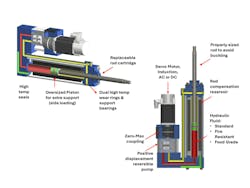
Hybrid linear actuators are a self-contained, totally sealed actuation system, integrating a motor and pump directly onto a hydraulic cylinder with a minimal amount of fluid. The fluid amount used is often less than most small gearboxes. Hybrid linear actuators combine the power and robustness of hydraulic actuators with the precision and controllability of electro-mechanical actuators while eliminating their inherent drawbacks.
Hybrid linear actuators offer advantages in pressing applications, such as:
- Energy efficiency with power-on-demand, reducing energy waste and operational costs.
- Leak free, low maintenance with a sealed, self-contained design, eliminating the need for bulky hydraulic power units, hoses or reservoirs.
- High shock load tolerance, by handling the impact forces common in pressing application without screw wear or duty-cycle limitations traditional electro-mechanical actuators experience.
- Future-ready for Industry 4.0 integration, enabling real-time monitoring, predictive maintenance and IoT capabilities.
- Programmable press profiles, supporting fast recipe changes with precise control of force, speed, position and dwell.
In addition to pressing, hybrid actuators meet the demands of new and retrofit situations across a variety of applications and industries including assembly, lifting, testing, material handling, extruding, clamping, valve control and more.
For more information on actuation solutions for pressing applications, check out the new Press Application Playbook from Kyntronics, a practical actuation guide designed to help engineers and manufacturers navigate actuation challenges, different technologies and application considerations.
About the Author
Carl Richter
VP and General Manager, Kyntronics
Carl Richter is the vice president and general manager at Kyntronics, a Cleveland-area (Solon, Ohio) manufacturing company specializing in advanced hybrid actuation solutions. With a background spanning both technical and business leadership, he drives innovation focused on energy efficiency, sustainability and system-level performance. Richter is a published industry thought leader and frequent webinar contributor, with work featured in multiple industry publications on topics including electro-hydraulic efficiency and the transition toward electrified actuation systems.
Voice Your Opinion!
To join the conversation, and become an exclusive member of Machine Design, create an account today!
 Leaders Logo
Leaders relevant to this article: