How Next-Gen Bearings Enable Lighter, Faster Designs
Key Highlights
- New geometries like gothic arch and elliptical contact profiles increase load capacity without enlarging bearing size.
- Advanced materials such as silicon nitride ceramics and hybrid steels reduce weight and improve fatigue resistance.
- High-performance cage designs and thermal management features enable higher speeds and longer service life under heavy loads.
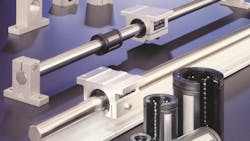
Design engineers face new challenges when building modern linear motion systems: heavier loads, faster speeds, tighter spaces, and all while being tasked with reducing weight and increasing efficiency.
Fortunately, a new generation of bearing technologies is meeting this challenge. Innovations in materials science, manufacturing precision and other technological breakthroughs let designers do more than previously possible.
Higher-load Capacity in Smaller Envelopes
The relationship between load capacity and bearing size has typically been unchangeable. A system requiring a high dynamic load capacity simply demanded a bearing of a certain minimum size. But new bearing designs are challenging this constriction.
Bearing designs have moved beyond simple circular raceway profiles to gothic arch and elliptical contact geometries that increase the load-bearing contact area. These profiles include four-point contact patterns that distribute loads more evenly, allowing higher dynamic loads in the same envelope.
Innovative Materials
Advances in materials science have allowed gains in several ways. Silicon nitride ceramic balls are becoming more common, with hardness values approaching 1600 HV, compared to 800 HV for bearing steel, and offer good fatigue resistance. Ceramic balls weigh up to 60% less than steel balls of equal size, reducing inertial loads during acceleration and enabling higher operating speeds.
Through-hardened bearing steels on raceways are seeing upgrades to case-hardened alloys and hybrid materials that combine tough, ductile core with an ultra-hard surface. Steels with controlled inclusion content show improved fatigue life under cyclic loading.
Speeds Under High Loads
At high velocities, centrifugal forces on the rolling elements become a limiting factor. When a ball bearing moves at high speed, the centrifugal forces can exceed preload forces that maintain proper ball-raceway contact, leading to ball skidding, wear and failure.
Optimal ball diameters and increased ball counts let designers reduce individual ball velocities while maintaining overall carriage speed. Advanced cage designs, such as those made from high-performance polymers, provide favorable strength-to-weight ratios compared to traditional steel cages. They also withstand harsh operating conditions while adding minimal inertial mass to the rolling element assembly.
Reducing heat from friction is another feature of innovative designs. These bearings incorporate thermal management features such as precision-machined lubrication channels to ensure lubricant flow, synthetic greases with high operating temperatures and innovative seal designs that minimize friction while preventing contamination.
Precision Advantages
The precision of a linear bearing system depends on the accuracy of its components. Modern ultra-precision grinding centers achieve surface finishes of Ra 0.01 µm on hardened bearing raceways. These “mirror-smooth” surfaces eliminate micro-asperities that could generate noise.
Ball manufacturing has similarly advanced and high-grade balls have virtually eliminated measurable cyclic error at the ball pitch frequency, which is something exhibited by previous generations of bearings.
An emerging trend in precision bearing design integrates position feedback directly into the bearing assembly. Magnetic or optical encoder scales embedded in the rail provide position information with submicron resolution, eliminating the accuracy limitations and installation challenges of separate linear encoders. These integrated systems automatically compensate for thermal expansion and mechanical deflection, maintaining position accuracy even as operating conditions vary.
For design engineers, this integration simplifies system architecture and improves overall accuracy. The encoder scale is manufactured on the same precision grinding equipment as the bearing raceway, ensuring perfect alignment between the feedback device and the actual motion. Closed-loop control systems using this integrated feedback routinely achieve positioning repeatability within ±0.5 µm precision that opens doors to applications in photonics alignment, precision assembly and advanced additive manufacturing.
Lightweight Design
The mass of moving components directly determines the forces needed for motion control and limits performance. New developments dramatically reduce mass while maintaining or even improving structural rigidity and load capacity.
Bearing carriages are increasingly substituting aluminum alloy bodies for steel construction, giving excellent stiffness-to-weight ratios while reducing carriage mass. For applications that need enhanced stiffness, aluminum matrix composites reinforced with silicon carbide deliver good performance.
Bearing rails made from carbon fiber reinforced polymer can reduce moving mass compared to steel rails while also offering thermal expansion coefficients an order of magnitude lower than aluminum. This is particularly valuable in precision applications where variations in temperature could cause positioning errors.
Self-alignment and Installation Tolerance
Achieving the tight flatness tolerances required by conventional bearings often demands skilled technicians, precision tooling and substantial alignment time. Next-generation bearing designs incorporate self-compensation features that dramatically relax installation requirements while maintaining precision performance.
Advanced carriage designs use four-way equal load ball circuits that automatically compensate for installation errors. Unlike traditional designs where misalignment creates uneven loading that accelerates wear, these self-equalizing systems distribute loads evenly across all four ball circuits regardless of mounting surface imperfections. Internal compliance elements allow each ball circuit to float independently while maintaining preload.
Some new designs incorporate spherical contact elements at mounting interfaces, allowing the carriage to automatically adjust to both angular and parallel misalignment. These systems can accommodate up to 0.5% of angular error; sufficient to compensate for most installation imperfections and even some deflection under load.
Practical Considerations
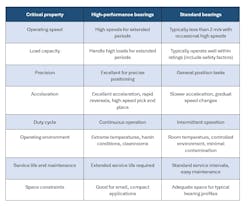
While the advantages of high-performance bearing designs are compelling, not every application requires cutting-edge technology. The key is matching the technology to the requirements: applications requiring high precision will benefit from ultra-precision manufacturing and integrated feedback systems and high-speed applications can justify costs of advanced materials and thermal management. Likewise, weight-critical applications warrant lightweight materials despite higher costs.
About the Author
Vicki Burt
Vicki Burt is a former Machine Design editor.
Voice Your Opinion!
To join the conversation, and become an exclusive member of Machine Design, create an account today!
 Leaders Logo
Leaders relevant to this article: