Bearing Selection for Linear Motion Applications
Key Highlights
- Proper bearing selection depends on load analysis, speed requirements, precision needs, and environmental conditions to ensure system reliability and efficiency.
- Ball bearings offer high precision and smooth motion, ideal for applications requiring accurate positioning and high speeds with moderate loads.
- Roller bearings are better suited for heavy-duty applications, providing higher load capacity and durability under shock and static loads.
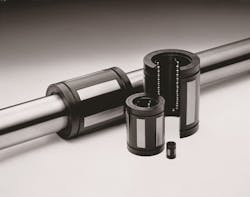
Linear motion systems are an essential part of manufacturing, automation, and precision equipment. From optical and measuring instruments to pick-and-place robot systems, the performance and reliability of these systems depend on proper bearing selection. This article talks about the difference between ball bearings and roller bearings, the primary types of bearings used in linear motion applications.
Load Capacity Considerations
For many applications, load capacity is the biggest factor in bearing selection. The ability to support required loads while maintaining acceptable stress levels directly affects bearing life, system reliability, and maintenance costs. Two kinds of loads should be considered, static load and dynamic load.
Static load capacity is how much a bearing can support when it is not moving (stationary). This is important for determining whether a system can handle shock loads, loading, and unloading. When the load exceeds capacity, raceways may develop “Brinelling” and fail prematurely.
Dynamic load capacity considers the movement of the load, as is defined as the load at which a linear guide will, with 90% certainty, achieve the targeted service life before fatigue (flaking) occurs on the rolling elements or raceways. The ISO 14728 Part 1 specification allows either 50,000 m or 100,000 m as the targeted service life when determining dynamic load capacity.
Precision and Accuracy
Many linear motion applications demand excellent positioning accuracy and repeatability. Semiconductor manufacturing, laser cutting systems and precision assembly equipment all require keeping tight tolerances.
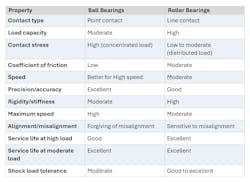
The spherical geometry of ball bearings gives them superior precision capabilities over roller bearings. High-precision ball bearing guides can achieve positioning accuracies of ±2 to 5 mm, with some sophisticated designs reaching sub-mm levels. The spheres center themselves naturally in the raceway, providing consistent positioning, and additionally, preloading allows engineers to eliminate clearances and optimize stiffness without significantly increasing friction.
Roller bearings achieve good precision, with positioning accuracies generally in the ±5 to 10 mm range. The cylindrical geometry of rollers makes them sensitive to manufacturing variations. However, in many applications, this level of accuracy is adequate and a good tradeoff for handling higher loads.
Ball Bearings
For precision applications with moderate loads and high-speed demands, ball bearings typically are the optimal choice. Examples include precision machine tools, measuring equipment, and electronics assembly systems, where positioning accuracy and smooth motion are important.
The rolling element is spherical balls, and they rotate on more than one axis. This means they can handle pure radial loads, pure axial loads, and combined radial and axial loads. The bearings consist of an outer ring, inner ring, steel balls, and cage. Common types of ball bearings include deep groove, angular contact, thrust ball, and self-aligning.
Because they have a small contact area (point contact) with the load, there is low friction and smooth rotational motion. This small point contact also makes them not usually great under heavy loads, and they are often used for high speeds and lighter loads. Some designs, including a type of self-aligning bearings from NB Corp. have a unique design that lets it carry heavier loads. The load plate of the Topball Ultimate series provides circular arch contact to the ball element, resulting in greater dispersion of the load. This gives up to three times the load capacity of conventional ball bushing designs.
Ball bearings are typically good for:
- High-speed operation
- Maximum precision and repeatability
- Smooth, quiet motion
- Lighter load applications
Roller Bearings
Heavy-duty applications with high loads, lower precision requirements and moderate speeds benefit from roller bearings. Press equipment, large gantry systems and heavy material handling equipment are a few applications where load capacity and stiffness justify the sometimes higher cost of roller bearings.
Cylindrical rollers (also tapered, needle shaped, or spherical) create the motion. The rollers are positioned between inner and outer rings, giving them larger contact surface area having line contact instead of point contact. The cage keeps the rollers evenly spaced which distributes the load more evenly.
Roller bearing systems are typically limited in movement and not always ideal for axial loads. They are prone to misalignment compared to ball bearings and common challenges include noise from rollers, cage, and raceways interacting, leading to wear and friction; vibration because dynamic forces cause the rollers to move along with misalignment from unbalanced loads; premature failure usually due to excessive stress and wear; lubrication (having too little); and contamination.
In high-load applications, roller bearings typically outlast ball bearings due to their lower contact stresses. The relationship between contact stress and fatigue life is exponential, so the reduced stress in roller bearings translates to substantially longer life expectancy. Applications operating near rated capacity particularly benefit from the advantage of roller bearings’ durability.
Roller bearings are typically good for:
- Heavy-load capacity
- Resistance to shock loads
- Frequent start/stop cycles under load
- Maximum rigidity and stiffness
Questions Engineers Should Ask
When specifying bearings for linear motion applications, consider these deciding factors:
Load analysis:
- What are the maximum static and dynamic loads?
- Are there shock loads or impacts?
- Does the application need to hold heavy loads while stationary?
Motion specs:
- What speeds are required?
- Does the system need to start and stop frequently?
- Is acceleration/deceleration rapid or gradual?
Precision and performance:
- What level of positioning accuracy is needed?
- Is repeatability important?
- How much deflection under load is acceptable?
- What are the noise or vibration constraints?
Operating environment:
- Will the system operate in harsh conditions (moisture, temperature extremes, dirt and grease)?
- What is the available space?
About the Author
Vicki Burt
Vicki Burt is a former Machine Design editor.
Voice Your Opinion!
To join the conversation, and become an exclusive member of Machine Design, create an account today!
 Leaders Logo
Leaders relevant to this article: