Linear Encoder Showdown: Wired vs. Wireless Read Heads
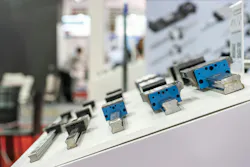
In automation, precision and reliability are no longer optional; they are requirements. For a wide variety of machine types and processes, linear guides provide that accuracy and high-capacity travel. In the most demanding applications, linear position feedback is often needed to ensure the tool, gripper or workpiece follows an exact path or reaches a precise position.
Traditionally, separate encoders were added to linear guideways to ensure positional accuracy. Today, linear guideways with built-in encoders are becoming the preferred choice for precision motion—especially in modern CNC machines, robotics, semiconductor tools and medical equipment—because they integrate motion guidance and position feedback into a compact, efficient system that reduces complexity and improves performance.
An integrated linear measuring system is very similar to a conventional linear encoder, but with the scale mounted onto the rail and the read head mounted onto the carriage. The scale is conventionally mounted in a groove machined into the side or upper face of the rail with a cover to protect against water ingress, dust or debris.
The other key element of this system, the read head, detects the scale pattern and converts it into usable position data. These read heads can be either wired or wireless, each with distinct advantages and limitations.
Wired read heads, for example, receive power and transmit analog or digital signals via the same wiring harness. As such, they are compatible with most standard motion controllers and provide stable signal transmission, unaffected by wireless interference.
On the downside, cable routing in multi-axis system can be complex. In addition, the wire harness is susceptible to cable fatigue or signal noise over long runs. Wired read heads may restrict system flexibility and increase maintenance requirements as a result.
Relatively new encoder designs use wireless read heads. Position data is transmited to the controller via radio waves or an optical wireless link, eliminating the need for cable carriers or protective conduits. They can also be powered by multiple means, including a battery, energy harvesting or inductive power transfer.
With no need for cable management and fewer physical connections, wireless read heads reduce cable complexity and lower maintenance. They are also ideal for long travel, rotary stages and modular machine setups.
They do incure a higher initial system cost, though, especially for battery-based heads that require power management. They can also suffer from potential signal interference in noisy industrial environments.
One of the most promising technologies is the cable-free read head capacitive linear encoders by Kappasense. Instead of using optical scales or magnetic scales with a cabled read head, these systems measure capacitance changes between a patterned scale and a cable-free sensing read head.
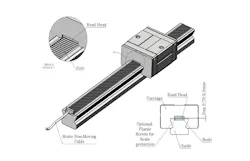
Unlike optics, magnetic or inductive encoders, capacitive linear encoders possess a high resistance to contamination, in that they are unaffected by oil, dust or coolant, and aren’t influenced by magnetic fields. They’re also energy-efficient, requiring very little power, and their compact form factor makes them ideal for embedded guideway systems (including miniature devices).
Given their advantages, linear guideways with capacitive linear encoders excel in high-speed automation systems where an optical or magnetic encoder would fail due to dirt, oil or change of gap as effect of vibration. Similarly , they are well suited to cleanroom applications and medical devices, as well as in semiconductor tools where ultra-precise, low-maintenance feedback is critical.
Linear guideways with built-in encoders are transforming precision motion systems by combining guidance and feedback in one package. Wired read heads remain a reliable, cost-effective solution, but wireless read heads bring advantages in design flexibility, reduced maintenance and long-term reliability.
Cable-free read head capacitive absolute linear encoders by Kappasense represent the next step forward—delivering contamination and magnetic-field resistance, compact integration and high reliability. As Industry 4.0 adoption accelerates, this technology is poised to become a key enabler of smarter, cleaner and more efficient precision systems.

About the Author
Michael Driker
Project Leader, Kappasense
Michael Driker is a mechanical engineer and project leader at Kappasense.
Voice Your Opinion!
To join the conversation, and become an exclusive member of Machine Design, create an account today!
 Leaders Logo
Leaders relevant to this article: