Why Ball Splines Matter: The Motion Control Technology Behind Precision Machines
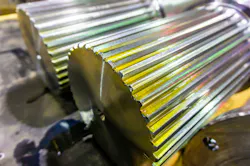
The ball spline, now 55 years old, is a motion component that has stood the test of time but has not stood still. Indeed, in recent years, this innovation has evolved with sizes and designs that allow it to take on very demanding applications—and those applications continue to expand with advances in groove profiles, weight reduction and more.
The first ball spline was developed in 1971 by THK as a precursor to linear motion guides. Ball splines combine with smooth linear motion (precise axial movement along a shaft) with low-friction torque transmission in a single mechanism.
Ball splines consist of balls circulating along one or more machined splines (axial grooves) on the shaft, all contained inside a retainer. The balls travel smoothly and efficiently along the length of the shaft, meeting low resistance. (For more background, see “5 Essential Facts About Ball Splines for Engineers.”)
The torque transfer and smooth linear motion offered by ball splines make them especially suitable for applications that require both rotational and sliding movements under load.
As Yoshinori Murakami, Manager of Corporate Engineering at THK America, explains, “the biggest advantage of ball splines over other shaft-type linear motion products has always been the higher load capacity without motion quality compromise.”
Current Application: Ergonomic Lift Assist Torque Tube
One current use of ball splines is in ergonomic industrial equipment such as torque-reacting lift-assist systems used on assembly lines.
Specifically, “torque tube” lift assist systems suspend an electric or pneumatic nut runner tool for tightening bolts, explains Pablo Olachea, Strategic Marketing Manager, Regal Rexnord – Linear Motion Division.
“Inside the telescoping torque tube, a medium-to-high torque ball spline serves as the guide,” he says. The spline allows the tool to be moved up and down freely by the operator, but it resists any rotation, thereby absorbing the tool’s reaction torque (which can be hundreds of N·m). In this application, the ball spline essentially functions as a linear bearing that prevents rotation.”
READ MORE: Bearing the Load in Rotary Ball Spline Design
Spline shafts in these scenarios typically have four grooves along their length, matched to a reinforced spline nut with recirculating balls. This provides zero rotational play and smooth vertical travel under load. A heavy-duty torque tube, notes Olachea, might use a spline rated for 500 lbs tool capacity and 1156 N·m of torque reaction, which is enough to handle a large impact wrench.
“Compared to older pneumatic swing arms or spring balancers, the ball spline-based tube offers much more rigid and controlled positioning,” he explains. “Workers can precisely align the tool on a fastener with one hand, and when the wrench is triggered, the tube’s spline confidently takes the twisting force. The grooved spline design distributes the torque across many balls, avoiding stress concentrations.”
Modern versions of these ball spline-based tubes include caged-ball technology to eliminate ball-to-ball rubbing, which results in lower friction and noise levels. They also feature internal grease retainers, minimizing maintenance.
“These lift assists see constant use, often 16+ hours a day, but thanks to the ball spline’s efficiency, they exhibit very slow wear,” says Olachea. “Plants report significantly reduced operator fatigue and injury since the spline absorbs sudden torques, and the longevity of the spline mechanism is excellent, often outlasting alternative linear slide systems due to its robust build and self-lubrication features.”
Current Application: Medical Analyzers
Ball splines are common components in medical analyzer systems, where patient or research samples are analyzed for the presence and concentration of various substances. Many analyzer machines have a pick-and-place or syringe-style motion system, says Murakami, well suited to the use of ball splines.
He notes that in the medical analysis sector and many other industries where THK ball splines are employed, increased speed and throughput are desired. But Murakami explains that “while speed capabilities of linear motion systems heavily rely on the efficiency of rolling element recirculation, specifically for ball splines we’ve taken a more macro approach.”
That is, many applications with ball splines involve the movement of the entire ball spline assembly itself, and in these types of applications, the weight of the ball spline affects the max speed at which the machine can operate. THK has therefore recently released two new ball spline lines (LT-X and LF-X) with lower weights.
These lines are going into the semiconductor industry in large numbers, a sector that has always needed fast takt time manufacturing operations to keep up with demand. “Specifically in die bonding and wire bonding,” says Murakami, “everything is moving so fast that weight reduction is very important.”
Current Application: Heavy-Duty Cable Spooler
Large cable spoolers (level-wind device) are now in widespread use for deploying and retrieving high-tension steel cables in mining or power line installations. Heavy-duty ball spline actuators are being used to guide the cable-layering mechanism back and forth across the drum.
“Previously, such lateral traversing was done with a lead screw or hydraulic cylinder, but those methods might struggle with the extreme forces when the steel rope pulled unevenly,” says Olachea. “In the ball spline design, the spline shaft is mounted parallel to the cable drum and a motor drives the spline nut to shuttle side-to-side, carrying the cable guide.”
The ball spline’s key advantage here is its ability to transmit torque and resist rotation: If the cable exerts a twisting or off-axis force on the guide, the spline’s nut and shaft constrain it, preventing any rotation or jamming of the guide.
READ MORE: 5 Essential Facts About Ball Splines for Engineers
“The heavy-duty spline specified for this task is built to handle intense loads—for example, a 6-groove spline of 50+ mm diameter can have a static torque rating over 3,000 N·m and huge radial capacity, ensuring it can hold the guide steady against the pull of a several-ton load,” says Olachea. “The groove geometry (e.g., a wide 6-point contact profile) means that the load is distributed over a large ball/raceway area, so even under high stress, the contact stress remains manageable. By using rolling steel balls in hardened grooves, the design achieves smooth, low-friction travel under conditions that would quickly wear out a sliding mechanism. This smooth rolling is crucial for evenly spooling the cable without snags.”
In this application, the guide motion remains consistent, where mud, debris or temperature changes would foul a lesser mechanism. In addition, the ball spline’s rolling contact and robust construction in this case significantly extends the service life of the level-wind system.
Looking Ahead—Groove Geometry and More
Groove geometry is one area of future evolution in ball splines, a characteristic that influences their performance across load capacity, precision, speed, smoothness and ball contact angles.
Gothic-arch grooves offer four-point contact between the balls and the raceways, providing which results in higher rigidity and increases load-bearing capacity. These ball splines are suited to robotics and CNC applications, where stiffness and accuracy is needed under heavy loads.
Olachea says in collaborative robots in particular there are new opportunities for ball splines opening up, as some of these “cobot” systems require compact, lightweight actuators that can provide linear motion while handling off-axis forces. “For example, a cobot arm might use a small ball spline for an extending link that also needs to resist torsional loads when it lifts an object,” he says.
The other main groove shape, circular-arc grooves, provide two-point contact, which provides smoother motion and less resistance under the load. Ball splines with this groove shape are often found in high-speed lab automation and instrument rails, where minimizing noise is crucial.
Olachea foresees more gothic-arc grooves instead of circular or V-shaped grooves in future ball spline designs and believes that groove shapes will increase in sophistication to maximize contact, increase load capacity and minimize backlash.
In addition, Olachea notes that the trend of preventive maintenance will lead to more embedding of sensors or IoT connectivity in ball splines and all other components, where monitoring of vibration, temperature, load, cycles, lubrication and more will help curb downtime. Some ball spline designs already feature built-in lubrication channels that extend maintenance intervals or provide near maintenance-free operation in some conditions.
To reduce downtime and also provide easier replacement and maintenance, THK is now offering ball splines in the form of individually sold nut and spline shafts, where before only full assemblies have been available. Murakami says, “this interchangeability has been achieved through rigorous work in tightening manufacturing tolerance and accuracy.”
About the Author
 Treena Hein
Treena Hein
Treena Hein is an award-winning science and technology writer with over 20 years’ experience.
Voice Your Opinion!
To join the conversation, and become an exclusive member of Machine Design, create an account today!
 Leaders Logo
Leaders relevant to this article: