How Edge AI is Transforming Motor Predictive Maintenance
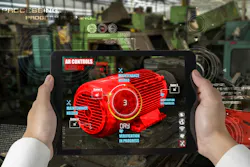
Electric motors are among the most widely deployed electromechanical systems in modern technology, powering everything from handheld tools and autonomous robots to industrial pumps and electric vehicles. Because they operate continuously under variable loads, mechanical wear and electrical degradation are inevitable. When they fail, the impact is immediate: unplanned downtime, costly repairs and disrupted operations.
Traditional maintenance strategies struggle to balance cost and reliability. Reactive approaches wait for failure, while preventive maintenance often replaces components prematurely, leaving usable life on the table.
Predictive maintenance (PdM) introduces a fundamentally different paradigm. Instead of relying on fixed intervals, PdM continuously analyzes operational data to estimate equipment health and anticipate failures before they occur.
At its foundation, PdM relies on condition monitoring (CM)—the measurement of physical and electrical signals such as motor current, vibration, temperature and back-electromotive force (back-EMF). CM provides real-time visibility into system behavior; PdM builds on these signals to infer degradation trends and remaining useful life.
Advances in embedded computing, sensor integration and optimized machine learning models now allow signal processing and predictive analytics to run directly on edge devices, including motor control microcontrollers. As a result, PdM is becoming a core capability rather than an optional diagnostic layer in modern motor-drive systems.
Predictive Maintenance and the Shift to Edge Intelligence
Traditionally, predictive maintenance was limited to large industrial systems where downtime costs justified complex monitoring infrastructure. These deployments typically relied on high-end sensors and centralized analytics.
This landscape has changed with the emergence of Edge AI, which has made PdM viable in small, distributed and cost-sensitive systems.
In modern connected devices, operational data can still be aggregated for fleet-level analytics and model refinement. However, critical fault detection must remain local to ensure real-time protection. Instead of streaming raw sensor data, edge systems extract features locally and transmit only health indicators or anomaly events, reducing bandwidth, latency and system cost.
Edge-based predictive maintenance is now being applied across a wide range of motor-driven applications, where system constraints ranging from power and cost to performance and reliability shape how it is implemented.
Motor Monitoring Across Applications
In cordless tools, drones, fans and robotic cleaners, motors operate under tight power and thermal constraints. As a result, predictive maintenance in these systems typically relies on opportunistic reuse of existing motor control signals rather than dedicated diagnostic hardware.
Phase currents and back-EMF waveforms used for control can also serve as indicators of early fault development. Variations in harmonic content may suggest bearing wear or rotor imbalance, while waveform distortions can indicate frictional or electromagnetic effects.
Because these signals are inherently available within the control loop, sensorless predictive maintenance can be implemented directly on the microcontroller unit (MCU). This enables lightweight anomaly detection with minimal system overhead and no additional sensing components.
Appliances such as washing machines, HVAC systems, refrigerators and compressors are strong candidates for PdM due to long service lifetimes and high maintenance costs. These systems typically combine electrical and mechanical sensing to capture a broader range of fault signatures.
Motor torque signatures, vibration patterns and compressor current profiles can reveal faults such as bearing wear, drum imbalance, refrigerant leakage or mechanical degradation well before failure occurs.
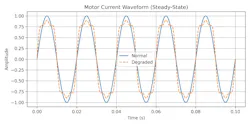
Industrial motor systems represent a more mature and structured implementation of predictive maintenance, driven by higher reliability requirements and larger operational scale. Pumps, compressors, conveyors and fans are commonly monitored using dedicated sensing approaches such as vibration analysis and motor current signature analysis (MCSA).
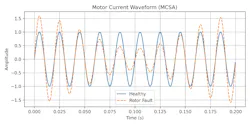
Unlike consumer-scale systems, industrial drives often incorporate engineered diagnostic frameworks with signal acquisition and fault detection integrated into the system architecture. MCSA enables detection of faults such as bearing damage, rotor bar defects and stator anomalies by analyzing characteristic frequency components in stator currents, providing a noninvasive alternative to mechanical sensing.
Modern motor drives increasingly integrate these diagnostic functions directly into drive electronics, reducing system complexity while improving detection speed, repeatability and reliability.
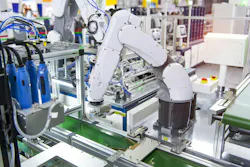
Robotic and collaborative systems extend predictive maintenance beyond fault detection by integrating component condition information directly into motion control. Torque estimation errors, friction changes and vibration signatures provide insight into mechanical wear in components such as gearboxes, harmonic drives and bearings.
In advanced systems, these diagnostic insights can be fed back into motion planning algorithms, enabling adaptive control that reduces load and extends operational life while maintaining performance.
Algorithms for Predictive Maintenance
Predictive maintenance systems combine signal processing and machine learning to interpret sensor data. These algorithms have evolved through several generations.
Rule-based diagnostic systems. Rule-based systems rely on fixed thresholds (e.g., temperature or vibration limits). While simple and deterministic, they struggle with varying operating conditions and often generate false alarms.
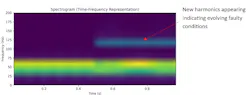
Signal processing and model-based techniques. Signal processing methods extract diagnostic features from raw data. Techniques such as FFT analysis, envelope detection, wavelet transforms and thermal models enable identification of characteristic fault signatures. These methods are efficient and widely used but require careful tuning for specific applications.
Machine learning-based diagnostics. Machine learning methods improve adaptability by learning patterns directly from historical data. Classical approaches include support vector machines, random forests and clustering methods.
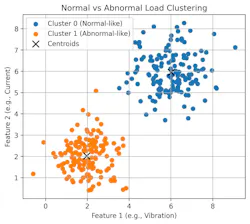
More recently, compact neural network architectures have been deployed for motor diagnostics. Convolutional neural networks can analyze spectrogram representations of vibration or current signals to identify fault signatures, while recurrent neural networks can track temporal degradation trends that may not be visible in steady-state frequency analysis. Importantly, these models can now be optimized for execution on resource-constrained embedded devices.
A Typical Edge Predictive Maintenance Architecture
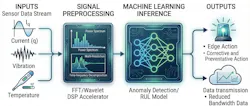
A typical edge-based PdM system begins with the acquisition of motor phase currents, vibration signals and temperature measurements. These signals are digitized via onboard ADCs or external interfaces.
Preprocessing removes noise and segments data into time windows. Feature extraction converts raw signals into spectral or statistical representations.
A trained machine learning model running on the embedded controller then produces outputs such as health classification, anomaly scores or remaining useful life (RUL) estimates.
Based on these outputs, the system can trigger alerts, adjust operating parameters, log events or communicate via industrial interfaces such as CAN, Ethernet or wireless protocols.
Emerging Trends in Motor Predictive Maintenance
Predictive maintenance is continuing to evolve, driven by advances in modeling, connectivity and system integration. Several emerging trends are shaping the next generation of motor diagnostics.
Digital twins are increasingly used in motor systems. These virtual models are continuously updated with real-time data to compare expected and measured behavior with deviations indicating early-stage faults.
Federated learning is also emerging, allowing distributed devices to collaboratively improve models without sharing raw data. Only model updates are exchanged, improving privacy and reducing bandwidth usage.
Sensor integration is advancing, with future motor systems expected to embed vibration, temperature and magnetic field sensing directly within motor assemblies to enable more context-aware diagnostics.
Another important shift is the integration of predictive maintenance with adaptive control strategies. Systems can dynamically adjust operating behavior based on system health, balancing efficiency, reliability and operational lifespan.
Together, these trends point toward a future where motor systems are increasingly autonomous, adaptive and capable of continuously improving through operational data.
Microcontroller and digital signal controller platforms are accelerating deployment of predictive maintenance systems. These integrated hardware and software ecosystems reduce development complexity and allow predictive maintenance to be embedded directly into motor control products.
Predictive maintenance is rapidly evolving from a specialized capability into a standard feature of motor-driven systems. What was once limited to high-end industrial applications is now becoming accessible across consumer devices, appliances, industrial automation and electrified mobility.
This transformation is driven by the convergence of embedded sensing, advanced signal processing and machine learning. As Edge AI continues to mature, intelligence will become increasingly integrated within motor control architectures, enabling systems to adapt dynamically based on operating conditions and component health.
In this context, predictive maintenance is no longer just about avoiding failure—it is becoming a foundational capability for building smarter, more efficient and more resilient systems.
About the Author
Pramit Nandy
Senior Product Marketing Manager, Microchip Technology
Pramit Nandy is senior product marketing manager for Microchip Technology’s dsPIC business unit.
Swapna Gurumani
Applications Engineer, Microchip Technology
Swapna Gurumani is an applications engineer for Microchip Technology’s edge AI business unit.
Voice Your Opinion!
To join the conversation, and become an exclusive member of Machine Design, create an account today!
 Leaders Logo
Leaders relevant to this article: