A Softer Start for Hard Plastic Production

Even the best-run manufacturing lines produce some rejects. Our team at Quality Science Systems typically works with clients to help them optimize production and minimize any kind of scrap. However, with one of our clients we recently had the opportunity to help with a secondary project, which was to upgrade some equipment for handling waste product.
Our client produces plastic containers, and some of them are off-spec due to shape, color or other factors. Fortunately, none of that plastic goes to waste as it is shredded in a granulator and sold for scrap but many operations can rework this type of material by routing it back into production, so keeping a granulator system running effectively improves the plant’s bottom line.
When Eight Relays Call it Quits
For years, the granulator’s control panel did its job with eight relays, five electronic timers, pilot lights, pushbuttons and a wye-delta motor starter. It mostly worked in a simple and adequate manner but it required a bit of electrical maintenance over the years and sometimes the granulator would become overloaded and jam up, requiring operators to clear it out manually.
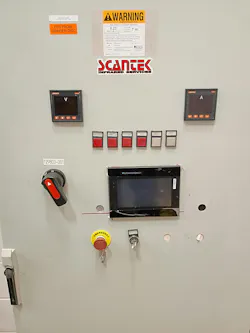
Eventually, the wye-delta starter finally failed completely. Although one contactor was sourced to temporarily patch things back together, we saw this as an opportunity for more than a repair (Figure 1).
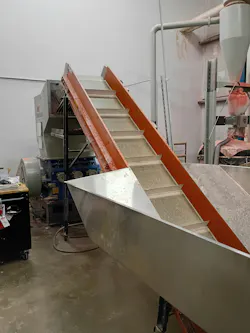
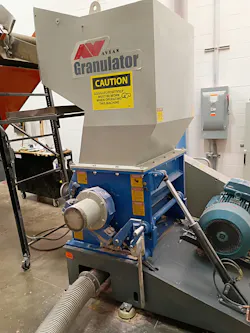
The granulator’s 50-horsepower, three-phase motor was energized in an old-fashioned way using a wye-delta starter. Instead of slamming the motor on at full power, a wye-delta starter provides a two-step way to start the motor, first at reduced current and torque to minimize electrical and mechanical stress on the equipment and then changing over to full speed after a period of time.
Wye-delta starting is an economical approach, but it requires three carefully interlocked contactors to operate in a sequence driven by relays and timers. This scheme relies on multiple ageing components to get the sequencing right and on this panel the wear was starting to show. Even though a quick fix was implemented, it was only a matter of time until the next part failed.
Instead of waiting for the next failure, our team pitched something better: a programmable logic controller (PLC) and human-machine interface (HMI) upgrade for the control logic, paired with a soft starter to retire the wye-delta scheme altogether. This refresh would incorporate more reliable solid-state components, provide much better starting characteristics and position the system for future improvements.
Smarter Starts and Cleaner Control
Replacing the discrete relay logic with code in a PLC/HMI would provide the flexibility to add sequence improvements and adjust timer parameters without the need to change wiring or fiddle with hardware timing relays. We would provide status screens on the HMI so the operators could clearly see how the equipment was running. The motor-starting method would benefit from the same kind of rethink.
A solid-state soft starter ramps voltage up gradually rather than snapping between wye and delta, which is easier on all aspects of the equipment and extends the life of machinery. Soft starters have on-board adjustments for ramp times and other parameters, so the motor starting characteristics can be adjusted to best match the driven equipment.
Because the operation could accept very little downtime, a multi-phase implementation was planned:
- Phase 1. Replace the relays and pushbuttons with a PLC/HMI, driving the wye-delta starter.
- Phase 2. Install the new soft starter.
- Phase 3. Add current monitoring to the soft starter power feed, so the PLC can stop the infeed conveyor if the granulator is becoming overloaded.
- Phase 4. Add level sensors to the feed bins for indication and improved control.
With the general solution settled, the next question was which automation platform would deliver the best performance and value, while fitting into a panel with limited room. The team has used AutomationDirect’s CLICK PLCs on past projects, but for this project, the Productivity1000 PLC fit the enclosure’s tight footprint better, while still leaving enough room to grow.
The platform’s support for descriptive tag-based addressing was also a factor, offering an alternative to the fixed memory addressing common in some legacy PLC systems. In addition, the programming software provided the instruction set needed for the application without requiring additional software licensing.
While this PLC family was originally only available in a stackable micro form factor, a more recent “mini” version incorporates some input/output (I/O) points right on board the processor to provide an all-in-one solution, with the option to add some more I/O modules if needed. This exactly met the needs for this project’s phased approach (Figure 2).
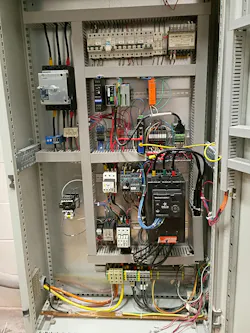
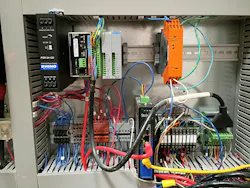
A C-more CM5 HMI and STRIDE Ethernet switch would provide visualization and connectivity. Many other components for this upgrade were also sourced from the supplier.
Sizing the soft starter took an extra phone call. The motor’s full-load current runs 68A and our original soft starter size choice came in lower than what an AutomationDirect application engineer recommended. They pointed out that grinders and other high-torque, shock-loaded equipment often warrant sizing a soft starter beyond what the motor’s nameplate alone might indicate, a useful insight that came out of a conversation rather than a datasheet.
Smoothing Out the Startup
Tearing out the old relays and installing the new PLC would need to happen quickly, without the opportunity to pre-build a subpanel. To ensure that everything would go smoothly, we first pre-assembled the PLC and associated components on a sheet of plywood. We designed the PLC solid-state outputs to drive DIN-rail-mount interposing relays, which is generally considered a good practice when driving heavier loads like contactors because it provides a degree of isolation and protection for the output module. While the I/O module is relatively inexpensive and easy to replace, it’s much cheaper, easier and faster to replace a relay.
Debugging the sequence on the test bench was a crucial step before we considered heading out to the plant floor, especially to maintain the proper wye-delta contactor sequencing. Both the PLC and the HMI include simulation options that facilitated this. The hardwired safety interlocks between the three contactors stayed in place and the goal was to get the new logic behaving exactly like the old one before commissioning. We tested the new PLC logic extensively, along with its interaction with the HMI, which now provided much more information to the operators (Figure 3).
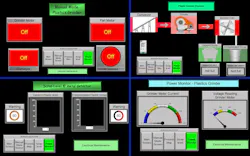
With testing complete, we proceeded with phase 1, installing the new PLC/HMI equipment with confidence. This changeover took just five days, and then we had the system up and running flawlessly.
Once the system had been running with the PLC for two weeks, we were ready to begin phase 2 and install the soft starter. This soft starter can be programmed through the faceplate with buttons and a small display, or with a programming package that creates a configuration file on a USB thumb drive, which can then be uploaded to the soft starter. We chose the latter approach because the programming software comes with a library of preset application profiles, so we didn’t have to build a starting curve from scratch.
Instead, we selected the “grinder” preset and adjusted from there, trimming the soft-start ramp time down to around 10 sec. to suit the load. We also called AutomationDirect technical support, and they provided some helpful suggestions for choosing soft start settings. As expected, the equipment started much smoother using the soft start.
Phase 3, which wrapped up more recently, adds a current transformer feeding one of the PLC’s analog input channels to keep an eye on granulator motor current in real time and halt the infeed conveyor if the load climbs too high, which is the surest sign that material is bogging down the equipment. Since this functionality was added, overload jams (which had still been happening sometimes) were eliminated, saving up to 45 min. of grinder cleanout downtime per event.
The Grind Goes on
What began as a reactive repair prompted a shift to a proactive modernization project. After replacing aging and outdated hardwired components with a PLC, HMI and soft starter, the granulator now starts smoother, runs more consistently, delivers clearer visibility and gives maintenance personnel a more reliable way to diagnose problems before they become downtime.
Just as important, the upgraded platform is ready for upcoming improvements, such as bin-level sensing, demonstrating how the right automation components and responsive application support can help turn a troublesome legacy system into a flexible, future-ready asset for the plant.
About the Author
 Pete Baker
 Pete Baker
President, Quality Science Systems LLC
Pete Baker is President of Quality Science Systems LLC. His company specializes in creating operational excellence through the application of Lean Six Sigma quality improvements. He likes optimizing manufacturing processes through applying the DMAIC process with DOE and the strategic use of automation controls. He has a BS EET and an MBA. He is also a Six Sigma Black Belt and is currently pursuing his Master Black Belt.
Voice Your Opinion!
To join the conversation, and become an exclusive member of Machine Design, create an account today!
 Leaders Logo
Leaders relevant to this article: