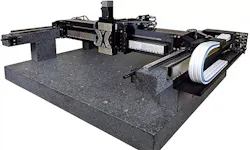
Content Designing, constructing, and controlling precision gantry motion systems is a multidisciplinary engineering challenge requiring deep expertise in structural mechanics, thermal modeling, mechatronics, and advanced motion control. While multi-axis gantry systems are foundational to high-throughput automation — think semiconductor inspection, laser processing, and advanced metrology — the challenges behind making them precise, reliable, and production-ready are often underestimated. At first glance, a precision gantry automation system may seem like a basic Cartesian setup: a few axes stacked over a work envelope. But once nanometer precision, micron-level repeatability, and 24/7 uptime are on the table, the reality gets far more complex. Here’s a look at the biggest engineering hurdles — and why experienced system-level design is essential. PI A-351 X-Y-Z gantries (cartesian robots) come in a large variety (size, base material, bearings, motors,…) and have become a standard for high precision 3D Printing processes with advanced gantry control and coordinated multi-axis synchronized laser trigger on virtual axes. For applications where particle generation by standard cable tracks is not an option, special solutions are available. 1. Staying Rigid Across the Span The longer the bridge, the more it wants to flex. Maintaining stiffness without adding excessive mass is a delicate balancing act. Add too much weight and you compromise dynamics; too little and precision falls apart. That’s why companies like PI invest heavily in FEA simulation and draw from decades of experience to optimize every gram of structure for rigidity without sacrificing responsiveness. 2. Thermal Drift is the Silent Precision Killer In general automation, a few degrees of temperature variation isn’t a big deal. But in precision systems, thermal expansion across long axes can create over-constrained conditions — sometimes even causing mechanical lock-up. More often, it increases bearing loads and shortens their lifespan. Knowing how to design for thermal decoupling and compliance is critical for long-term reliability and accuracy. 3. Gantry Motion Control and Dual Drive Sync: Racking is Real When a gantry bridge is driven from both sides, even minor mismatches between motors — mechanical or electrical — can cause racking. This twisting motion introduces angular errors and can compromise part quality. A capable motion controller helps but knowing which features (like gantry alignment loops or torque following) to activate — and when —is where many teams struggle. Video: See how advanced gantry motion control algorithms enable lock or independent control of both axes, for example adding an additional degree of rotation if the design allows for it. 4. Heavy and Fast Don’t Mix Easily High payloads and long bridge spans moving quickly generate enormous inertia, leading to position overshoot, long settling times, and dynamic instability. This instability directly undermines constant velocity , which is critical for many manufacturing and metrology processes where speed fluctuations translate to process errors. Designing with sufficient margin is non-negotiable to ensure stable, uniform motion under real-world conditions. The gantry has to perform not just under ideal conditions, but in the messy realities of production — where small issues like cable snags or unexpected payload shifts can compound quickly. Advanced motion control algorithms, such as PILOT , virtually increase the motor constant, allowing for higher performance, while reducing motor current and thermal load. A custom granite-based A-351 gantry system with and additional linear axis and 6-DOF hexapod 5. Assembly Tolerances Are Critical It’s not just the design — it’s the execution. Every mating surface in a gantry system must be flat, orthogonal, coplanar, and precisely aligned. Iterative alignment isn't scalable in volume production, especially when you're up against tight delivery deadlines. Precision must be built in from the ground up — starting with the frame. 6. Position-Based Event Synchronization Processes like laser firing , image capture, or part placement must happen at exact positions — not just when the stage thinks it’s there. With long travel ranges, mechanical flex, and loop delays, achieving rock-solid event synchronization is tougher than it looks. Hardware-timed outputs tied directly to encoder feedback are a must to avoid image blur, part misplacement, or delayed process triggers. Video: A hybrid air bearing / mechanical bearing gantry for laser processing 7. Cable Management: The Hidden Variable Cables and hoses might seem like an afterthought, but they often introduce unpredictable forces that affect repeatability and tuning. There’s no one-size-fits-all rulebook for managing drag chains in high-dynamic precision systems. Experience is key — understanding how even subtle cable-induced torques impact performance separates functional systems from exceptional ones. In critical applications, a second motorized system can be added to reduce friction. Also, for clean-room applications special cable management solutions are available. Video: A custom 7-axis gantry for 3D printing. The Z-axis carries 4 additional motorized stages. The Bottom Line: It’s a System, Not Just a Stack of Components Thinking of building your own precision gantry? Be warned: the margin for error is razor-thin, and the number of things that can go wrong adds up fast. Success takes more than quality components. It requires deep system-level expertise — understanding how mechanical design, thermal behavior, control algorithms, cable dynamics, and real-world process variables all interact. That’s where PI stands apart. With decades of real-world application experience, simulation-driven engineering, and integrated motion control, PI delivers precision gantry systems that work the first time — and keep working long after. Ready to build a gantry that meets the spec — and reality? Talk to an expert at PI . We’ll help you avoid the traps and deliver the precision your process demands. Custom, low-profile gantry with aluminum base More Reading Sign up to receive an email of new blog posts. First Name* Last Name* Company / Organization City* State* Country* Email* Please read the following and confirm your consent to the processing of your data. By submitting this form, you consent to the PI Group contacting you through the communication channels you specify. Additionally, you acknowledge that the PI Group may store, process, and analyze the necessary data. For further information, see our >> Privacy Policy . Each email includes an unsubscribe link that allows you to withdraw your consent. Privacy Policy* I have read the Privacy Policy and agree to its terms and conditions. Submit Blog Categories Compliance with Applicable Laws; Export Control Laws User access to this website is governed by all applicable federal, state, and local laws. All information available on this website is subject to U.S. export control laws and may also be subject to the laws of the country where you reside.