Standing Out in a Crowd: Innovative Industrial Tech on Display at Automate 2026
For more Automate 2026 coverage, be sure to visit our Tradeshow Takeover event hub.
For those attending Automate 2026 in Chicago this week, there will be a number of high-profile booths that it’s a good bet attendees will either head for or repeatedly pass by during the four day industrial technology event.
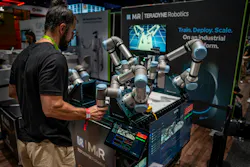
For example, given the focus on robotics and artificial intelligence that has dominated the industrial trade show circuit this year, Universal Robots’ display will be a natural touch point for many attendees seeking a first-hand look at the real-world production capabilities of physical AI.
In addition to a series of physical AI/UR robot integration demos, Universal Robot’s Automate booth will showcase the company’s imitation learning platform, the UR AI Trainer. Developed with UR partner, Scale AI, the AI Trainer allows users to physically guide a pair of UR robots through various tasks to capture high-fidelity, force-aware data. Users can then leverage that data to train the NVIDIA GR00T open VLA model or use the NVIDIA Isaac Sim open simulation framework to validate and test robot behavior.
UR’s booth will be a compelling draw for attendees, but with more than 1000 exhibitors spread over the roughly 450,000 square feet of Automate 2026’s show floor, it’s all too easy for less well-known yet highly innovative companies to get lost in the crowd. The following is a short-list of industrial technologies worth checking out (click to the link for booth location on the Automate 2026 floor map).
XELA Robotics
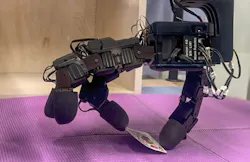
While most physical AI systems focus on 6-axis or humanoid robotics with only one sensory input (i.e., machine vision), XELA Robotics has narrowed its efforts to where work actually gets done, at the end-effector. More specifically, the company’s uSkin tactile sensors provide a robot’s end-effector with gripping force feedback, as well as data indicating how an object is moving or slipping while grasped.
For the Automate show, XELA is introducing a robotic fingertip with a six-axis, force-sensitive “finger nail.” Equipped with 30 tri-axial force sensing points, the XELA tactile nail is designed to enable grasping of thin objects or facilitate actions such as scraping tape off a surface, the company says. To illustrate the capabilities of its gripper sensors, the company’s booth will feature a pick-and-place demo of a gripper equipped with uSkin sensors grasping a delicate quail egg and folding a paper origami crane.
Sensory Robotics
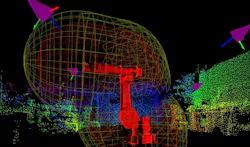
Sensory Robotics will display its SR-1 system, a UL 1740–certified “fenceless” robotic safety system that uses coordinated 3D cameras and edge computing hardware to monitor the “air space” around one or more industrial robots. In practice, SR-1 monitored robots slow or stop as workers enter safe zones and resume automatically when the person exits the space. As a result, users can optimize valuable floor space by fine turning the virtual safe zones to conform to the path of a robotic arm.
At Automate, the robot-agnostic SR-1 system will be paired with both DENSO and FANUC robots operating without safety barriers. Attendees will see a real-time video feed of virtual bubbles or point clouds surrounding the robots that define the system’s layered safe zones.
RealSense
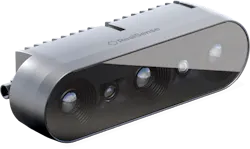
Vision sensor firm, RealSense, will launch its D585 Pro depth camera featuring on-board AI compute that allows inference tasks to be off-loaded from a host computer. The 3D camera combines dual IR projectors and high-resolution vision sensors with a custom Gen 5 SoC that integrates a depth engine, image signal processor, digital signal processor, AI accelerator circuity and a quad-core ARM processor.
Designed for humanoid robots, AMRs, cobots and industrial robots, the camera’s AI capabilities will provide enhanced depth processing and person detection at launch with additional AI functions planned for the future, the company says. Usable between 15cm and 10 meters, the D585 Pro offers 120 ×100 deg. FOV and simultaneous 30 FPS RGB and 30 FPS depth streams at up to 1280 × 960, merged on camera.
Thoro.AI
Thoro.AI doesn’t make logistics robots (e.g., pallet jacks, floor scrubbers, forklifts); instead, the company provides the safety-certified embodied AI that provides those vehicles with autonomous capabilities. At Automate 2026, Thoro.AI’s booth will showcase the company’s cloud-based CoreFlex platform that integrates 3D sensors, onboard AI compute and standardized interfaces with its embodied AI software, fleet management and cloud platform.
Taken together, CoreFlex is designed to be compatible with multiple vendors and vehicle types providing each access into a unified toolbox of autonomous including shared SLAM navigation, dynamic safety fields, pallet detection and multi-robot coordination, among others.
Cardinal Kinetic
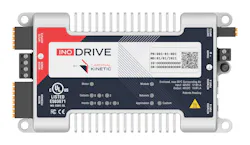
Cardinal Kinetic will exhibit its InoWorx motion control platform which provides a single hardware/software environment for controlling and coordinating brushless DC servomotors. For the hardware component, the company’s InoDrive combines a servo amplifier, motion controller and logic engine within a compact, distributed control unit. Networking two or more InoDrives together allows for users to coordinate multiple axes.
To program the InoDrive, the platform’s InoWorx Programmer offers a visual drag-and-drop programming environment in which users can graphically configure motion sequences, synchronize multiple motors and test setups.
At Automate, Cardinal Kinetic will display the integration of the InoWorx platform with Pulseroller Senergy motorized drive rollers to illustrate how users can replace centralized control panels, multiple hardware layers and complex programming environments with Cardinal Kinetic’s simplified system architecture.
ESTAT Actuation
Designed to replace traditional mechanical motion control systems, ESTAT Actuation builds ultra-thin clutches and brakes that leverage static electricity to adhere and release rotating components. In essence, the clutches are built from flexible layers of load-bearing capacitors. When voltage is applied across the clutch electrodes, positive charges build up on one side and negative charges on the other, resulting in adhesion between the rotor and the electrodes. Removing the voltage disengages the clutch.
The result is a motion control component that’s roughly 1mm thick and weighs 30 grams per module, which according to the company, makes the electrostatic clutches 10 times lighter and more compact than conventional clutches and 1,000 times more efficient.
About the Author
 Mike McLeod
Mike McLeod
Senior Editor, Machine Design
Mike McLeod, senior editor of Machine Design, is an award-winning business and technology writer with more than 25 years of experience. He has covered the full spectrum of mechanical engineering, from industrial automation, aerospace and automotive, to CAD/CAE, additive manufacturing, linear motion and fluid power.