Contributed by CW Bearing
Motion - Turning Intelligence into Performance
Artificial intelligence is often discussed in terms of software, algorithms, and data. But every AI-enabled system ultimately relies on mechanical motion to execute decisions in the physical world.
From industrial robots and automated manufacturing equipment to inspection systems and intelligent infrastructure, AI determines what should happen. Mechanical systems determine how well it happens.
As intelligent systems become more advanced, the connection between digital decision-making and physical execution becomes increasingly critical. Performance is no longer defined solely by logic or data, but by how precisely those decisions are translated into motion.
Motion as a Mechanical Foundation
Controlled motion is fundamental to intelligent systems. Bearings enable this motion by:
- Supporting rotation and linear movement
- Reducing friction and wear
- Maintaining alignment under load
- Allowing smooth, repeatable operation
As AI pushes machines toward tighter tolerances and higher duty cycles, motion quality becomes increasingly critical.
In applications such as robotic arms, high-speed pick-and-place systems, and precision inspection equipment, even small deviations in motion can introduce measurable error. These deviations may affect positioning accuracy, cycle time, and overall system consistency.
In traditional equipment, small variations in motion may be tolerable. In AI-controlled systems, those same variations can affect accuracy, repeatability, and system learning.
Simply put, AI amplifies the importance of mechanical fundamentals.
AI increases precision requirements. Mechanical systems must meet that precision.
Vibration - Protecting Accuracy and Sensor Performance
In AI-enabled systems, vibration is not just a mechanical concern. It is a data quality issue.
Sensors, vision systems, and feedback loops rely on stable mechanical platforms. Excess vibration can introduce noise, reduce measurement integrity, and degrade system performance over time. In highly sensitive systems, even minor instability can lead to incorrect data interpretation or reduced system confidence.
This is particularly critical in systems that depend on real-time feedback, such as machine vision inspection, force-controlled robotics, and autonomous equipment. In these environments, instability at the mechanical level directly impacts the quality of data used for decision-making.
The Mechanical Impact of Vibration
Vibration in rotating systems can lead to:
- Reduced sensor accuracy and signal integrity
- Inconsistent positioning or tracking
- Increased wear on mechanical components
- Less reliable predictive maintenance models
Bearings play a central role in controlling vibration by influencing internal geometry, surface finish, lubrication behavior, and system stiffness. These factors directly affect how motion is transmitted and how stable motion remains under operating conditions.
Vibration Control Enables Better Intelligence
AI systems depend on clean, consistent input data. When vibration is minimized:
- Vision systems operate with greater clarity
- Force and torque sensors respond more accurately
- Predictive algorithms perform more reliably
Mechanical stability directly supports intelligent decision-making by ensuring that the data feeding those decisions remains consistent and reliable.
Reduced vibration supports system accuracy, mechanically.
Reliability - Supporting Continuous Operation
AI-driven systems are increasingly expected to operate continuously, with minimal downtime and predictable maintenance cycles.
Whether in robotics, automation, or infrastructure, reliability is no longer optional. It is a design requirement. Systems must not only perform accurately but also sustain that performance over extended periods of operation.
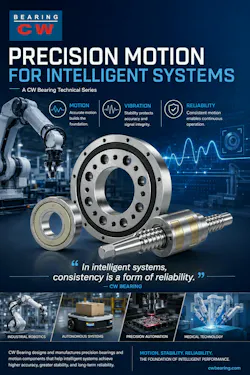
“In intelligent systems, consistency is a form of reliability.”
— CW Bearing
Continuous Duty Changes the Equation
As duty cycles increase, motion components must perform under sustained:
- Loads
- Speeds
- Temperatures
- Operating cycles
In high-duty applications such as automated production lines, logistics systems, and continuous monitoring equipment, even minor inconsistencies can accumulate over time, leading to performance drift or unexpected downtime.
Extended operation introduces cumulative effects such as wear, heat generation, and material fatigue, all of which influence long-term stability. Failures or inconsistencies in motion components can interrupt production, compromise data integrity, or shut down entire systems.
Reliability Enables Predictive Maintenance
Modern AI systems are often used to monitor equipment health and anticipate maintenance needs. Consistent mechanical performance improves predictive maintenance by providing stable, repeatable operating behavior over time.
Reliable motion enables more accurate diagnostics, more effective maintenance strategies, and greater system confidence in system performance. Without consistent mechanical performance, predictive models become less reliable and less actionable.
Precision bearing design supports durability and consistency in continuous-duty environments, helping manufacturers maintain uptime and long-term performance.
Consistent motion enables reliable operation, and smarter maintenance.
Conclusion
As intelligent systems continue to advance, performance is no longer defined by precision alone, but by the ability to sustain that precision over time.
Motion, vibration, and reliability are interconnected elements of intelligent system design. Each build upon the other, forming the foundation for accurate, stable, and continuous operation.
Sustained performance depends on consistent motion, controlled vibration, and components engineered for continuous operation. Mechanical design therefore plays a central role in enabling intelligent systems to perform reliably in real-world conditions.
https://www.cwbearing.com/industries/industry/automation-and-robotics