3D Printing Tissues and Organs Just Got Faster
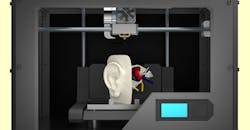
More than 113,000 people are on the U.S. transplant list. A shortage of donors means about 20 of those people die every day waiting for organs, according to the U.S. Dept. of Health. But this could change, thanks to researchers at UC Berkeley, who have developed a device with the potential to 3D print living tissue, bone, blood vessels, and even entire organs on demand.
Currently, two major hurdles stand in the way of organ printing. Living cells and functioning organs require specialized temperature and chemical conditions to survive, so cells deteriorate during 3D printing because the process is too slow. And even if an organ gets printed, transporting it requires safe storage which is not as developed as it could be.
To 3D print organs faster, the Berkeley researchers developed bioprinting, a technique that employs parallelization in which several printers turn out two dimensional layers of tissues simultaneously. These layers are then stacked layer-by-layer to form 3D structures.
To overcome the storage problem, the team relied on seven decades of knowledge and techniques for preserving single cells. Their technique freezes each 2D layer immediately after it is merged into the 3D structure, and this process of freezing a single layer of cells provides good conditions that should help the printed organ survive the process of freezing, storage, and transportation.
Printing tissues in 2D first and then assembling them into a 3D object at a different station significantly speeds production by eliminating printing time. After the assembly line of bioprinters creates in parallel several 2D layers of tissue, a robotic arm picks up the layer and carries it to another station. There, the tissues are stacked together to create a 3D object and fused via freezing.
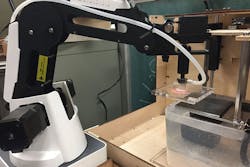
Robotic arm stacking layers of 2D tissues. (Courtesy: Gideon Ukpai)
As each layer is stacked to form a 3D structure, it is first dipped into a cryogenic bath to freeze it rather than having the bath fill up to meet each layer. This also lets researchers control the freezing rate more accurately.
In addition to organs, another potential application for this technology is food. Layer-by-layer printing and assembly lets manufacturers explore different textures of food and develop food responsive to the needs of sick people.
“Dysphagia (difficulty swallowing) is common among geriatrics and they are being fed food that is basically mush—which doesn’t improve their appetite—and the problem exacerbates,” says mechanical-engineering professor Boris Rubinsky. “But if we can create food with texture, it may be more appetizing. Then as they chew, the food will melt in their mouth so they can swallow and get the nutrients. Our technology can this with any kind of food.”
He notes that the technology also allows for the development of industrial scale manufacturing of frozen food, where ice crystals in the food are meticulously controlled at the single cell layer throughout the product.
“This is important because the size and homogeneity of the ice crystals are a central element in the quality of the frozen food,” says Rubinsky.
Although the concept of stacking thin layers to create a 3D object isn’t new to manufacturing, it’s novel to do so with biological materials. There is also a big difference between the rigid materials used in conventional laminations—such as paper, plastics, ceramics, and metals—and biological materials consisting mostly of liquid that are much less so. So, the team used judiciously designed hydrophilic and hydrophobic rigid surfaces on which the 2D layers are printed. These layers let the 2D layers be moved, regardless of the direction of gravity, for placement onto a 3D object.

About the Author
Voice Your Opinion!
To join the conversation, and become an exclusive member of Machine Design, create an account today!

Leaders relevant to this article: