HP Multi Jet Fusion Targets Production as Demand Grows and Service Bureaus Scale
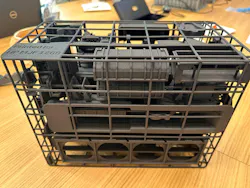
A decade after its introduction, HP’s Multi Jet Fusion technology appears to be coming into its own as a production manufacturing process. What began as a rapid prototyping tool is today being used for end-use production, where throughput, repeatability and manufacturing economics matter as much as design freedom.
The move toward production was a recurring theme during a recent HP media event, where executives and service bureau customers discussed application growth and introduced the HP MJF 1200, an entry-level system designed to lower the barrier to industrial polymer additive manufacturing. Rather than developing an entirely new platform, HP simplified elements of its existing Multi Jet Fusion workflow, including build handling and calibration, while reducing the system footprint and automating powder management.
The goal was to lower the operational burden for smaller manufacturers, design firms, university labs and in-house model shops seeking production-grade polymer parts. “The less time these users spend with our printer, the better,” said Marc Garcia Grau, Product Manager for 3D Printing at HP, describing the company’s effort to reduce the operational overhead associated with producing parts. The system will launch in 2027 with PA12 material, with additional materials planned.
While speed remains an advantage, it is no longer the primary selling point for additive manufacturing. Manufacturers are paying closer attention to whether additive manufacturing can support repeatable production, where cost per part, dimensional consistency, material efficiency and process control carry as much weight as design flexibility.
François Minec, Global Head of Sales and Business Development for HP Additive Manufacturing Solutions, said production applications now account for roughly 75% to 80% of activity among HP customers. The company also estimates that service providers are growing at about twice the rate of the broader additive manufacturing market, reflecting rising demand for outsourced production capacity rather than in-house prototyping alone.
Global additive manufacturing revenues rose 10.9% to $24.2 billion in 2025, according to the Wohlers Report 2026, signaling steady but more mature post-pandemic growth. Printing services accounted for 48% of the market, compared with 26% for hardware sales and servicing, suggesting that a growing share of value creation is occurring in production and service delivery rather than equipment sales alone.
As adoption expands, the industry must meet the demands of consistent and economical production at scale. Alex Moñino, Senior Vice President and General Manager of HP Additive Manufacturing Solutions, said the business has evolved from selling printers to helping customers identify applications that justify their use. HP is seeing strong demand, he said, with printer availability constraining growth in some markets, particularly the United States.
Moñino identified orthotics and prosthetics, automotive, drones and robotics as areas gaining traction. In robotics, for example, additively manufactured end-of-arm tooling can be customized and made lighter, potentially enabling smaller robots to perform tasks that would otherwise require larger systems. Drone applications offer similar opportunities to tailor components to performance requirements while accelerating design iteration.
HP’s executives also pointed to cranial helmets as an example of how digital workflows can reshape a product development process. Scanning can replace portions of a traditional plaster-based workflow, reducing the number of patient visits while enabling a more personalized fit. The benefits, however, are highly application-specific rather than evidence that additive manufacturing is the best choice for every component.
How MJF Differs from Other Powder-bed Processes
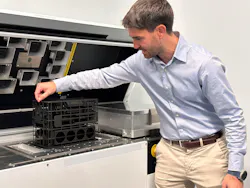
In her technology presentation, Clara Remacha Corbalán, Head of Product Management for HP 3D Printing Polymers, focused on the mechanics behind MJF’s production proposition and how it differs from selective laser sintering (SLS).
Both are powder-bed fusion processes, but they apply energy differently. SLS uses a laser to fuse material along a path. MJF applies fusing and detailing agents across a powder layer before infrared energy fuses material across an area. Because energy is applied across an area rather than traced along a single path, HP argues that MJF can deliver higher throughput than traditional laser-based systems.
The two agents also serve distinct functions. The fusing agent helps bring material to fusion temperature, while the detailing agent controls heat around part boundaries. HP says its system dynamically adjusts agent application according to part geometry and spacing between parts, helping balance material fusion with dimensional accuracy.
READ MORE: How Hybrid Manufacturing Combines CNC and 3D Printing for Accelerated Product Development
Remacha Corbalán argued that the time available for fusion also contributes to polymer properties. The process allows polymer chains more time to entangle across layers, helping produce more consistent elongation-at-break properties in the X, Y and Z directions than some competing powder-bed processes. These are HP’s technical claims and engineers evaluating a material should compare relevant datasheets and validate performance against their own application requirements.
Material utilization is another area where HP sees an advantage. HP says its MJF materials can operate with a high proportion of reused powder, reducing the amount of fresh material required. The achievable refresh ratio depends on material selection and build conditions, including packing density. A tightly packed build of compact parts behaves differently from one filled with thin-walled or widely spaced components. Packing density alone, therefore, is not a fair basis for comparing technologies unless part geometry and build conditions are comparable.
HP also said it has transitioned production of PA12 (polyamide 12, or nylon 12), one of the most widely used materials in its MJF portfolio, to a version manufactured using renewable energy, lowering the material’s production-related carbon footprint. The company continues to target lower cost per part through productivity gains and reduced material waste.
The MJF 1200 and the Production Workflow
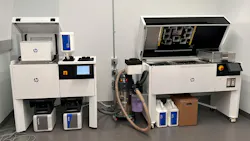
HP positioned the MJF 1200 as an entry point for manufacturers interested in powder-based additive manufacturing but not yet ready to invest in one of the company’s larger production platforms. The company has also focused on making powder handling more approachable for users new to the process.
Print time, however, is only one part of the production cycle. HP said a typical MJF 1200 build takes about 12 hours to print, followed by about 10 hours of cooling for the smaller system. Depending on the build, parts may be available in less than 24 hours. Larger industrial builds can require another 15 to 20 hours of cooling after printing.
The print itself is only part of the production equation. The total production cycle also includes cooling, depowdering and any required finishing or machining operations, all of which affect how quickly parts move from the printer to final use.
Service Bureaus See Larger Production Orders and New Demands
A customer panel offered a window into how production requirements change as MJF adoption scales. Cody Laursen, Founder and CEO, Streamline 3D, described a business that expanded from its first MJF system in 2021 to a larger fleet focused on production work.
Keith Schneider, General Manager, ADDMAN, said his company grew its MJF operation from two machines to four and then to 64, with further expansion under consideration. Their experiences suggest that growing demand for production parts is creating opportunities for service providers while exposing the infrastructure needed to support sustained manufacturing.
For Laursen, one sign of that shift is the size of customer orders. Requests that once called for five or 10 parts now routinely involve volumes of 5,000 or 10,000. Those programs bring expectations more commonly associated with conventional manufacturing, including documented processes, material traceability, quality controls and certification records.
READ MORE: Replacement Parts are a 3D Print Away
Schneider echoed that reality, noting that ADDMAN runs three shifts around the clock and still struggles to keep pace with demand. Scaling production, he said, requires far more than adding printers. Floor space, humidity control, HVAC systems and powder-handling workflows must grow alongside machine capacity.
The panelists repeatedly returned to a related point: MJF’s value depends heavily on the application. As Schneider put it, "[the economics] are really part dependent." Injection molding may remain the most economical option for parts suited to high-volume, multi-cavity production, but MJF can become competitive when several components can be consolidated into a single printed part, reducing assembly steps and associated costs.
That application-driven approach also shapes how service bureaus work with customers. Rather than accepting every drawing specification at face value, the panelists said they routinely review tolerances and identify which dimensions genuinely require tight control. Where necessary, machining can be used to finish specific features. Relaxing an unnecessary tolerance or designing for build efficiency can make a part more economical without affecting its intended function.
Finishing remains another consideration. Laursen said dyeing is often required because MJF parts typically emerge gray and may show uneven coloration. Depending on the application, smoothing, coating, machining, inserts and assembly can introduce additional cost, labor and lead time. He noted that one improvement he would like to see is parts emerging black rather than gray, eliminating a common post-processing step.

Beyond the Printer: Determining Where MJF Makes Sense
Multi Jet Fusion has matured from a prototyping tool into a viable option for production applications, supported by improvements in throughput, powder reuse and application development. The experiences shared by service bureaus suggest that opportunity is real, but so are the operational demands. Scaling from dozens of parts to thousands requires far more than additional printers. Quality systems, material management, post-processing capacity and production workflows all become part of the equation.
For engineers, the decision starts with the part and its function. MJF should be evaluated alongside molding, machining and other additive processes using the actual geometry, material requirements, tolerances, annual production volumes and finishing needs. Cooling and post-processing should be factored into cycle-time estimates, along with how suppliers or internal operations will maintain repeatability and document quality across production runs.
As additive manufacturing moves deeper into production environments, its success will largely depend on the balance between economics and execution, as opposed to the technology capability alone. Printer performance remains important, but manufacturers ultimately evaluate any process against stablished alternatives based on cost, throughput, quality requirements and production volume. Those factors, more than print speed or machine specifications, will determine where Multi Jet Fusion earns a place on the factory floor.
Have a question, comment or idea? Get in touch with the Machine Design editors at [email protected].
About the Author
 Rehana Begg
Rehana Begg
Editor-in-Chief, Machine Design
As Machine Design’s content lead, Rehana Begg is tasked with elevating the voice of the design and multi-disciplinary engineer in the face of digital transformation and engineering innovation. Begg has more than 24 years of editorial experience and has spent the past decade in the trenches of industrial manufacturing, focusing on new technologies, manufacturing innovation and business. Her B2B career has taken her from corporate boardrooms to plant floors and underground mining stopes, covering everything from automation & IIoT, robotics, mechanical design and additive manufacturing to plant operations, maintenance, reliability and continuous improvement. Begg holds an MBA, a Master of Journalism degree, and a BA (Hons.) in Political Science. She is committed to lifelong learning and feeds her passion for innovation in publishing, transparent science and clear communication by attending relevant conferences and seminars/workshops.
Follow Rehana Begg via the following social media handles:
LinkedIn: @rehanabegg and @MachineDesign
YouTube: @MachineDesign-EBM
Voice Your Opinion!
To join the conversation, and become an exclusive member of Machine Design, create an account today!
 Leaders Logo
Leaders relevant to this article: