Contactless Ethernet: Lowering Downtime in Automated Transport Systems
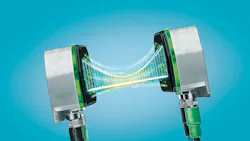
In the factory, there are no longer any physical connections in moving applications. Production downtimes due to bent or worn contacts are a thing of the past. Goods distribution systems, handling robots and automated guided vehicle systems communicate quickly, efficiently and without contact.
Is this some vision of the future? No, such scenarios are already possible with a new contactless technology that transmits both Ethernet and power. The automotive industry in Germany has pioneered this technology, creating a path to future factories that other industries, such as plastics, electronics and food, can follow.
The modular factory, which focuses on individuality and scalability, can be quickly and economically adapted to changing requirements. Machines and systems frequently expand and move. Traditional methods of transmitting data between mobile systems in a production facility have had numerous problems. Previous solutions either performed inadequately, were prone to errors or required intensive maintenance—all of which increased operational costs.
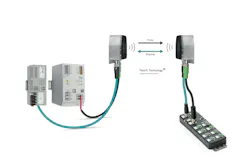
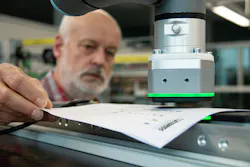
Contactless power and data exchange across an air gap is the perfect solution here (Figure 1). This approach enables wear-free and maintenance-free connections and also allows transmission through glass or other non-conductive media, opening up a wide range of application options (Figure 2). The new contactless real-time transmission technology can be used to exchange power and data across an air gap in the centimeter range.
Close to Latency-free Transmission of Real-time Ethernet Protocols
The protocol-independent Ethernet communication gives the contactless couplers a significant advantage in real-time transmission technology. The technology works as a physical media converter, so it is not tied to the familiar standard protocols.
Existing packet-oriented exchange methods, such as WLAN or 5G, require waiting for the full data packet to be received. This results in latencies. In contrast, the new technology employs a bit-oriented transmission method with two 60 GHz connections—one for uplink and one for downlink—operating in parallel on separate frequency bands. This full-duplex forwarding makes it possible to communicate real-time Ethernet protocols with virtually no latency (<1 μs).
READ MORE: Spotlight on Time‑Sensitive Networking: A Special Report on Real‑Time Industrial Ethernet
The growing number of WLAN wireless systems, primarily used for machine and data exchange with automated guided vehicle systems (AGVS), is resulting in increased use of frequency bands. Complex frequency planning is necessary. Transmission interference due to overloading the frequency bands leads to failure and downtime.
Because this contactless communication takes place in the near-field range over a small distance of a few centimeters, there is no interference spectrum in the vicinity of the devices. Multiple systems can be used in parallel. It also ensures coexistence with existing wireless technologies, such as WLAN or Bluetooth.
Industrial interference spectrums, such as those that occur with arc welding, cannot influence the technology. Data exchange requires at least two devices: a base and a remote coupler. Coupling is automatic, so it does not require configuration or programming. An LED ring indicates a successful connection and provides visibility from every position.
Reliable Forwarding of Safety Data
Automated processes can only be successful and efficient if they are intelligently linked. The interlinking of processes refers to the integration of automated transport systems into the various processes or stations within a material flow system in production. Materials and goods are automatically transported from one station to the next without human intervention. To do this, AGVS must communicate with the processing stations (machines) to transfer the materials to be processed between the processing stations via workpiece carriers.
AGVS that dock onto machines interact with them. As a result, they become part of the machine and must exchange data with it from a safety perspective. For example, if an emergency stop is actuated on the machine side, the AGVS must also be set to the safe state.
The same applies to the reverse. During the docking process, safety and non-safety data are transmitted between the machine and the AGVS via Ethernet-based protocols (such as Profinet/Profisafe, EtherNetIP/CIP Safety or Ethercat/FSOE). The AGVS typically hosts a Profinet/Profisafe device that communicates with the machine control system.
For example, the machine forwards enable signals to the AGVS. When transmitting the safety data to the machine, the communication connection must not be interrupted, as this would bring the machine and the AGVS to a standstill. This stoppage reduces the uptime of the production plant, which results in economic losses. Until now, the available solutions are based on WLAN technology.
Various Advantages Compared to WLAN Communication
In production halls, WLAN networks are often occupied by other applications, such as forklift applications. The WLAN network might experience temporary disruptions, like those caused by employee smartphone hotspots. This can impair the docking application or data transmission between the automated guided vehicle system and the machine.
Since the WLAN system only supports half-duplex communication, Ethernet data can only be exchanged with a delay. For example, the Profinet cycle time in a WLAN application must be set to 32 milliseconds instead of 4 milliseconds. This, in turn, leads to longer safety watchdog times. If the WLAN network transmits safety protocols, it must be state-of-the-art and comply with IT security requirements.
READ MORE: Single-Pair Ethernet Standardized for Smarter, Scalable Machine Design
With this contactless technology, the connection to the machine can be viewed in terms of latency as an Ethernet connection in full duplex with a data rate of 100 Mbps. In contrast to the WLAN connection, the communication settings are reduced to a Profinet cycle time of 4 milliseconds, so that the safety watchdog times remain low. The data is forwarded across an air gap over a distance of up to 40 millimeters and is insensitive to sources of WLAN interference (Figure 3).
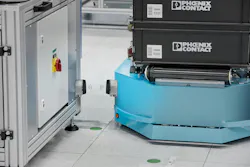
This prevents reductions in system uptime and ensures clear coupling to the machine, making it impossible to connect to the neighboring machine accidentally. It also eliminates complex network planning or special IT security measures. In addition, the contactless technology can be used for data coupling between interlinked vehicles.
Easy Pairing Without Precise Alignment
Workpiece carriers act as components in automation technology applications. They are essentially a device on which one or more workpieces are attached or inserted. A workpiece conveyor transports the carrier along different production lines or stations. Automated production typically includes assembly, joining, handling, precise processing, intelligent control and complex testing processes (Figure 4).
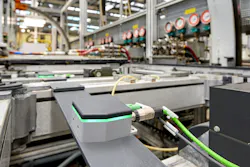
A workpiece is transported to these production stations during production. The form and function of the workpiece carrier adapts accordingly to the product and the production facility. The workpiece is usually processed directly on the workpiece carrier by robots or employees.
READ MORE: Sending Signals: Sorting Out Single-Cable Sensor Connectivity
Workpiece carriers have sensors, actuators and hydraulics, which are usually connected to I/O modules or valve terminals. From there, the data is usually transmitted to the controller using Ethernet-based protocols via connectors.
The flexible use of automation technology can reduce production process costs by improving cycle times. However, the shorter cycle times and movements result in more wear. For example, this can be seen in the case of connectors that communicate Ethernet data between the moving system elements (Figure 5).

The resulting downtimes cannot be predicted or planned. Unlike conventional connector solutions, the base and remote couplers can be positioned to face each other from any direction. They can also rotate in relation to each other.
When using a connector, the male and female connectors must be positioned precisely. Otherwise, the sensitive pins can quickly become damaged. With the contactless couplers, on the other hand, the user does not need to align the devices precisely. They can face each other with an offset or at a tangential angle (Figures 6 and 7). This significantly reduces the degree of precision required for the mechanical movement of two independent system parts.
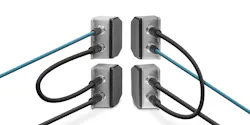
The contactless couplers can reduce service calls and eliminate maintenance costs, which increases system availability. The decreasing expenditure and optimized production processes significantly reduce the amortization period of the devices.
About the Author
Benjamin Fiene
Product Marketing for Communication Interfaces, Phoenix Contact Electronics GmbH
Danny Walters
Product Marketing Specialist – Wireless and Surveillance, Phoenix Contact USA
Voice Your Opinion!
To join the conversation, and become an exclusive member of Machine Design, create an account today!

Leaders relevant to this article: