AI-Driven Material & Component Classification for Faster Product Design Cycles

Walk into the maintenance planning room of almost any large industrial facility (a refinery, a mine, a power plant) and you will find engineers doing something that, in 2026, should no longer occupy skilled human attention: hunting through fragmented databases to confirm whether a specific pump seal or valve housing is in stock, correctly described and matched to the right equipment.
The problem is classification. When material and component data is inconsistent, incomplete or disconnected from the equipment structures it supports, every downstream process slows down. AI is now mature enough to address this at industrial scale.
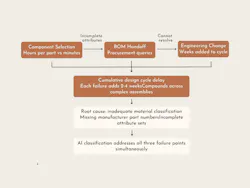
The impact runs further upstream than most organizations recognize. Product and design engineers encounter the same broken data at an earlier stage: selecting a component in a CAD environment only to find it is obsolete, releasing a design BOM that procurement cannot fulfil because the part description does not resolve against any live supplier record, or discovering after design sign-off that a specified part is misclassified and triggers an engineering change order.
Each of these failures adds weeks to a product design cycle and each one traces back to the same root cause: component data that was never properly classified in the first place.
While every manufacturing organization with a parts inventory faces some version of this problem, the consequences are most severe in asset-intensive industries where equipment complexity is highest, downtime costs are steepest and the volume of unique components under management is largest.
The Scale of the Problem
Material and component classification means assigning every inventory item a standardized identity: a taxonomy code from frameworks like UNSPSC or eCl@ss, plus a complete attribute set covering grade, dimensions, operating specifications and manufacturer part numbers linked to the correct functional location.
Most asset-intensive organizations underestimate how severely their classification data has degraded. Duplicate material records in industrial MRO databases consistently run between 15% and 30%. Research on mine site inventories has found that roughly one-third of held spare parts are obsolete or inactive, tying up capital with no operational justification.
A 2024 Siemens study reported that unplanned production downtime costs large automotive plants up to $695 million per year—a 150% increase over five years prior—with the 500 largest global companies losing 11% of annual revenue to unanticipated stoppages.
The downstream effects are direct. Incorrect parts issued against work orders. Stockouts on critical spares while lookalike duplicates sit elsewhere in the storeroom. BOMs that do not reflect the current as-maintained equipment configuration. BOMs that do not reflect the current as-maintained equipment configuration. MRO is frequently deprioritized despite its direct impact on uptime and poor classification is a core reason the data environment stays broken.

What AI Classification Does in Practice
Taxonomy Mapping and Attribute Enrichment
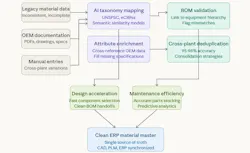
AI classifiers trained on industrial parts vocabulary map raw, inconsistent material descriptions to standardized taxonomies with high accuracy, processing bulk legacy records at a speed no human team can match. Enrichment agents then cross-reference OEM portals and supplier catalogues to fill missing attribute fields automatically: frame size, voltage rating, mounting configuration and current part numbers, without manual research.
Cross-Plant Duplicate Detection
The same physical component may appear as “Bearing, SKF 6205-2RS” in one plant's SAP instance and “Ball Brg 6205 sealed” in another, with different internal numbers and stock positions. AI deduplication systems using semantic similarity models identify these cross-plant duplicates with 95% to 98% accuracy, then propose consolidation strategies: which record becomes the master and which stock positions should be merged.
BOM Validation
A classified spare part that is not linked to the correct equipment BOM has limited operational value. AI systems validate BOM completeness by comparing structured component lists against equipment hierarchies, flagging missing items, mismatched specifications and orphaned records no longer associated with live assets. This matters most when you consider that predictive maintenance strategies are only actionable when parts and equipment data is structured, complete and current. Classification is the precondition, not an afterthought.
Intelligent document processing extends this further: AI agents extract BOM data from scanned engineering drawings, OEM manuals, and PDF specifications and create or update structured ERP records without manual re-entry. For capital project teams and maintenance planning groups dealing with large volumes of as-built documentation from equipment vendors, the throughput gain is significant. Documented deployments have shown BOM processing time reductions of up to 80%.
For example, regulatory compliance in power generation creates a direct dependency on classification quality. Every component used in a maintenance or capital activity must be traceable to its specification, its certification and its approved BOM. Manual processes for maintaining this traceability at scale are both expensive and error-prone.
AI-maintained classification systems, continuously updated as OEM specifications change and as equipment is modified, make compliance-grade traceability achievable without the overhead of dedicated manual data stewardship teams. This is particularly relevant as the energy sector accelerates equipment modernization: Each retrofit or upgrade requires BOM updates that manual processes frequently miss.
|
Metric |
Benchmark |
|
Cross-plant duplicate detection accuracy |
95 to 98% |
|
BOM processing time reduction |
Up to 80% |
|
Inventory overstock reduction |
30 to 65% |
|
Part ID time in emergency repairs |
Reduced 50%+ |
|
Aftermarket parts planning inventory level reduction |
Up to 30% |
|
Aftermarket parts service level improvement |
Up to 97% |
Source: MRO industry benchmarks and documented enterprise deployments
For manufacturers running complex production operations, BOM accuracy is a direct production continuity variable. MRO prioritization has long been an uphill battle, not because teams underestimate its impact, but because sustaining data accuracy manually costs more than most organizations can justify. AI classification removes that constraint. When component data can be governed automatically and continuously, the economic case for deprioritizing it disappears.
Where Asset-Intensive Industries Feel it Most
In oil and gas, a misclassified pressure relief component is not a procurement inconvenience. It is a potential safety and regulatory event. AI classification maintains full attribute traceability across geographically distributed assets, which is critical for organizations that have grown through acquisition and consolidated multiple legacy ERP systems.
In mining, the criticality curve for spare parts is steep. A haul truck suspension component can sit unused for months, but when needed, its absence is measured in halted production shifts. AI criticality classification evaluates operational impact, safety risk and lead time simultaneously, giving maintenance teams a far more accurate picture of what genuinely needs proactive stocking.
For discrete manufacturers, BOM accuracy is a direct production continuity variable. The discipline of keeping maintenance bill of materials current with as-maintained equipment configurations is what separates organizations that can plan and execute maintenance from those that discover discrepancies only when a work order is already open.
The bottleneck in most maintenance design cycles is not engineering skill. It is the time spent verifying whether the data in the system can be trusted.
The Design Cycle Connection
The connection between classification and product design cycle speed is most visible at three points. The first is component selection: When a design engineer searches a parts library or CAD component database, well-classified records with complete attributes let them select, validate and lock in a component in minutes. Poorly classified or incomplete records force manual verification against supplier datasheets, OEM portals and procurement systems, often taking hours per part across a complex assembly.
The second is the design-to-procurement handoff. A BOM released from engineering only moves cleanly into procurement when every component on it resolves unambiguously against a live, classified material master record. When it does not, procurement raises queries, design teams re-engage and the cycle extends.
The third is engineering change orders. A significant share of ECOs in asset-intensive product environments are triggered not by genuine design improvements but by classification failures discovered after release: a part that turns out to be superseded, unavailable or mismatched to its specification. Eliminating that class of ECO through accurate upfront classification is one of the most direct ways AI shortens the product design cycle.
Underpinning all three is the gap between the as-designed BOM and the as-maintained equipment configuration. In asset-intensive industries, products are modified over their operational life: Components are substituted, equipment is upgraded and the physical asset diverges from its original design record.
When the as-maintained BOM is kept current and classified accurately, design engineers working on modifications or replacements start from a reliable baseline rather than an outdated one. Every design iteration they avoid is time returned to the product cycle.
When classification data is accurate and instantly accessible across all of these points, dependencies that previously took days resolve in seconds. BOM creation time drops by up to 80% when AI extracts and classifies component data from engineering drawings. Procurement accelerates because classified parts can be sourced and substituted based on dimensional and functional equivalency rather than manual supplier research.
And as Machine Design has documented in its coverage of SciML-based predictive maintenance, advanced condition monitoring models generate actionable alerts only when the underlying asset data is structured and current. Classification is the enabling layer beneath the predictive strategy.

Conclusion
Material and component classification is infrastructure. Like structural steel or electrical wiring, it is not visible in finished work but the quality of everything built on top of it depends directly on whether it is correct.
For product design engineers, poor classification means avoidable ECOs, stalled BOM handoffs and component selections that collapse under procurement scrutiny. For maintenance and reliability engineers, it means wrong parts issued, critical spares out of stock and equipment BOMs that no longer reflect what is actually installed. These are not separate problems with separate solutions. They are the same data quality failure showing up at different points in the asset lifecycle.
AI-driven classification, integrated continuously into the ERP material master, addresses all three. The technology is available now and the organizations that deploy it earliest will carry a compounding advantage in maintenance efficiency and design cycle speed.
About the Author
Kalpesh Shah
Global Client Partner, Verdantis
Voice Your Opinion!
To join the conversation, and become an exclusive member of Machine Design, create an account today!

Leaders relevant to this article: