How Digital Twins Boost Teleoperation in Hazardous Environments
This article was featured in Machine Design’s Automation & Robotics Takeover Week (July 13-17, 2026).
Robotic systems are routinely deployed in hazardous environments where human access is restricted or impossible. In nuclear facilities, radiation limits exposure times, so complex cleaning, maintenance and decommissioning tasks are typically performed using teleoperated robotic systems. For example, a robotic arm may be used to cut and remove contaminated pipework inside a nuclear facility, where tight clearances and limited visibility make precise positioning difficult.
Even mildly radioactive environments can degrade robotic systems, disrupting electronics and damaging materials over time. This can lead to signal errors, drift and eventual component failure. Whether deploying specially designed radiation-tolerant systems or adapting industrial robots with shielding, teleoperation is typically required.
And teleoperation introduces its own challenges. Operators do not directly observe the robot but rely on cameras, sensors and haptic feedback to interpret the workspace. This results in a partial and sometimes misleading view, with reduced depth perception, occlusions and spatial relationships that must be inferred rather than directly observed.
System latency further complicates control, meaning movements that appear safe on screen can result in near-collisions. In these environments, the cost of error is high. Collisions can damage equipment that is difficult to repair and recovery operations may be impossible.
Engineering Challenges: Restricted Access and Limited Visibility
In conventional industrial settings, engineers can test motions, observe results and refine programs right beside the robot. They can see and touch the system directly and intervene as required.
In nuclear environments, where teleoperation is required, this is not possible. Access is limited. Manual adjustments to the robot are not possible. And visibility is reduced. At first glance this seems like a visualization problem, but it’s actually a control architecture problem.
Digital Twins Enable Integrated Control
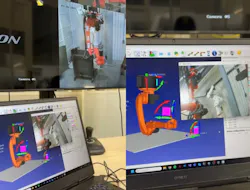
One strategy is to introduce a synchronized virtual model of the robot and its environment using digital twin software. The model can be continuously updated using live data from the robot controller, with joint positions, tool orientation and system state being updated in real time within the digital environment.
READ MORE: Partnerships Progressing Robotic Potential
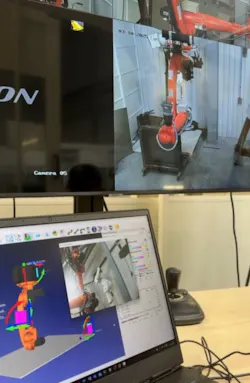
This creates a layered control architecture in which the physical robot executes commands at the controller level, the digital twin mirrors the robot state in real time and the operator interacts with the system using the virtual model combined with a live camera feed.
The digital twin provides a complete and coherent representation of the workspace, giving operators the extra information and control they need to safely perform teleoperated applications in hazardous environments.
Control Architecture
At a system level, the control architecture has three interconnected layers.
- Command layer. This is where the operator defines intent. Commands can be sent through the digital twin software, a teach pendant or other control system. In teleoperation, with safety in mind, these commands are typically incremental. The operator adjusts position, orientation or motion by small margins and in a careful, step-by-step manner.
- Execution layer. The robot controller translates commands into motion. It manages factors such as joint interpolation and trajectory planning. This layer is responsible for the physical behavior of the robot.
- Representation layer. This is where the digital twin operates. The controller streams state data to the simulation environment. The digital twin reconstructs the robot’s position and motion within a full 3D model of the workspace.
This layer provides context that enables the operator to understand what the robot is doing and how that action relates to its surroundings.
Enhancing Perception
Using digital twins reduces reliance on cameras by providing an accurate and consistent spatial model of the environment.
This enables direct measurement of distances and clearances and visualization of planned and executed paths. For instance, when inserting a tool through a confined opening or navigating a tool around fixed structures, the operator can verify clearances and approach paths directly within the digital model rather than relying on camera angles.
Digital twins can also detect potential collisions before they occur. As the robot moves, the digital twin can continuously evaluate its proximity to surrounding objects. This provides immediate feedback that is not dependent on camera perspective.
For human operators, this means that instead of relying on incomplete visual data, they are supported in their decision making by a model that accurately encodes the geometry of the environment.
OLP Enables Pre-deployment Testing and Validation
The same architecture supports offline programming (OLP). This enables engineers to define tasks in the digital twin, validate those tasks and generate the robot code required before deploying the automation.
As a result, many decisions can be made and validated in advance, reducing the need for real-time human intervention during teleoperation.
Consider a complex sequence such as cutting, grasping, or removing a component. OLP enables such tasks to be planned and validated in advance so that, during execution, the operator supervises and adjusts instead of having to define each motion, step by step.
The workflow for incorporating digital twins into teleoperated hazardous applications becomes:
- Planning and validating in the digital environment
- Deploying to the physical robot(s)
- Monitoring execution using cameras and a digital twin
This approach to robot operation reduces the burden on the operator during live operation.
Fidelity in the Control Loop
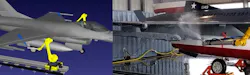
For control and collision avoidance, kinematic accuracy is typically sufficient. The digital twin must accurately represent joint motion, tool position and environmental geometry.
Physics-based modeling becomes relevant when control decisions depend on forces or material interaction. This may apply in tasks such as cutting or handling deformable objects. Tasks that involve material removal or contact forces, for example, may require additional modeling to ensure that the tool behaves as expected.
Real time performance requirements mean that the simulated environment must update quickly enough to remain useful during operation.
Calibration and Synchronization
The effectiveness of this engineering approach depends to a large extent on the degree of alignment between the digital and physical systems.
READ MORE: Flexible Robots, Messy Worlds: Inside Siemens’ Push for Practical Industrial AI
In hazardous environments, where access is limited, this correspondence between the simulated environment and the real world becomes critical.
Software-based robot calibration tools ensure that coordinate systems, tool offsets and environmental models are reliable. Meanwhile, synchronization capabilities ensure that the digital twin reflects the current state of the robot with minimal latency.
Limitations and Risk
Digital twins don’t eliminate all uncertainty, but they do reduce it. In the real world, environmental changes may not be captured immediately, sensor data may be incomplete and materials deform.
Think of digital twins as an extra tool in the human operator’s toolkit, not a replacement for all the other tools available. And even though leading digital twin software systems are highly accurate, they provide an abstracted layer of information, so it is still necessary to maintain margins and validate assumptions.
Conclusion
Hazardous environments impose both physical and perceptual constraints on teleoperated robotic systems. Operators must control complex machines while relying on limited and indirect feedback.
A digital twin integrated into the control architecture provides a practical way to address this challenge. It supplements camera-based perception with a complete spatial model. It supports offline validation and reduces reliance on real-time interpretation.
By integrating a synchronized digital twin into the control loop, engineers can improve operator awareness and achieve more reliable first-time execution in the most challenging environments.
About the Author
Albert Nubiola
CEO, RoboDK
Voice Your Opinion!
To join the conversation, and become an exclusive member of Machine Design, create an account today!
 Leaders Logo
Leaders relevant to this article: