Flexible Robots, Messy Worlds: Inside Siemens’ Push for Practical Industrial AI
Inside Siemens’ corporate research division, Dr. Kal Mos is less interested in chasing robot demos as a lab trophy than reshaping how the global industry actually runs. His current mandate is to push flexible robotics and prototypes into systems that operate reliably in unpredictable factories and warehouse floors.
Nine months into leading research and predevelopment at Siemens Foundational Technologies, Mos is occupied with solving the stubborn engineering problem of turning technologies that perform well in controlled environments into robust, commercially viable solutions for the real world.
Transforming Vision-Language-Action (VLA) Models into Real-World Robotics
A big part of that effort is simulation. Training robotic systems invariably relies on pairing real-world data with large-scale simulations in controlled environments. And about 18 months ago, Siemens developed its program by having robots observe humans. The process, known as a vision-language action (VLA) model, allows a robot to look at a task, reason through it and execute it later—and on its own.
The process starts with teleoperation, where humans repeat the same tasks hundreds of times while the robot watches, records and learns from their actions. The data is used to fine-tune the model and teach it to handle variations.
From there, researchers observe how well the model works and create a closed-loop simulation. “The closed-loop simulation basically means the robot has perception—it has a lot of sensors and it can actually perceive the environment around it,” said Mos.
READ MORE: Are Humanoid Robots Ready for Industry? Hannover Messe Thinks So (Maybe)
Still, the work of creating an autonomous robot remains a research goal. “It doesn’t exist in reality yet,” he noted.
Siemens uses some of its prototypes in its factories, where they are actively employed in the production process. “We call them flexible robots because they are not completely autonomous yet, but they are not pre-programmed.” Mos explains. “You don’t program all the steps—you give them a job and tell them to figure out the steps in between, and they can do that.”
Once deployed, the system enters a “closed-loop simulation” environment where it builds on the AI model, refining tasks through repeated demonstrations. The robots use sensors to perceive their surroundings, adjust their actions based on real-time data and operate in an iterative cycle—observe, act, adjust—training them to function beyond controlled settings.
These “flexible” robots are an early step toward more independent machines. On the shop floor, that capability takes shape in systems like mobile manipulators that combine a robotic arm with a mobile base. They are not fully autonomous but can perform selected tasks with a degree of independence, and are beginning to bridge the gap between instruction and initiative.
Flexible Manufacturing and Automated Pipeline Demos
At the Siemens Innovation Hub during Hannover Messe 2026, the company demonstrated how industrial AI is shaping a growing autonomous industry. In one example, industrial vision AI supports picking robots by helping them identify and handle a variety of objects.
By analyzing an object’s shape, size or packaging within milliseconds and using vacuum-powered multi-grippers, the robot can move items along the pipeline. The Simatic Robot Pick AI Pro helps to overcome complex intralogistics challenges in ways that were not possible before.
When it comes to picking up solid or flexible materials, humans don’t give it a second thought. That’s not the case in robotics. “If you think about it, for robots, it’s a very difficult operation because [picking up] flexible materials are much harder than picking up something solid,” said Mos. The core challenge is sensing and control when handling soft objects. The robot needs to understand how much pressure to apply so it can grasp the object without deforming or damaging it.
READ MORE: Physical AI Hype vs Reality: Kung Fu Robots are Cool...But Should You Hire One?
This becomes even more complicated when placing an object into another flexible container (for example, placing several items into a plastic bag). Both the objects and the bag can change shape or configuration unpredictably, so the robot must continuously adjust its grip and motion using force/torque sensors and perception systems.
Rather than chasing general-purpose intelligence, Siemens is focusing on developing fewer, more tightly defined use cases. The rationale behind flexible robots, according to Mos, is that narrowing the scope will allow developers to train systems more effectively and more reliably with a goal to achieve full autonomy. Even so, the path forward remains labor-intensive, he said.
Developing Factory-Grade Humanoid Models
Manufacturing and logistics companies are increasingly eyeing bipedal systems as the next step in automation. At Hannover Messe 2026, at least 15 exhibitors showed robots built for deployment on actual production lines. These robots were designed to slot into existing workflows and take on more complex tasks.
For Mos, the question is not whether humanoids belong in industry, but whether they truly outperform conventional automation. The preference, he said, comes down to an “equation between value and cost.” Because the world was built for humans—chairs, tables, transportation and factories—a machine that can move through the same spaces and behave in similar ways would be immensely valuable.
Yet the path there is likely incremental. Mos argues that until that milestone can be achieved at a reasonable cost, there may be more value in machines with wheels. In the near term, simpler platforms may offer greater utility; they are easier to move, can carry larger batteries and avoid many of the stability challenges that come with legs and feet, he said.
Neither is Siemens in the business of developing hardware for robotics. Rather than producing physical hardware, Siemens is addressing such challenges through its software-centric approach, targeting the intelligence and orchestration layer of robotics. The goal is to improve decision-making and system integration.
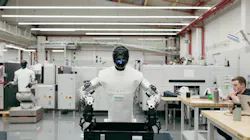
As part of a press tour, Machine Design visited the Siemens electronics factory in Erlangen, Germany to observe this strategy in action. There, Siemens, in collaboration with Humanoid, a UK-based AI and robotics company, is developing the Humanoid’s HMND 01 wheeled Alpha robot for executing autonomous logistics tasks without adding more hardware.
The collaboration relies on foundational AI models built on NVIDIA’s AI stack. So, instead of designing a new gripper for handling fabric, Siemens is developing AI that allows an existing robot to understand how to grasp, adjust force and coordinate with machines in a production line.
In this setting, Siemens Xcelerator provides the digital twin, simulation environment and orchestrates data flows that tie together the design, simulation, industrial control and analytics of the humanoid robot, allowing it to be monitored and updated in real time.
About the Author
 Rehana Begg
Rehana Begg
Editor-in-Chief, Machine Design
As Machine Design’s content lead, Rehana Begg is tasked with elevating the voice of the design and multi-disciplinary engineer in the face of digital transformation and engineering innovation. Begg has more than 24 years of editorial experience and has spent the past decade in the trenches of industrial manufacturing, focusing on new technologies, manufacturing innovation and business. Her B2B career has taken her from corporate boardrooms to plant floors and underground mining stopes, covering everything from automation & IIoT, robotics, mechanical design and additive manufacturing to plant operations, maintenance, reliability and continuous improvement. Begg holds an MBA, a Master of Journalism degree, and a BA (Hons.) in Political Science. She is committed to lifelong learning and feeds her passion for innovation in publishing, transparent science and clear communication by attending relevant conferences and seminars/workshops.
Follow Rehana Begg via the following social media handles:
LinkedIn: @rehanabegg and @MachineDesign
YouTube: @MachineDesign-EBM
Voice Your Opinion!
To join the conversation, and become an exclusive member of Machine Design, create an account today!
 Leaders Logo
Leaders relevant to this article: