Will AI Replace Programmers? What Elon Musk’s Prediction Means for Mechanical Engineers
This article was featured in Machine Design’s Automation & Robotics Takeover Week (July 13-17, 2026).
Recently, Elon Musk dropped a bit of a bombshell, one that all engineers should pay attention to. “I think by the end of this year you don't even bother doing coding,” Musk said. “The AI will just create the binary directly.”
In response, an X user called Dustin noted what has been known from the start of computer use, that code has always been “friction, a tax we paid because machines didn’t speak human. [But now,] AI just learned fluent human.”
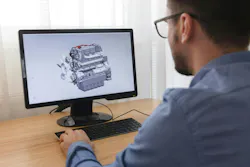
That is, with the advent of generative AI and large language models (LLMs), we are now in an era of simply using spoken or typed language to direct an AI to do certain tasks, drawing on its existing code or forcing it to develop new code to complete the task. Although human expertise and validation remain essential, for mechanical engineers, natural language model interfaces are practical and will aid enormously in the process of designing a machine or solving a design problem.
Potential uses include generating component or entire assembly designs; configurating parts; running what-if scenarios and trade-off evaluations; determining efficiency; and testing and validating designs.
READ MORE: Leo AI: How CAD-Aware AI is Changing Mechanical Design and Engineering Workflows
Software engineers knew this day would come. And there are those who recognized the day was coming fast. In early 2023, for example, Dr. Andrej Karpathy, previous Director of AI at Tesla and a founder of OpenAI, posted on X, “the hottest new programming language is English.”
Fast forward three years, and on April 2026, he declared on X that “in my opinion, ‘[LLM] agent proficiency’ is a CORE SKILL of the 21st century. These are extremely powerful tools—they speak English and they do all the computer stuff for you.”
Using LLMs
In April 2026, Karpathy shared a powerful new way of using LLMs that he has recently developed, one that anyone can use for a personal interest (e.g., cooking, genealogy) or an engineer can use to generate a new concept or solve an engineering problem. It’s a workflow system where you can ask plain language questions of an AI focused on specific information and receive much more powerful answers than would have been possible otherwise.
Let’s look at this in a machine design context. The first step is for the mechanical engineer to find and then place in a folder selected raw sources of pertinent information (e.g., articles/blogs, research papers, datasets, images) related to a design problem or the exploration of a new design concept. The chosen LLM agent is directed to analyze and distill pertinent information in the folder to build and maintain a “wiki” on the topic—a structured, interlinked collection of files.
“When you add a new source [that you have vetted], the LLM doesn’t just index it for later retrieval,” Karpathy explains. “It reads it, extracts the key information and integrates it into the existing wiki, updating entity pages, revising topic summaries, noting where new data contradicts old claims, strengthening or challenging the evolving synthesis.”
Once the wiki is large and rich enough, the engineer can start asking the LLM questions—in plain English—and the LLM generates answers. Each time this happens, the LLM grows as an expert on the project’s knowledge and also grows in its ability to further enrich the wiki by filling gaps, noting new connections and generating context-aware answers.
Engineers thus create a “second brain” for themselves completely focused on a specific problem or project. All without using a programming language.
Inherent Dangers
Of course, using human language and not having an expert human being write (or at least check) lines of code—or even using “low-code” approaches where coding is minimized—is not infallible. Indeed, any AI use introduces the risk of errors, from very small to very large.
Amazon’s reliance on AI-generated code is a prime cautionary tale. Like other companies, Amazon has been pressuring its software engineers to use more and more AI to do coding. But in December 2025, its engineers let Amazon’s Kiro AI update some code without oversight, and Kiro “decided” the best solution was to delete the code and start from scratch.
READ MORE: From Data to Decisions: The Race to Make Industrial AI Operational
In early March 2026, Amazon’s AI systems caused 120,000 lost orders and 1.6 million website errors. Three days later, 6.3 million orders were lost. Amazon software engineers must now use strict protocols, including their own complete oversight of code creation/updates, and have a second engineer review changes before they are deployed.
And oversight takes time. Indeed, experts like Dr. Kai Lin Woon, Associate Professor at University of Malaya in Malaysia, note the growing evidence that on complex or highly contextual tasks, the need to review an AI’s work can slow task completion. Yes, AI accelerates the simple and the standard, he says, but at this point, it does not accelerate the subtle, complex and the novel—making strong mathematical and physical reasoning critical.
“The engineer must break down the problem, decide what matters most, work through the steps carefully and check that the answer is right,” says Woon. “AI can help, but it may not understand the full situation. So the engineer still needs to guide it, review its work and fix errors.”
At the same time, he notes that “engineers will get better at using AI. They will learn which job parts to delegate, how to ask better questions and how to check answers faster. Secondly, AI itself will improve. It will reliably get better at following long chains of reasoning, handling context and solving harder problems.”
The Future of Programming
While Woon agrees with Musk that programming languages may soon become obsolete, he’s not convinced their demise will happen by the end of 2026.
“AI is clearly getting better at writing code, and it may eventually handle more of the low-level technical work, possibly even creating machine-level instructions more directly,” says Woon, “but that does not mean human-readable programming languages suddenly stop mattering.”
READ MORE: Q&A: How Contextualized Data and AI Agents Enhance Manufacturing Automation
Software, he says, still has to be understood, updated, checked, fixed and tested to ensure it behaves properly in the real world.
But if Musk’s prediction proves correct in the longer term, what does this mean for machine designers?
A rebalancing of responsibilities may be underway. The most significant shift is not simply less time spent on implementation tasks, but a greater emphasis on defining system intent. In Woon’s view, “their job will shift toward defining the real-world goal, the limits, the safety requirements and the tests that a solution must pass.”
Moreover, mechanical engineers will need to be even stronger at understanding physics, design, failure and real-world performance. An AI may generate many possible solutions but humans will still need to decide which one is correct and safe.
Engineering with AI
No matter whether the engineer talks to an AI and it produces the code to address a given task or the engineer is involved in creating the required code, Woon stresses that it is very important, and in many cases becoming necessary, for mechanical engineers to understand enough science, mathematics and computing to check whether AI is giving a trustworthy answer.
...Woon stresses that it is very important, and in many cases becoming necessary, for mechanical engineers to understand enough science, mathematics and computing to check whether AI is giving a trustworthy answer.
“AI can produce responses that sound confident and look impressive but that does not always mean they will work in real life,” he says. “That is why every mechanical engineer should be trained to think from basic principles, test assumptions and compare AI’s suggestions against physical reality. They should be able to ask simple but powerful questions: Does this make sense according to the laws of physics? Will it still work outside a small test case? Could a tiny error grow into a serious problem? Has this been checked against experiments or real data?”
At the same time, some mechanical engineers need only be experts in one area of computing, says Woon. That is, some areas, like understanding when calculations can become unstable or when a problem becomes too large and slow to handle efficiently, are useful for many engineers, but “other topics, such as how computer memory affects performance or how failures happen in large connected systems, are mainly essential for engineers working in areas like robotics, smart factories, autonomous systems, digital twins or other highly computerized machines.”
“The real goal is not to turn every mechanical engineer into a computer scientist,” he says. “The goal is to ensure they know enough to distinguish between a truly reliable AI answer and one that only looks convincing.”
Editor’s Note: This article is part of Machine Design’s summer reading series exploring global design engineering trends redefining how products are conceived and scaled.
In This Series:
- From Data to Decisions: The Race to Make Industrial AI Operational
- The Coming Shift: Why Industry 5.0 Will Be Driven by AI in Mechanical
- Will AI Replace Programmers? What Elon Musk’s Prediction Means for Mechanical Engineers
- Q&A: The AI-Robotics Convergence: Global Perspectives for Machine Builders
- The Robots Are Getting Real: Lessons from Hannover Messe’s Industrial AI Reality
About the Author
 Treena Hein
Treena Hein
Treena Hein is an award-winning science and technology writer with over 20 years’ experience.
Voice Your Opinion!
To join the conversation, and become an exclusive member of Machine Design, create an account today!
 Leaders Logo
Leaders relevant to this article: