Automation in 3D: The New Standard for Smart Manufacturing
This article was featured in Machine Design’s Automation & Robotics Takeover Week (July 13-17, 2026).
To stay afloat in today’s economy, manufacturers are expected to perform a balancing act. While product lifecycles continue to shrink, the demand for customization increases, and the labor shortage persists. As such, manufacturers face mounting pressure to reduce costs and bring new production capacity online faster than their competitors. Unfortunately, traditional factory planning methods simply aren’t enough to keep pace anymore.
For decades, engineers relied heavily on static 2D drawings and spreadsheets for designing production systems. While these tools remain useful for documenting concepts, they often fail to reveal how an automated system will behave once equipment runs on the actual shop floor. Instead, they can cause project delays and expensive modifications that emerge only after the initial installation has already begun.
To overcome these challenges, manufacturers are increasingly turning to 3D automation simulation. When manufacturers create virtual production environments that accurately represent real-world operations, they can optimize and validate automation systems before purchasing equipment and laying the groundwork for new plants or additions to existing facilities. In doing so, the deployment of automation is smarter, faster and involves less risk.
Why Traditional Planning Methods Fall Short
Modern manufacturing systems are far more interconnected than the production lines of previous decades. Automated material handling robots, machine vision systems, autonomous mobile robots and advanced controls must all work together seamlessly. Unfortunately, traditional planning tools often provide only a partial view of how these systems interact.
A static 2D drawing can show equipment placement but fails to accurately demonstrate key factors such as machine movements, cycle times, operator interactions or material flow. Thus, these critical issues frequently remain hidden until commissioning.
READ MORE: The Eyes of Automation: Machine Vision’s in AI-Powered Automation
Communication challenges further complicate the process. All those involved in a project from engineers to automation suppliers and company leadership often interpret technical drawings differently. Any misunderstandings can then require design revisions, which in turn lead to schedule delays and budget overruns. This is why manufacturers need planning tools that can identify potential problems before they become real-world roadblocks.
Manufacturing Comes to Life in 3D
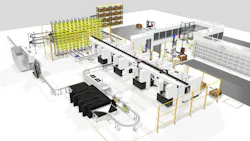
Instead of relying solely on static documentation, manufacturers can use 3D simulation to visualize how an entire system will operate before construction starts. With it, engineers can observe robots moving through programmed paths as well as evaluate machine interactions, verify material flow and test production scenarios, all within a digital environment.
Because the simulation reflects actual equipment behavior, everyone involved gains a much clearer understanding of system performance. Engineers can identify design issues earlier. Operations personnel can evaluate workflow efficiency. Decision-makers can assess project feasibility with greater confidence. But most importantly, 3D simulation allows them to quickly and easily test various iterations.
Rather than waiting weeks or months to evaluate a design change physically, engineering teams can make adjustments within a virtual model and immediately observe their impact.
Validation Before Installation
Another significant advantage of 3D automation simulation is the ability to validate production processes before equipment reaches the factory floor. It allows manufacturers to analyze cycle times and identify if a robot’s motion path creates inefficiencies or if material flow causes congestion, for example. Engineers can then optimize it virtually and test alternative layouts instantaneously.
Simulation replaces assumptions with data. By modeling actual production behavior, teams can verify whether performance targets are realistic before capital expenditures occur. This enables organizations to make more informed investment decisions and avoid costly surprises during startup.
The ability to validate processes early also supports faster commissioning. When systems have already been tested extensively in a virtual environment, fewer issues remain to be resolved during installation and ramp-up.
Scenario Testing Reduces Risk
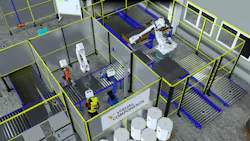
As production schedules shift and new automation technologies emerge, 3D automation simulation provides a powerful platform for exploring “what-if” scenarios. Manufacturers can test multiple layouts and compare alternative automation strategies without disrupting actual operations.
Additionally, they can analyze how increased demand affects throughput or assess the impact of introducing new products or automation variants, which significantly reduces implementation risk.
Instead of discovering limitations after deployment, organizations can evaluate alternatives in advance and select the most effective solution. The ability to explore multiple scenarios also supports more strategic decision-making by providing quantitative insights into system performance.
Collaboration Across Teams
Operators, maintenance technicians, floor managers and external suppliers all contribute to automation project success. Yet, collaboration remains one of the most persistent challenges in manufacturing. A shared 3D simulation environment, on the other hand, can bridge these collaboration gaps.
Because virtual models are visual and intuitive, stakeholders can quickly understand system behavior without interpreting complex drawings. Engineers can demonstrate automation concepts more effectively. Operations personnel can provide practical feedback earlier. Leadership teams can evaluate project outcomes with greater clarity.
Instead of reacting to issues after implementation, teams can identify project execution concerns during the planning process and resolve them collaboratively.
Using 3D Simulation for Smarter Manufacturing
While simulation delivers immediate project-level benefits, its value extends far beyond factory planning and into digital transformation initiatives focused on connectivity, data analytics and intelligent decision-making. Simulation increasingly serves as a foundational technology for smarter manufacturing, and the digital twin is an excellent representation of this evolution.
When they create accurate virtual representations of production systems with 3D simulation, manufacturers establish a platform that supports future analytics, optimization and operational improvements. Once the virtual environment exists, organizations can test modifications digitally before implementing them physically for continuous improvement while minimizing operational disruptions.
Make Data-Driven Decisions
Manufacturers generate enormous volumes of operational data, but the challenge is transforming that data into actionable insights. Simulation bridges that gap.
When production data is combined with virtual models, organizations gain a deeper understanding of system behavior. Engineers can evaluate performance trends and test corrective actions in a flexible environment.
READ MORE: MBSE Roadmap for Deisgn Engineers
Instead of relying solely on historical performance data, manufacturers can now explore future outcomes. Such predictive capability is increasingly valuable as organizations adopt advanced technologies such as artificial intelligence and machine learning. Simulations allow these technologies to evaluate potential scenarios and optimize system performance before changes occur in the real world for a more proactive approach to manufacturing improvement.
As Industry 4.0 initiatives continue to mature, manufacturers are moving beyond isolated automation projects and more toward fully integrated digital ecosystems as a competitive advantage.
3D simulation enables those organizations to improve collaboration, accelerate deployment and make better-informed decisions. It transforms factory planning from a reactive process into a proactive strategy built on data and validation.
Most importantly, simulation delivers measurable business outcomes. It helps manufacturers avoid costly mistakes to shorten project timelines and maximize their return on investment (ROI). Those companies that embrace 3D simulation today are positioning themselves to build smarter factories tomorrow.
Key Definitions for Smarter Manufacturing
Artificial intelligence. A technology that enables computers and machines to perform tasks that typically require human intelligence. AI systems can analyze data, recognize patterns, make predictions and support decision-making to improve operational performance.
Digital twin. A virtual representation of a physical asset, process or production system. Unlike traditional models, digital twins can incorporate real-world operational data, creating a dynamic connection between physical and digital environments.
Industry 4.0. The integration of connected digital technologies, such as Internet of Things (IoT), automation, artificial intelligence and data analytics, into manufacturing operations. These technologies enable real-time data sharing, greater visibility and smarter decision-making across the production lifecycle.
Machine learning. A subset of artificial intelligence that allows software systems to learn from data and improve their performance over time. By identifying patterns and relationships within large datasets, machine learning helps automate analysis, generate insights and predict future outcomes.
3D simulation. A computer-generated digital environment that mimics real-world scenarios, physical forces and dynamic systems. Creating geometric 3D models allows users to safely test, visualize and analyze how objects and processes behave over time.
About the Author
Graham Wloch
Director of Business Development, Visual Components
Voice Your Opinion!
To join the conversation, and become an exclusive member of Machine Design, create an account today!
 Leaders Logo
Leaders relevant to this article: