The Eyes of Automation: Machine Vision’s Role in AI-Powered Automation
For more Automate 2026 coverage, be sure to visit our Tradeshow Takeover event hub.
The camera never lies. At least, that was the premise behind machine vision’s earliest industrial deployments in the 1970s and 1980s, when manufacturers relied on cameras to inspect parts, verify assembly steps and catch defects before they leave the line.
Four decades on, that definition no longer holds. Today, the camera is merely the front end of a distributed intelligence system. Vision systems can now operate across a perception layer that fuses AI, edge computing, RFID, 3D sensing and real-time analytics. This allows the system to look beyond surface-level appearance to interpret context, track an object’s identity and trajectory, and anticipate the next logical action.
In practice, said Charlie Long, Vice President and General Manager of Machine Vision at Zebra Technologies, that means a smart camera can read text, classify defects, correlate a tag ID and trigger an action without shipping every frame back to a central server.
“Recent advancements in embedded processing have completely altered the landscape for OCR (optical character recognition) deployment,” Long added. “Modern smart cameras now feature powerful general-purpose processors, multicore systems on a chip and dedicated neural processing units. This on-camera intelligence is democratizing access to high-performance machine vision, enabling engineers and integrators to deploy sophisticated inspection solutions with the ease of a simple sensor, but with the analytical power of an industrial computer.”
Growth Drivers for Machine Vision Through 2030
These enabling technologies are driving a market that is shapeshifting in response to new demands. Interact Analysis, which tracks the global machine vision sector through supplier data and primary research, notes software, 3D vision and AI-enabled systems as primary growth drivers through 2030. The momentum is closely tied to the industry’s push toward automated production lines. According to the International Federation of Robotics’ 2024 forecast, robot installations have doubled globally over the past decade, underscoring the rapid push toward automated production lines.
But as capabilities expand, so do the challenges. “The most pressing bottleneck for our customers is integration and the complexity of scaling systems to handle massive data volumes as they move from pilot to full-scale production,” Long said. “Many organizations struggle to unify disparate technologies and extract actionable value without overwhelming their networks or relying on highly specialized engineers.”
Addressing that gap is central to Zebra’s strategy. Long said the company is focused on simplifying deployments through edge processing, more cohesive software platforms and deep learning analytics—capabilities strengthened by its Matrox and Photoneo acquisitions.
That integration challenge extends beyond machine vision alone. As manufacturers deploy a growing mix of sensing and automation technologies, they are figuring out that value comes from connections between systems.
“Machine vision is a crucial connective tissue within our broader intelligent automation portfolio,” Long said, noting its role alongside fixed industrial scanning, RFID, 3D vision and robotics. “For example, pairing machine vision with RFID in material handling provides precise tracking and automated visual quality control, drastically reducing errors and optimizing material flow.”
Unified Sensor Data Creates the Biggest Opportunity for Smart Factories
The opportunity lies in orchestrating these complementary technologies to create fully connected factories and supply chains. By harmonizing data from multiple sensors through AI-driven analytics, manufacturers can create fully connected factories and supply chains. This unified approach “ensures that every asset and frontline worker is visible, connected and optimized to drive unprecedented operational efficiency and intelligent operations,” Long said.
Addressing that end-to-end vision is central to Zebra’s strategy. Long said the company is focused on simplifying deployments through edge processing, more cohesive software platforms and deep learning analytics—capabilities strengthened by its Matrox and Photoneo acquisitions. The goal, he added, is to help manufacturers “unify, simplify and scale” machine vision systems without introducing new layers of integration complexity.
Tracking the Advances in Machine Vision at Automate 2026
For readers following the evolution of machine vision, the following products provide a useful cross-section of the technologies that were on display at Automate 2026.
1. Connecting Vision, RFID and Automation
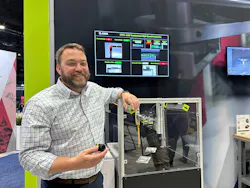
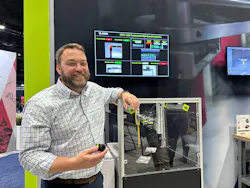
Zebra Technologies, a specialist in mobile computing, barcode scanning and RFID readers, used Automate 2026 to showcase how manufacturers can better connect physical operations with digital workflows through a combination of machine vision, RFID, industrial scanning and real-time asset visibility technologies. The demonstrations highlighted applications spanning material intake, production and distribution, with a focus on improving data access and decision-making for frontline workers.
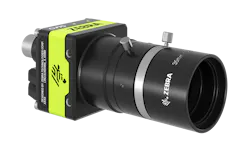
Among the product introductions was a new high-performance machine vision camera (CV70 CXP) designed for demanding inspection tasks, including small-parts inspection, EV battery assembly and semiconductor manufacturing. Zebra positioned the compact camera as a high-resolution solution for space-constrained applications requiring fast image capture and analysis. Paired with Zebra's Aurora software, frame grabbers and vision controllers, the CV70 forms part of a fully integrated machine vision platform designed to simplify deployment and system validation.
Also featured at the booth was Photoneo, a part of Zebra Technologies, which demonstrated vision-guided robotics applications for bin picking, box depalletizing and 3D volume measurement.
South Building—Booth 1825
2. Real-Time Processing for SPAD Sensors
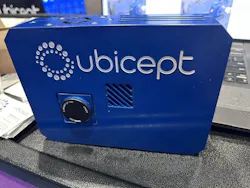
At Automate 2026, Ubicept showcased its computer vision technology with a live demonstration comparing conventional imaging systems against its physics-informed approach to image processing. The Madison, Wis.-based startup focused on challenging conditions that often degrade machine vision performance, including high-speed motion, low light and extreme dynamic range.
“We are showcasing our computer vision system, demonstrating how our processing technology handles lighting conditions that trip up conventional cameras, such as high-speed motion, low light and extreme dynamic range,” said Sebastian Bauer, CEO and co-founder of Ubicept. “Our live demonstration will show a side-by-side comparison where a conventional camera struggles with overexposure in bright conditions and near-invisibility when light drops, while a SPAD camera with Ubicept processing maintains sharp, properly exposed frames throughout.”
Bauer argues that many robot vision failures originate at the sensor level before AI systems ever process the data. To address that challenge, the company takes a physics-informed approach to machine vision that aligns image processing with how light and motion are actually captured. Its Ubicept Toolkit supports both emerging single-photon avalanche diode (SPAD) sensors and conventional CMOS cameras, enabling improved image quality without requiring new camera hardware.
At the core of the platform is FLARE (Flexible Light Acquisition and Representation Engine), which compresses and organizes the large data streams generated by next-generation SPAD sensors to reduce bandwidth and processing demands while preserving critical imaging information.
Combined with Ubicept Photon Fusion (UPF) processing algorithms, the system is designed to make more effective use of photon-level sensor data. “Our technology targets a common bottleneck in machine vision and robotics: When imaging fails under challenging conditions, automated systems must either slow down or accept more errors, compromising reliability, efficiency and safety,” Bauer said.
The result is more reliable visual inputs for robotics, automotive and industrial vision applications, improving the performance of downstream computer vision and AI systems.
North Building—Booth 20160—Automate Start-Up Pavilion
3. Configurable Lighting for Inspection
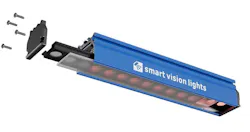
At the Smart Vision Lights booth, engineers and system integrators saw an expanded range of LSR300 configurable lights, now available in sizes from 150 mm to 1050 mm. The display highlighted the series’ custom features for tailoring beam angles and lighting characteristics for different inspection challenges, including interchangeable OptiCard microfilm lenses for narrow, medium and wide beam angles and swappable clear, polarized and diffused optic windows that let systems integrators fine-tune a single platform for many inspection environments.
The LSR produces over 340,000 lux and ships with a built-in driver supporting both continuous and OverDrive strobe modes at working distances of 200–2000 mm. Attendees could also explore how SVL lighting integrates with LMI Technologies’ new Gocator 2D Smart Cameras and could view a live demonstration of the XP Series with Hidden Strobe technology, showcasing higher brightness for high-speed imaging applications.
South Building—Booth 1821
4. High-Speed Vision Meets AI
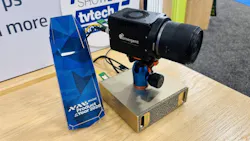
Emergent Vision Technologies showed what happens when machine vision pipelines scale for both speed and data intensity. The new 100GigE ZENITH camera family is built around Sony’s latest back-illuminated Pregius S sensors for applications that call for ultra-high resolution and high-speed imaging. Designed for semiconductor inspection, precision metrology, electronics manufacturing and automated optical inspection, the cameras deliver up to 105 MP resolution or frame rates as high as 662 fps, paired with ultra-low-latency 100GigE connectivity and microsecond-level synchronization for multi-camera deployments.
The new ZENITH cameras will be combined with an NVIDIA DGX Spark edge computer featuring the latest Blackwell AI processor. The demo performed markerless motion tracking while highlighting Emergent’s new eSDK Pro development kit. The company noted that it can reduce vision programming code by up to 90%. Applications include detailed surface analysis, semiconductor wafer and panel inspection, flat panel display manufacturing, electronics assembly, battery production, precision metrology and automated optical inspection.
South Building—Booth 977
5. 1 MHz Line-Scan Inspection
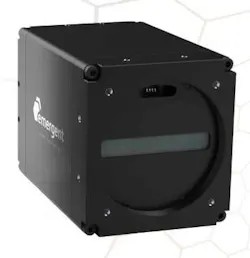
For machine vision developers chasing ever-higher inspection speeds, bandwidth is becoming a competitive advantage. Emergent Vision Technologies also debuted the PINNACLE LZT-8KG5, a 100GigE line scan camera that delivers 8K resolution at up to a 1 MHz line rate.
Built around Gpixel’s GLT5008BSI back-side illuminated CMOS sensor and a 256 TDI architecture, the camera pairs high-speed image acquisition with a single 100GigE QSFP28 interface. It supports GigE Vision 3.0, RDMA and zero-copy image transfer to simplify integration while scaling to multi-camera deployments. Applicable for semiconductor inspection, printing and web inspection, battery inspection and high-speed industrial automation.
South Building—Booth 977
6. Pushing Quality Inspection Closer to Real-Time Decision-Making
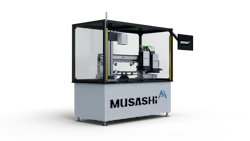
AI is becoming part of the production workflow. Musashi AI is a growing hardware- and software-focused company that builds and develops smart vision solutions. Based in Waterloo, Ontario, Canada, the company will demonstrate the second generation of its Cendiant automated inspection system, a modular platform designed to inspect parts ranging from small precision components to assemblies the size of a car door.
Powered by Cendiant Inspect software, the system uses deep learning to perform surface defect detection, assembly verification and process completeness checks, with defect detection rates of up to 98% on features as small as 50 µm. In addition, Cendiant Quality Insights Gen 2 was on display with new software updates that include enhanced analytics, edge and cloud access, ERP/MRP/QMS connectivity, and new security features aimed at helping manufacturers turn inspection data into process improvements.
South Building—Booth 3837
7. High-Performance Edge AI Compute
As edge computing moves closer to the factory floor, industrial PCs are being asked to handle everything from AI inference to machine connectivity in increasingly compact footprints. At Automate, Teguar debuted its Regiment Series of fanless industrial edge box PCs, spanning high-performance AI systems, compact edge AI platforms and lightweight IoT gateways.
The lineup includes the Intel Core-powered Regis for machine vision and edge AI workloads, the Core Ultra-based Optio with an integrated NPU for on-device AI processing, and the compact Scout gateway for secure data aggregation and thin-client deployments. Designed for harsh industrial environments, the systems combine wide operating temperature ranges, flexible I/O and expansion options, and support for applications ranging from collaborative robotics and vision systems to industrial networking and centralized computing architectures.
North Building—Booth 32022
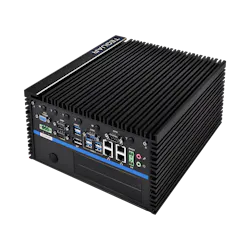
8. Edge AI Without GPUs
Industrial computer manufacturer OnLogic showcased edge AI deployments running on conventional embedded computing platforms. In partnership with viso.ai, the company demonstrated a forklift safety application in which real-time vision inference operated on integrated graphics and on-chip neural processing units (NPUs), illustrating how many industrial AI workloads can be deployed at the edge without requiring discrete GPUs.
Another demo focused on automated quality control. A fine-tuned YOLOv10 object detection model scanned rotating components for defects in moving parts and activated a downstream sorting mechanism to reject faulty components on the product line.
The company also previewed an updated Karbon 800 Series platform built on Intel’s Core Series 2 processors. The system targets more deterministic performance for robotics and edge applications, including autonomous mobile robots (AMRs).
South Building—Booth 867

About the Author
 Rehana Begg
Rehana Begg
Editor-in-Chief, Machine Design
As Machine Design’s content lead, Rehana Begg is tasked with elevating the voice of the design and multi-disciplinary engineer in the face of digital transformation and engineering innovation. Begg has more than 24 years of editorial experience and has spent the past decade in the trenches of industrial manufacturing, focusing on new technologies, manufacturing innovation and business. Her B2B career has taken her from corporate boardrooms to plant floors and underground mining stopes, covering everything from automation & IIoT, robotics, mechanical design and additive manufacturing to plant operations, maintenance, reliability and continuous improvement. Begg holds an MBA, a Master of Journalism degree, and a BA (Hons.) in Political Science. She is committed to lifelong learning and feeds her passion for innovation in publishing, transparent science and clear communication by attending relevant conferences and seminars/workshops.
Follow Rehana Begg via the following social media handles:
LinkedIn: @rehanabegg and @MachineDesign
YouTube: @MachineDesign-EBM