Divine Intervention—The Carmelite Brothers of Wyoming Excel at DIY Machining
Key Highlights
- The Carmelite Brothers started their monastery project in 2003 with minimal funds and have relied solely on private donations and their labor for construction and equipment.
- They have self-educated in CAD and CAM, using Rhinoceros 3D and Mastercam software to design and machine intricate stone components for their gothic monastery.
- Mastercam's multi-axis toolpath and collision detection features enable the Brothers to efficiently produce complex, detailed stonework, including ornate canopies and foliage, with high precision.
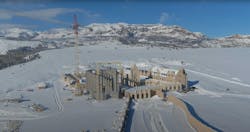
Wyoming: Beautiful, mountainous, expansive. Some might say God’s country. They’d be right—because nestled in this serene vastness reside the Carmelite Brothers of Wyoming. And they’ve built their own gothic monastery.
In the Beginning
The first monks ventured out to the state in 2003, with $400 in their pockets, says Mary, head of stone-cutting operations. In 2010, they bought the land where the monastery sits now, in Meeteetse, Wyo.
Of the 26 Brothers currently at the monastery, typically 8-10 have been engaged in its design and construction. (The Chapter House and hermitages have been completed—only the chapel remains under construction, with completion estimated for 2030.)
“It’s a unique construction site,” says Brother Isadore Mary. “It’s a monastery, so it’s pretty quiet and very prayerful. At the same time, there’s a lot of heavy-equipment work happening.”
READ MORE: How a Precision Machine Shop Boosted CNC Productivity with CAM and Multi-Axis Machining
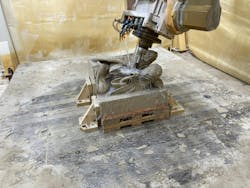
One such piece of heavy equipment is the Brothers’ very first CNC machine (they have seven in total)—a 5 Axis Gantry Mill. It was purchased for them, as the Brothers do not receive any federal funding.
“It’s all private donations and our own labor,” says Mary, adding that they also roast coffee beans, selling their Mystic Monk Coffee online.
“I remember the first meeting we had with contractors bidding out what [the monastery] was going to cost,” he says. “I know monasteries took hundreds of years to build, but it was going to take us hundreds of years to raise the money to build this!”
Learning Curve
That did not deter the Brothers. With their horarium of prayer and manual labor, they headed back to school, as it were, teaching themselves CAD and CAM. Interestingly, not one of them had any background in machining or computer-aided design or manufacturing.
Somewhat expectantly, there was a rather messy learning curve—both figuratively and literally.
“I recall the first time I ran overnight machining. I started the machine, walked away, and came back the next morning. It looked like a hurricane had come through,” says Mary. “The machine was fine, but the stones were not. It took a little bit to figure out what we did wrong.
The Brothers worked with the Mastercam reseller in Denver to help them get comfortable with the interface. “That really helped us get a general understanding of the different options and how to navigate and work with it,” says Mary.
In addition to that help through authorized resellers, Mastercam offers online resources (e.g., video tutorials, webinars); its University (an e-learning platform with online courses tailored to different skill levels); community forums and customer support lines; and CONNECT (a comprehensive maintenance and support program providing access to software releases, technical support and educational resources).
While Mastercam offers its own CAD program, the Brothers had been using Rhinoceros 3D, a CAD program equipped to develop and design more artistic endeavors. (Mastercam is CAD software-agnostic, so integrating Rhinoceros was not an issue.)
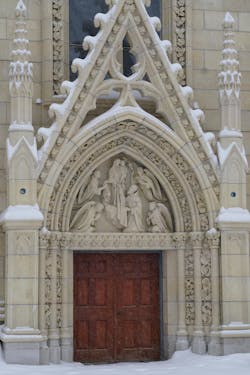
After trying out a number of CAM software programs, they landed on Mastercam two years ago, because they wanted “something more robust” to give them a better tool set, explains Mary. By that time, they had roughly eight years of fairly intensive experience with CAM programming.
Translating “between a theoretical CAD drawing inside of software to the physical world out on a machine,” says Jesse Trinque, CMTSE, product marketing engineer II, with Mastercam. “[Mastercam is] focused on tool pathing and creating a human-machine interface that happens to create that code. We spend a lot of time making that as simple and as useful as we can for the person who’s sitting in front of the computer doing the programming.”
Trinque says the Brothers’ use of the Mastercam software is atypical. “It’s not to say we don’t have customers that produce furniture and wood and stone products, but it’s a much smaller fraction of our customer base. Mastercam software would be used for manufacturing metal components for autos, airplanes—even structural components for buildings or bridges.”
READ MORE: Precision Meets Process: MBSE and Laser Metrology Aid in Complex Assembly
Mastercam’s programming has been efficient, helping to speed up the programming time, says Mary. Versus the previous CAM programs the Brothers were using, Mary estimates that what might have taken two hours before decreased to 5 min. with the Mastercam program. “Not everything is that kind of timesaving, but in certain applications, it’s amazing how much it has saved us.”
Trinque points to the intricate shapes the Brothers are milling, which require millions of lines of code. “It’s all broken up into tiny linear segments as it goes through the path,” he says. “We’re turning that into a human-digestible format where you can do that at volume.”
Collision Control
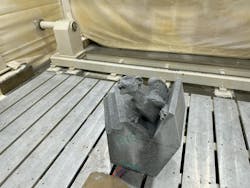
In addition to the time-saving measures, Mastercam’s different collision control options play a key role in the pieces the Brothers are machining. “There are five basic collision control strategies,” says Trinque, “with myriad options in each, allowing for any and all combinations or collision detection and avoidance for any situation.”
For example, when programming for oversized, irregular components with deep recesses and limited access points, one option is Safe Zones and Holder Avoidance, says Trinque. “Users can define restricted areas or ‘safe zones’ that the tool must avoid.” Another option is Dynamic Collision Checking, which provides real-time collision detection between the tool, holder and part geometry during simulation.
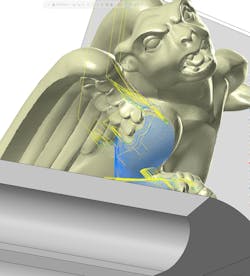
Mary says one of the more “intricate pieces” to mill was a canopy, part of the chapel interior. “Imagine an extremely ornate umbrella made out of stone sitting over a statue and the inside of it is completely hollowed out and carved up,” he says.
Inside that hollow are details and flowers. “You’re reaching around and carving all these little details just through this little hole, so access is very difficult,” he says. The Brothers were able to use Mastercam to tell the machine inside this area not to “run into anything.”
Multi-axis Precision
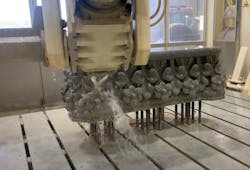
The multi-axis precision has also been beneficial. “Being able to take a piece and approach it from a million different sides,” says Mary, “you have a perfectly smooth surface finish. You don’t have a jog or a step where you came in.” Without that smooth surface, “we’d have to then take that by hand and try to blend it in to rectify those steps and jogs. In other words, the tool is rotating continuously as it works over the piece. “In some ways, that motion is blending for you,” says Mary.
“Having that precision really helps us to run it on the machine, take the finished part off and it’s just done. There’s no extra processing—saving a lot of wear and tear on manual labor. According to Mary, roughly 95% of their work is done through the CNC machines.
Trinque says that machining materials such as stone “demand more fluid; surface-sensitive tool motion; and careful control of feed rates, tool engagement and stepovers. Mastercam addresses these issues through its unified multi-axis tool path. The tool path combines a number of cutting patterns into a single, flexible strategy, allowing the programmer to adjust tool motion to follow complex surface contours, maintain consistent material removal, and achieve smooth finishes that are essential for sculptural or decorative forms, he explains.
The Final Stage
Currently, the Brothers are working on the chapel, the exterior of which is granite—a much harder stone compared to that used in the other buildings. (The Chapter House is all limestone; the hermitages and other buildings use limestone for their doors and windows, and a rough “split-face” sandstone for the rest of the walls.)
“It has been a learning curve on how to work with that hard of a stone and how to actually get the level of detail and the finish we’re looking for,” says Mary. “The technology has definitely helped us with that to develop, tweak and find the right parameters to actually machine that kind of rock.
READ MORE: Making the Jump to Multiaxis Machining
“We keep learning and evolving and applying what we’ve found worked well. Even what we did with the [previous] sculptural work, Mastercam’s multi-access abilities have really helped us to take that sculptural to another level.”
He points to milling foliage into the rock. “We try to make it as three-dimensional as possible, trying to punch in the spaces between the leaves and create a lot of shadow and depth,” he says. “That’s been a challenge to learn how to program because we’re reaching very deep behind and around these leaves and flowers and trying to machine in these really small spaces that, frankly, just aren’t big enough to get into. Just being able to find ways with Mastercam to actually work those spaces and program them more efficiently and accurately has been huge.
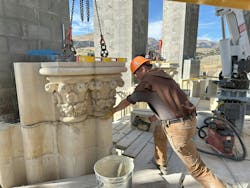
“As we were experimenting with it, the first several pieces we did, we had to do a lot of touch-up by hand afterwards, in and behind the leaves and flowers, because we just couldn’t figure out how to get in there with the machine,” says Mary. “But as we became more and more comfortable with Mastercam and the different options we had, we’re able to do more and more of that on the machine.”
With this kind of ornate architecture, says Trinque, most of the structure is symmetrical—in other words, lefts and rights of every piece. “The ability to mirror programs and CAD geometry of intricate, ornate architectural details within the software saves countless hours designing and programming what would otherwise be duplicates of the same piece. Once one piece is cut and the program proven, it’s a straightforward, fast process to make a mirrored piece.”
Trinque says he has received some requests for that tool path mirroring capability. “This was passed along to our development teams to improve,” he says, adding that there were also some linking enhancements made as a result of the Brothers’ use of the software and their feedback.
Mastercam is software that can be kind of intimidating because it gives you access to everything, says Mary. “Every single little thing has a bajillion options,” he says. “That can be a lot if you’re trying to get into those options and you don’t know what they do.”
From Art to Part—When Intricate Designs Meet Unconventional Materials
When intricate geometries meet unconventional materials, such as stone, standard workflows aren’t enough. Mastercam’s multiaxis toolpath is providing the Carmelite Brothers of Wyoming the capabilities they need to transform centuries-old artistry into modern manufacturing workflows. The following pointers from Mastercam’s subject matter experts offer more streamlining strategies.
Q: Regarding toolpath optimization for ornate designs: How does Mastercam adapt its toolpath strategies for highly detailed, multi-axis machining of non-metal materials—such as stone—compared to traditional metalworking workflows?
A: When it comes to highly detailed designs—especially in non-metal materials like stone—Mastercam’s multiaxis machining capabilities offer the precision and adaptability needed to bring artistic vision to life. Unlike traditional metalworking workflows, which often prioritize rigidity and chip control, machining materials such as stone demands more fluid, surface-sensitive tool motion and careful control of feed rates, tool engagement, and stepovers.
Mastercam addresses these needs through its unified multiaxis toolpath, which consolidates multiple cutting patterns into a single, flexible strategy. This unified approach lets programmers adjust tool motion to follow complex surface contours; maintain consistent material removal; and achieve smooth, flowing finishes essential for sculptural or decorative forms.
This flexibility transforms the machining process from a rigid, pre-defined operation into a creative workflow, where the user can experiment with different cut patterns and tool orientations to capture fine artistic detail. Whether sculpting stone, machining composites, or carving intricate prototypes, Mastercam’s unified multiaxis system provides a direct path from “art to part,” empowering users to translate design intent into beautifully machined physical forms with efficiency and precision.
Q. Collision control for large components: What collision detection and simulation features are most critical when programming for oversized, irregular components with deep recesses and limited access points?
A. When programming for oversized, irregular components with deep recesses and limited access points, Mastercam’s most critical collision detection and simulation features include:
- Dynamic collision checking. Mastercam performs real-time collision detection between the tool, holder part geometry during simulation, which is essential when access is limited and tool clearance is tight.
- Machine simulation. For large and complex setups, full machine simulation is vital. Mastercam allows visualization of machine kinematics, helping programmers anticipate and avoid issues related to axis limits, component interference, and fixture collisions.
- Multi-axis toolpath validation. With multi-axis machining, Mastercam provides toolpath backplotting and verification to check tool reach ensuring the path does not lead to gouging or unexpected crashes in deep or undercut areas.
- Safe zones and holder avoidance. Users can define restricted areas or “safe zones” that the tool must avoid, and Mastercam automatically links toolpaths to respect these limitations.
- Stock model awareness. Toolpaths adapt based on real-time stock conditions, reducing unnecessary tool movements in tight areas that increase collision risks.
These features collectively allow safe and efficient machining of complex, large-scale components by minimizing manual intervention and trial-and-error setups.
Q. Describe an option that is available to make the programming process faster and easier for this type of work within Mastercam.
A. One of the options utilized in this project is the ability to mirror parts. On such an ornate piece of architecture as this, most of the structure is very symmetrical meaning there are left and rights of each and every piece. The ability to Mirror programs and CAD geometry of intricate and ornate architectural details within the software saves countless hours designing and programming what would otherwise be duplicates of the same piece. Once one piece is cut and the program proven, it’s a straightforward and fast process to make a mirrored piece.
About the Author
 Brooke Smith
Brooke Smith
Brooke Smith is a freelance editor and writer and professor of technical writing. She has worked in B2B publishing for more than 20 years.
Voice Your Opinion!
To join the conversation, and become an exclusive member of Machine Design, create an account today!
 Leaders Logo
Leaders relevant to this article: