Q&A: What AI-Native Electrical CAD Could Mean for Engineers

When WSCAD approached Machine Design about the U.S. launch of ELECTRIX AI, the timing aligned neatly with a week of editorial coverage focused on CAD, CAE and the evolving engineering software landscape. With growing industry attention on how AI is infiltrating design workflows, our editors wanted to understand what an AI-native approach could mean for electrical CAD users.
A key voice in that discussion is Dr. Axel Zein, CEO of WSCAD GmbH and President of WSCAD Inc., who describes his role as helping drive the transition from conventional electrical CAD systems toward AI-enabled engineering environments.
WSCAD positions ELECTRIX AI as the industry’s first AI-powered electrical CAD platform, designed to integrate AI assistance directly into the engineering workflow rather than treating it as a separate layer of automation. The software was built to support U.S. electrical standards, including NFPA 79, and ships with IEEE 315 / ANSI Y32.2 symbol libraries integrated into the platform. Users can design projects in compliance with NFPA 70 (NEC) and UL 508A requirements.
“Electrical engineers do not need more hype around AI—they need practical tools that help them get real work done faster,” said Zein. “ELECTRIX AI gives engineers an AI-powered assistant that supports their work inside the CAD environment, helping them save time, work smarter, reduce friction in the design process and create capacity for more innovation.”
READ MORE: Why Design Intent is More Critical Now Than Ever
In the following conversation, Machine Design asked Zein about the role of AI in electrical engineering workflows.
Machine Design: Many companies are currently experimenting with AI. In your opinion, where does a truly sustainable competitive advantage emerge?
Axel Zein: With AI in general, the competitive advantage is most likely to come from time and labor savings. In electrical engineering specifically, AI will change the role of designers and engineers, allowing them to reduce low-value tasks, increase quality and free up time for humans to spend on ideation and iteration. Competitive advantage does not come from tools; it comes from evolving the roles of humans to embrace new ways of working that create value for the business.
MD: What exactly is the difference between “AI-native Engineering” and traditional CAD systems with AI features?
AZ: CAD systems help engineers design and document products before they are built. But product engineering still happens in the engineer’s mind and is then translated into CAD systems. AI-native systems take over parts of the actual engineering work. It is the difference between: “drawing the product you engineered in CAD” and “defining the product, and having the system generate the design.”
MD: If you had to give one piece of advice to a mid-sized company today: Where should they start?
AZ: Don’t start with the technology. Start with the question: Where are we making decisions today that could be systematized? Once you understand this, you can determine where the greatest leverage for AI lies.
MD: In your view, what are the biggest mistakes companies are currently making when dealing with AI?
AZ: The biggest mistake is treating AI like an IT project. AI is not a tooling issue. It is a leadership and organizational issue. If companies fail to understand that, everything remains stuck in experimentation.
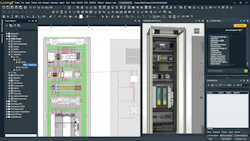
MD: Where do ECAD tools still fall short, particularly when engineers are designing electromechanical machines?
AZ: Most electrical CAD systems are still documentation-centric rather than engineering-centric. They are very good at creating schematics and documentation, but they do not truly understand the engineering intent behind the design. In electromechanical systems, engineers constantly have to bridge gaps manually between electrical logic, mechanical constraints, control behavior and manufacturing realities. The software supports drafting, but not the engineering thinking itself.
READ MORE: From CAD to Co-Design: Mastering AI, Material Science, Digital Twins and MBSE
MD: When mechanical and electrical CAD systems have to work together, where do engineers hit a wall? And why has that friction proven so hard to overcome?
AZ: Friction exists because mechanical and electrical engineering evolved from completely different worlds. Mechanical CAD is geometry-driven while electrical CAD is logic- and connectivity-driven. As a result, engineers often exchange files, but not true engineering intent. Every design change creates coordination overhead across disciplines. Solving this has proven difficult because it is not simply a software integration challenge; it requires a common engineering model across multiple domains.
MD: Which parts of electrical CAD work have resisted automation the longest, and what makes them so stubborn?
AZ: The areas that have resisted automation the longest are the ones involving engineering judgment rather than repetitive drafting. Tasks such as system architecture decisions, control logic definition, balancing cost versus manufacturability or handling exceptions are difficult because they operate in ambiguity and trade-offs. Traditional automation depends on fixed rules. Engineering rarely does. That is exactly where AI becomes transformative.
MD: AI is reshaping many engineering disciplines. Where is AI delivering the most tangible productivity gains?
AZ: The biggest productivity gains come from reducing repetitive engineering work and minimizing manual coordination effort. In electrical engineering specifically, AI already delivers strong productivity improvements in areas such as macro (template) generation and reuse, cabinet layout generation, generation of terminal lists, BOMs and more.
Tasks that previously required highly specialized knowledge of CAD tools and significant manual effort can now be completed much faster and by a much broader range of users. But the larger shift is that AI increasingly supports engineering decisions themselves, not just documentation generation.
MD: WSCAD is being positioned as the first electrical CAD software to use AI to automate routine tasks. Tell us more about its applicability.
AZ: At WSCAD, we focus on practical AI use cases that create immediate value for engineers. Designed and used in Europe for more than 30 years, ELECTRIX AI combines electrical engineering, control cabinet design, fluid and process engineering, electrical installation and building automation in one seamless electrical CAD solution. Built-in AI capabilities accelerate engineering workflows, allowing electrical engineers, designers and planners to reduce manual work and automate the creation of finished parts and products, such as control cabinets, design schematics, supporting files and bill of materials.
ELECTRIX AI helps users work more efficiently across tasks, from importing schematic data, exchanging components and validating project requirements and compliance to translating documentation and automatically generating control cabinets, wiring and finished design files.
One example is the AI-powered generation of cabinet layouts, where we use our own models to automatically create control cabinet designs from the schematics. We developed this capability in collaboration with several of our panel builder customers. What used to take days is now done in minutes. We have also embedded automated project translations in 102 languages.
Many clients told us that checking whether a project adheres to customer requirements can be a tedious task, often requiring engineers to browse through endless pages of specifications and compare them with their schematics. With AI, engineers simply upload the requirements, and the job is done in seconds.
WSCAD’s solution has demonstrated measurable productivity gains. WAGO, one of our customers, said that using our software ELECTRIX AI shortened their engineering effort by 50%. We believe AI must create measurable engineering productivity gains, not just impressive demos.
READ MORE: Leo AI: How CAD-Aware AI is Changing Mechanical Design and Engineering Workflows
MD: Given how entrenched EPLAN and Autodesk are in North America, where does WSCAD see its clearest path to market share? Is AI the primary wedge?
AZ: AI is an important differentiator, but the larger opportunity is productivity and simplicity. Many mid-sized machine builders, panel builders and system integrators feel that existing enterprise solutions have become increasingly complex, resource-intensive and too expensive to maintain.
WSCAD takes a different approach: faster deployment, easier usability, strong engineering depth and AI-driven productivity gains on top. We believe the market is entering a transition phase where customers increasingly evaluate how quickly engineering teams can actually deliver projects, not just the number of software features.
MD: Is ECAD evolving into a decision-support system? If so, what would that shift actually look like on the shop floor?
AZ: Yes, absolutely. Historically, electrical CAD systems documented decisions engineers had already made. The next generation of systems increasingly participates in the decision-making process itself. On the shop floor, that means systems that proactively suggest architectures, identify design risks, optimize cabinet layouts, validate manufacturability or detect inconsistencies before they become expensive downstream problems. Engineers remain responsible for the final decisions, but the software becomes an active engineering partner instead of a passive drawing tool.
MD: What separates high-performing teams from struggling ones?
AZ: The best teams are the ones that adapt fastest. High-performing teams embrace continuous learning, cross-disciplinary collaboration and process change. They understand that AI is not replacing engineers but is elevating the role of the engineer and offering a new way for teams to add value. Struggling teams often try to preserve old workflows and organizational structures, sometimes merely adding AI on top. But AI rewards organizations that rethink how engineering work is done from the ground up.
More content from Special Focus: CAD/CAM/CAE.
About the Author
 Rehana Begg
Rehana Begg
Editor-in-Chief, Machine Design
As Machine Design’s content lead, Rehana Begg is tasked with elevating the voice of the design and multi-disciplinary engineer in the face of digital transformation and engineering innovation. Begg has more than 24 years of editorial experience and has spent the past decade in the trenches of industrial manufacturing, focusing on new technologies, manufacturing innovation and business. Her B2B career has taken her from corporate boardrooms to plant floors and underground mining stopes, covering everything from automation & IIoT, robotics, mechanical design and additive manufacturing to plant operations, maintenance, reliability and continuous improvement. Begg holds an MBA, a Master of Journalism degree, and a BA (Hons.) in Political Science. She is committed to lifelong learning and feeds her passion for innovation in publishing, transparent science and clear communication by attending relevant conferences and seminars/workshops.
Follow Rehana Begg via the following social media handles:
LinkedIn: @rehanabegg and @MachineDesign
YouTube: @MachineDesign-EBM
Voice Your Opinion!
To join the conversation, and become an exclusive member of Machine Design, create an account today!
 Leaders Logo
Leaders relevant to this article: