The Hardest Products to Reinvent Are the Ones That Already Work
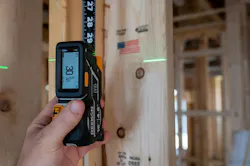
Almost everyone has picked up a tape measure at some point in their life, from college students moving into their first dorm room to homeowners renovating their dream homes to tradespeople using one 50-plus times a day on a jobsite. It’s one of the most elemental and reliable tools in construction…and we set out to reinvent it.
When engineers develop something entirely new, there is room to define the experience from scratch. However, redesigning a product people are already familiar with comes with a different set of challenges:
- Users already have an expectation for how it should feel, how it should behave and what they expect it to withstand. They will expect any changes to raise that standard.
- Innovation in this category cannot compromise impact durability, usability, manufacturing or the workflow built around the original product.
At REEKON, we ran into these challenges with measuring tools. The standard experience with a tape measure goes like this: The user takes a measurement, scribbles it on a scrap of wood or piece of paper, and a few minutes later may forget what it said. It was a workflow no one had challenged previously because it had worked just well enough to get the job done for decades, and any faults or errors were placed on the user rather than the product.
The problem wasn’t the tape itself. It was what happened after the reading.
Starting With What Already Works
The first step is identifying the characteristics users already depend on and treating those as non-negotiable engineering requirements.
In the case of the tape measure, people are already comfortable with the process of pulling out the blade, reading a measurement, locking it and moving on. They expect the blade to hold up, the hook to work, the housing case to survive the environment and the measurement to be accurate. Adding digital functionality only raises those expectations.
Before we could add anything digital, the physical tool had to hold up on its own. There’s a surprising amount of engineering in the metal, the heat treating and the hook at the end of a standard tape measure, refined over decades. We couldn’t have a good digital tape measure until it was a remarkable normal tape measure first.
That principle applies well beyond measuring tools. When engineers add sensors, connectivity, displays or software to an established mechanical product, the technology should not become an excuse to compromise the underlying product.
In some cases, technology makes engineering problems harder. Electronics need space, and new components can affect weight or balance. A different housing may even change how the product is held or assembled. New interfaces can introduce points of failure. And any new feature added to a product is expected to survive the environment it was built for, no matter how demanding.
Solve the Workflow, Not Just the Object
The second step is to dig beyond surface-level observations to find functional bottlenecks.
A tape measure is only one component of a measurement workflow that will also consist of someone reading a number, recording it and using it elsewhere. This handoff is where things usually break down.
That changes the engineering question. The opportunity isn’t simply to make the tape measure digital. It's to determine whether technology can remove some of the friction around measurement without making the basic tool harder to use.
Technical sophistication does not always equate to value and problem solving. When evaluating an established product, it helps to map the entire workflow around it:
- What happens immediately before the product is used?
- What happens immediately afterward?
- Where are users currently writing down, transferring or re-entering information?
- Which steps are necessary only because of the limitations of the existing tool?
- Which redundant steps could technology eliminate?
That kind of analysis can surface opportunities that are easy to miss when the engineering problem is defined too narrowly around the physical product.
It also raises the adoption question. We don’t try to make something 10 or 20% better, because that isn’t enough reason for someone to change a workflow they already know. If you’re asking a tradesperson to trust a new tool for something they’ve used every day for their entire career, the improvement has to be obvious enough to be worth the disruption.
Have a question, comment or idea? Get in touch with the Machine Design editors at [email protected].
Use Simulation to Find the Right Problems Before Building Them
Once the product requirements are set, digital engineering tools can help narrow the physical iteration process. Not every design question needs to be answered with a physical prototype.
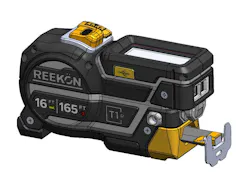
We used SOLIDWORKS design and simulation throughout development to model the product, evaluate how different components and design decisions would behave, and flag potential failure points before committing to physical iterations.
Simulation is usually the first step, because it lets you explore more possibilities at lower cost and in less time than physical testing would. It’s never perfect, especially for a consumer product like this one. However, it’s a useful way to figure out which of a thousand possible problems are worth looking at first and to prioritize where physical testing will tell you the most.
Simulation helped us decide where to spend time and money on physical iterations. The model could point to a feature that might pop out, giving us an area to examine or potentially reinforce.
We compared simulation results with urethane-cast parts and later results to see how well the model reflected real-world behavior. That mattered because injection-molded iteration could take about four weeks and cost several thousand dollars. Simulation didn’t replace physical testing, but it helped us focus it.
The same principle applies to other established products. The goal isn’t to simulate everything simply because the tools are available; it’s to use analysis where it reduces uncertainty and focuses engineering time on the questions that matter most.
A Prototype and a Manufactured Product Are Different Engineering Problems
Next, we moved into prototyping. One of the easiest mistakes in hardware development is assuming that a design that works as a prototype is ready for production. It isn’t.
A prototype answers one set of questions: Does the concept work? Production introduces another set: Can it be built repeatedly, calibrated consistently, tested efficiently and maintained at the required level of quality?
That distinction matters even more when you’re reinventing a mature product. Engineers aren’t only trying to make the new design function. They have to make sure it can be manufactured without undermining the qualities that made the original product useful in the first place.
During my time as a mechanical engineer and program manager at Formlabs, I learned how much changes when you go from making one working product to producing it consistently at scale.
At REEKON, we treated the production setup as part of product development. We built product-specific calibration jigs, factory fixtures and test software in-house, so the process for calibrating and checking each unit was designed alongside the tool. That extended the engineering work beyond the product itself and helped us build it consistently.
A product isn’t finished when the CAD model is finished or even when the first prototype works. The manufacturing and validation process is part of the engineering system, not a separate step that happens after the “real” design work is done.
Validation is also an incredibly important part of the process because it accounts for how people actually use the product in an uncontrolled environment.
In addition to SOLIDWORKS simulation, the fully assembled product was tested in the physical world, drop-testing it from 3 and 6 ft for 1,000 drops and running it through a test rig 10,000 times. The goal was to see what, if anything, broke under impact and repeated use.
Resist the Temptation to Reinvent Everything
Lastly, the instinct when redesigning a familiar product is to use the opportunity to change it as much as possible. That instinct is usually wrong.
Part of the job is figuring out what to leave alone. The parts of a product that already work well don’t need to be reinvented just because the rest of the product is changing. The engineering effort should go toward the handful of things that are actually broken, not toward making every surface of the product feel new.
That takes more discipline than it sounds. It means being willing to leave a design decision unchanged even when you have the tool to revisit it and saving the engineering effort for the places where it will actually improve how the product is used. People trust what they know, so where you don't have to reinvent the wheel, don’t. It's better for you in the long run of adoption.
The Real Engineering Question
Reinventing a familiar product isn’t about finding places to add technology. It’s about identifying where technology solves a real problem, preserving everything the product already does well, and proving that balance with both simulation and physical testing before it ever reaches users.
That’s a harder problem than building something from a blank page. It’s also, in my experience, a more rewarding one to solve.
About the Author
 Christian Reed
Christian Reed is the Founder & CEO of REEKON Tools, a Boston-based developer of digital measuring tools and data capture software for construction.
Related

Voice Your Opinion!
To join the conversation, and become an exclusive member of Machine Design, create an account today!
 Leaders Logo
Leaders relevant to this article: