Rockwell Integrates Emulate3D Virtual Twin Software with NVIDIA Omniverse
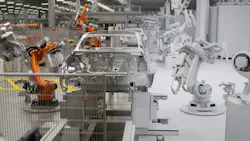
At Automation Fair 2026, Rockwell Automation announced the integration of its visualization and virtual commissioning software, Emulate3D, with NVIDIA Omniverse, RTX and OpenUSD technologies. According to the company, the integration will allow Emulate3D to simulate larger and more complex systems, enhance graphics rendering and lay the groundwork for AI performance optimization.
Although Emulate3D and Omniverse are both digital twin modeling applications, they serve different purposes. Acquired from SimPlan in 2019, Emulate3D helps engineers model, test and optimize manufacturing cells, machines and lines digitally to spot problems early rather than discovering them during physical commissioning.
Built around the Unreal 3D rendering engine, Emulate3D allows designers compose virtual manufacturing environments from libraries of parameterizable standard blocks (e.g., robot arms, storage tanks, smart conveyors); custom blocks; or the import of full custom-build CAD assemblies designed in Inventor, Solidworks, Creo, NX, etc.
In addition to optimizing factory layout, an assembled digital twin can also be animated to catch collision and production flow issues. The software also incorporates four physics engines designed to address different applications. For example, NVIDIA’s GPU-accelerated PhysX, originally designed for computer gaming, is built for speed, while the CPU-bound Bullet and Algoryx’s AGX Dynamics are high fidelity engines designed for robotics and complex multi-body dynamics, respectively.
In addition, engineers can also virtually test and optimize control programming. Emulate3D supports both hardware-in-the-loop testing, with interfaces to hardware from Rockwell, Siemens, B&R and Beckhoff, as well as software-in-the-loop using PLC emulation via FactoryTalk Logix Echo and Siemens S7-PLCSIM Advanced.
However, given the complexity of rendering, emulating and simulating complex automation systems, Emulate3D inevitably runs into performance caps running on a single workstation, depending on the level of geometric detail in the CAD models, the fidelity of the physics engines and the number of tags processed through multiple emulated PLCs.
Ultimately, though, the goal of this type of enterprise digital twin is to display the entire factory floor at once, not parts in isolation. To address this, Rockwell expanded Emulate3D’s capabilities with the launch last year of Emulate3D Factory Test. An upgrade from the standard version, Factory Test orchestrates the output of multiple simulations running on individual workstations and combines them into a single factory-scale simulation environment.
This is where Omniverse enters the picture as that unifying environment. For one, being an NVIDIA application, it was developed from the ground-up to leverage the company’s enterprise-level RTX graphics and AI accelerating GPUs.
For example, RTX and Omniverse enable ray tracing, a computer graphics technique that emulates the behavior of real world light and thereby produces photo-realistic rendering. It also integrates NVIDIA’s latest GPU-accelerated physics engine, Newton, a substantial upgrade from its general purpose predecessor, PhysX.
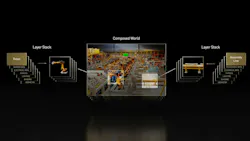
Equally critical is Omniverse’s native file format, OpenUSD (Unified Scene Description). Originally developed by Pixar, it acts as a multi-layered “stage” onto which 3D geometry, textures, lighting and other virtual components, produced by various design software, can be positioned, animated and even modified non-destructively. As such, a Solidworks model of a machine can share the same virtual environment as a conveyor model designed in PTC Creo, a lighting scheme from Blender, electric wiring and HVAC ducting from AutoCAD, and an architectural model designed in Revit or Sketchup.
More importantly, the open source standard also encapsulates extensive non-geometric data, including physics (e.g., mass, friction, joints), materials, trajectories, time-series data, sensor streams, semantic labels and annotations, among others. All of the above is organized in a hierarchical structure that delineates the relationships between elements. Taken together, this unified and comprehensive data set offers an efficient way to train a physical AI model, via the production of synthetic data, or for an existing inference model to quickly traverse and “comprehend.”
At one level, the coupling of Emulate3D with Omniverse is Rockwell keeping pace with moves by competitors. In 2022, for example, Siemens announced a similar integration of its digital twin application, Process Simulate, with Omniverse as part of a larger industrial metaverse initiative. Ultimately, both look to maintain their dominant automation position as industrial AI adoption expands across the global manufacturing market.
Despite all that pairing Emulate3D with Omniverse offers, there is a potential caveat. Given its complexity and extensive capabilities, Omniverse does impose a heavy learning curve. And to be sure, taking the time and effort to model an entire factory floor, complete with digital replicas of all physical assets—plus the non-geometric control, physics and kinematic simulation data—isn’t a quick and dirty endeavor.
Even so, there’s something to be said for going slow now to go fast later. Better to catch a slew of major and minor hiccups when they can be fixed with the click of button rather than when the aluminum extruding is being assembled.
About the Author
 Mike McLeod
Senior Editor, Machine Design
Mike McLeod, senior editor of Machine Design, is an award-winning business and technology writer with more than 25 years of experience. He has covered the full spectrum of mechanical engineering, from industrial automation, aerospace and automotive, to CAD/CAE, additive manufacturing, linear motion and fluid power.

Voice Your Opinion!
To join the conversation, and become an exclusive member of Machine Design, create an account today!
 Leaders Logo
Leaders relevant to this article: