COMSOL Multiphysics Version 6.4 Speeds Up Simulation with GPU-Accelerated Solvers
Key Highlights:
- COMSOL now supports GPU acceleration across all physics, significantly speeding up simulations with the help of NVIDIA technology.
- Enhanced structural and explicit dynamics capabilities allow for precise impact and drop test simulations, predicting product durability under real conditions.
- The new Granular Flow Module enables simulation of millions of particles, benefiting industries such as pharmaceuticals, chemicals and mining.
In the accompanying video, Bjorn Sjodin, SVP of product management at COMSOL, discusses COMSOL’s latest capabilities using modeling and simulation, as well as how to work with digital twins and virtual models to better understand products and processes in engineering and research.
COMSOL multiphysics software is used by engineers and researchers for modeling and simulating design, technology or devices and processes. The platform enables analysis of interactions between physical domains, including electromagnetics, fluid flow, heat transfer and structural mechanics.
“The software is used to predict what happens to product when it’s exposed to real operating conditions, for example, or to better understand a chemical process and the like,” said Sjodin, who spoke with Machine Design at the COMSOL Conference 2025 in Boston (Oct. 8-10). “It’s a way of virtually representing reality.”
READ MORE: How Multiphysics Simulation Accelerates Innovation in Energy, Healthcare & Manufacturing
When using multiphysics simulation, engineers often face the challenge of balancing complexity with numerical stability. But having the ability to couple multiple physical phenomena in a model will expedite computational demands and sensitivity. The results from these simulations are often visualized as color fields, to represent stress distributions in structures or velocity profiles in fluid flow, said Sjodin.
This field data can be exported as numerical files (in text format) to compare simulated results with experimental data.
This is where COMSOL Multiphysics can further facilitate correlation analysis through side-by-side numerical or visual comparisons, or by exporting simulation data to Excel or other third-party software for further processing. For greater accuracy and design confidence, the results can then be compared “with simulation data from the virtual world or with experimental data from the physical world,” Sjodin said.
Version 6.4 Rolls Out Three New Capabilities
At the Boston conference, attendees were briefed on the latest enhancements and capabilities to COMSOL Multiphysics: Version 6.4.
Sjodin outlined three new capabilities. The first is that it offers GPU support across all physics.
“Previous versions of COMSOL have been able to support GPU acceleration for training neural networks, for circuit models, for accelerating things like simulation apps to make them run faster,” he said. “We have also been able to utilize GPU acceleration for acoustic simulations. But what’s new this year is that we have GPU acceleration for all physics, and that’s a big step forward.”
Sjodin said the upgrades have been made possible with the assistance of technology provided by NVIDIA. The new cuDSS is a GPU-accelerated sparse direct solver optimized for hybrid CPU-GPU computation. It provides substantial speedups compared to CPU-based direct solvers.
READ MORE: COMSOL 2025 Highlights Real-World Multiphysics Applications
COMSOL’s press note stated that “GPU acceleration is beneficial for both single-physics and multiphysics simulations, particularly in cases where solver robustness is important. In benchmarks, some multiphysics simulations have achieved speedups of 5× or greater.”
The second capability revolves around structural or explicit dynamics. Sjodin said COMSOL has enhanced robustness and speed of simulations involving structural contact, such as those encountered in drop tests or impact analysis.
An example might be a drop test for consumer products or components, such as dropping a cell phone on a table. Simulations can predict the maximum height at which the device can still withstand impact without failure, he explained.
READ MORE: Crunching the Numerics: Computer Aided Engineering
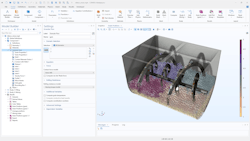
The third enhancement is the introduction of the Granular Flow Module. Sjodin said this development has been requested by the user base for many years. Based on the discrete element method (DEM) for simulating granular materials and processes such as hopper discharge, silo storage, chute transport, powder spreading and mixing, the add-on enables simulation of millions of solid particles interacting in bulk flow. The module applies to pharmaceutical, chemical processing, agriculture, mining and additive manufacturing industries.
In addition, interfacing tools enable the integration of COMSOL Multiphysics simulations with major technical computing and CAD tools on the CAE market.
About the Author
 Rehana Begg
Rehana Begg
Editor-in-Chief, Machine Design
As Machine Design’s content lead, Rehana Begg is tasked with elevating the voice of the design and multi-disciplinary engineer in the face of digital transformation and engineering innovation. Begg has more than 24 years of editorial experience and has spent the past decade in the trenches of industrial manufacturing, focusing on new technologies, manufacturing innovation and business. Her B2B career has taken her from corporate boardrooms to plant floors and underground mining stopes, covering everything from automation & IIoT, robotics, mechanical design and additive manufacturing to plant operations, maintenance, reliability and continuous improvement. Begg holds an MBA, a Master of Journalism degree, and a BA (Hons.) in Political Science. She is committed to lifelong learning and feeds her passion for innovation in publishing, transparent science and clear communication by attending relevant conferences and seminars/workshops.
Follow Rehana Begg via the following social media handles:
LinkedIn: @rehanabegg and @MachineDesign
YouTube: @MachineDesign-EBM