Connectors and Sensors for Heavy Equipment and Off-Highway Vehicles
Key Highlights
- China’s updated China IV regulations have effectively prohibited diesel-powered machinery at urban construction sites.
- Battery-powered construction equipment ranges from compact loaders to Komatsu’s 24-tonne PC210E excavator.
- Electrification increases the need for connectors as more data and wireless capabilities are added to heavy equipment.
- Jobsite connectors must withstand dirt, dust, high-pressure washing, and cleaning chemicals.
On June 4, 2026 in All, Connectors, Industrial, RF, Sensors by Amphenol
Noise, exhaust fumes, and dirt: These are what spring to mind when thinking about building and construction sites. And, looking at these monster machines, it’s challenging to imagine it ever being different. Surely earth movers and excavators will be forever dependent on fossil fuels to perform their tasks? But the reality is different. Much like the automotive and haulage industries, these machines, which move tonnes of dirt each day, are also being electrified.
Can an Excavator Be Battery-Powered?
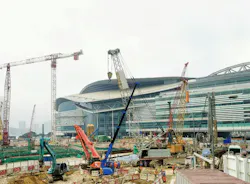
China is particularly focused on the benefits of electrifying heavy equipment. Their China IV regulation update in 2022 builds on existing tailpipe emissions for non-road vehicles, meaning that, today, the use of diesel-powered machinery is essentially prohibited at urban construction sites (Figure 1).[1]
nd we’re not just talking about the lightweight bits of equipment. As highlighted by EV Magazine, electric options start with smaller machines such as the Bobcat E10e mini excavator and the Avant E Series loader. But then there is Komatsu’s PC210E, a 24-tonne excavator featuring a 123kW electric motor with a lithium-ion battery that supports eight hours of operation, matching the performance of their conventionally powered excavator.[2]
Need for Connectors and Connectivity Is Growing
Much like in the automotive sector, the move to electrification means more connectors are required. Additionally, more data is flowing through this equipment, and support for wireless systems, such as GPS, remote monitoring, and remote control, is being added, enabling new modes of operation on construction sites.
What’s not changed are the environmental conditions. Mud, dirt, and dust accumulate throughout the day, so connectors must withstand high-pressure washing and the chemicals used during cleaning.