Video Insights: The "New Collar" Workforce
Preparing for the "New Collar" Working World

What’s the Difference Between Lug-centric and Hub-centric Wheels?
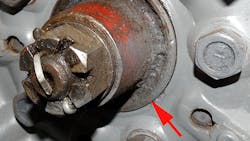
There are two commonly used ways to fasten wheels to a hub: lug-centric and hub-centric. In hub-centric designs (see figure below), the wheel fits snugly against the hub which provides support along with the wheel lugs.
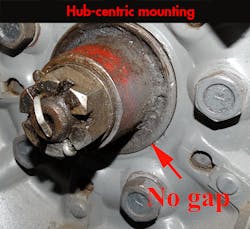
In lug-centric mountings, the wheel lugs center and support the wheel with no support from the hub because of the gap (as indicated by the arrow). (See figures below.)

The easiest way to tell the difference between the two designs is to look at the hub of a hub and wheel assembly. If the hole in the center of the wheel fits snugly against the hub, then it is hub-centric. If there is a gap between the center hole of the wheel and the hub, then it is lug-centric.
Automotive applications usually use the hub centric design because the support and centering of the wheel better resists impact loads from being used on typical roads. Other low-speed and low-impact applications use lug-centric designs which are less costly and strong enough for these applications. Golf carts, for example, often use lug-centric designs.
Aftermarket wheel manufacturers typically sell lug-centric attachments because the wheels will work on a wider variety of vehicles without having a specific wheel shape for a hub. Some aftermarket manufacturers provide a spacer that goes in the gap to mimic a hub-centric design. The spacer looks like a large washer that fits in the gap between the hub and wheel. It is designed to contact both the wheel and hub and acts as a means of transferring lug loads to the hub.
A problem arises when using a lug-centric wheel on a vehicle and suspension that was originally a hub-centric design. Without the hub’s support, road impacts can deform lugs enough to where the wheel is no longer concentric with the hub, leading to vibrations. This can reduce the clamping force of the wheel to the hub. Road loading conditions can then move the wheel around on the hub, as can be seen by the worn holes in the image below of a lug-centric wheel used on a hub-centric vehicle.
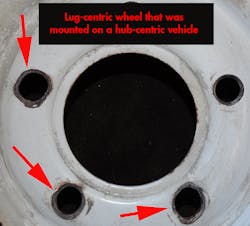
In this instance, the lugs could not adequately clamp and center the wheel to the hub. The run-out (off-centered operation) created enough vibrations that the lugs suffered fatigue failure, the wheel came off the vehicle, and there was an accident.
In another mismatch in which a lug-centric wheel was installed on a hub requiring a hub-centric wheel, the loss of clamping force led to a fatigue failure of the bolt (see cross-section of failed bolt below).
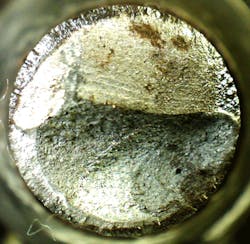
It should be noted that hub-centric and lug-centric wheels are distinct designs with different stress levels at different locations. Substituting a lug-centric wheel in place of a hub-centric wheel can decrease reliability, especially in high wheel-loading and impact- loading environments.
Charles C. Roberts, Jr., Ph.D., P.E., is an engineering consultant in the areas of accident reconstruction, failure analysis, structural analysis, heat transfer, fire origin analysis, computer analysis, mechanics, and biomechanics.
Looking for parts? Go to SourceESB.

Workholding Solutions Have a Grip on Lightweighting
At a Glance:
- Manufacturers prioritize lightweighting as they move to a mix of lighter, more advanced materials for structural parts.
- Historically, automotive manufacturers favored steel for its strength and lower cost relative to other materials, such as carbon fiber, aluminum and magnesium. That’s changing thanks to mixed-materials strategies.
- One of the challenges with changing materials in the manufacturing process is being able to keep up with the most efficient ways to make those parts.
- Innovative super-precision machining and non-deforming workholding solutions can offer some relief.
In the automobile and aircraft industries, the course has been set for some time to develop materials and design methods as a way to reduce fuel economy and reduce emissions.
Lightweighting strategies have been ongoing for internal combustion engines and will continue to be high priority for electric vehicle manufacturers, according to Chris Brown, commercial sales engineer, Forkardt, a manufacturer of custom designed rotating workholding devices for machine tools. Designers in the aerospace and automotive industries have for decades considered lightweighting, or reducing the weight of a product, to be a challenging constraint that’s driven by both cost and performance, he said.
Regardless of the method and targeted variables to switch out heavy metals, such as steel and aluminum, in favor of composite materials, the objective remains tied to optimal design. Over time, initiatives that started with the objective to achieve higher mileage for automobiles, evolved into changes to materials.
“We started seeing automobile bodies change from steel to [using] more plastics,” said Brown, who has been observing the lightweighting trend over the course of his 18-year career with Forkardt. “Your front and rear bumpers used to be made of steel. Now there’s just a steel backbone to what is typically a plastic of some sort. And when you look at the aircraft industry, where they’re trying to make those much more efficient, they’ve also looked at reducing weight.”
Forkardt’s Soft-Touch chucking system has a unique design that allows clamp fingers to conform to a part’s natural, as-processed contour.Forkardt
Losing Weight
Broadly speaking, lightweighting can be described as the practice of “reducing weight or mass of materials in order to make the product more efficient,” said Brown.
The concept has been being applied across industries for decades, but the airline and automotive industries have demonstrated the most promising examples and overall success. A McKinsey report, which investigated the future development of the lightweight materials market, estimates that the aviation industry currently leads market share with almost 80%, while automotive is poised to increase from 30% to 70% by 2030.
Take as an example the automotive industry, which has for decades depended on steel. On average, OEMs use about 900 kg of advanced high-strength steel (AHSS) per vehicle. The World Steel Association notes that 40% of that total is used in the body structure, panels, doors and trunk closures; 23% is in the drivetrain (consisting of cast iron for the engine block and machinable carbon steel for the wear-resistant gears); 12% is used in the suspension; and the balance is distributed to a variety of components, such as the wheels, tires, fuel tank, and steering and braking systems.
The desirable standards in strength and safety—relatively low in cost compared to other materials, including carbon fiber, aluminum and magnesium—are threatened by new prospects in vehicle design and materials that can reduce weight, improve fuel efficiency, provide better performance, lower tooling costs and lower environmental costs. Aluminum, viewed as the fastest growing automotive material, is expected to grow to 514 pounds per vehicle by 2026, a growth of 12% from 2020 levels, according to a DuckerFrontier survey.
When Ford switched its F-150 to an aluminum body in 2015, the costly decision paid off. Engineers increased the use of high-strength steel in the frame to 77% from 23%, which resulted in a stronger, more durable and structurally more rigid structure, while saving up to 60 lb of weight.
They also opted for a high-strength, military-grade, aluminum-alloy body, which helped the pickup lose about 700 lb in total. Ford’s engineers boasted the materials were torture-tested, and that the change resulted in increased towing and hauling capability and even better efficiency. The F-series continues to be the nation’s best-selling pickup.
For its part, GM, Chevrolet and Fiat-Chrysler followed a different path by lashing back with “mixed materials strategies” that also feature high-strength steel.
McKinsey analysts report high-strength steel offers a weight advantage of 20% over steel at an additional cost of 15% per part. Compare this to aluminum, which is 40% lighter but 30% more expensive. If cost considerations have been prohibitive in using lightweight materials until now, McKinsey suggests the introduction of CO2 targets and penalties will see lightweight materials delivering monetary benefits and a net increase in the use of lightweight materials in the future.
Chris Brown commercial sales engineer, Forkardt.Forkardt
A Grip on Workholding
When OEMs run the numbers to determine the best business case for selecting a mix of lighter and advanced materials for structural parts, they realize new materials go hand-in-hand with new equipment and tooling solutions. Tool & die and workholding companies are presented with designs featuring lighter materials as lightweighting becomes more prevalent, noted Brown.
Forkardt, which specializes in manufacturing aluminum die-cast materials and thin-walled components where part deformation is a concern, keeps tabs on evolving demands of automotive and aerospace markets with an eye to catering to challenging applications.
Brown pointed out that newer, flexible thin-walled parts can easily distort under the pressure of normal machining and have a higher risk of bending or deforming in the clamping process.
Grip forces generated from standard or semi-standard workholding products will deform these new lightweight materials.
One of Forkardt’s workholding solutions, a Soft-Touch chuck design, allows clamp fingers to conform to a part’s natural, as-processed contour. Coupled with regulated clamping pressure, the resulting force dynamics actually give rigidity to fragile and delicate parts.
A bladder within the chuck expands to grasp a part by matching a component’s irregular shape, explained Brown. “What that bladder pushes against are a bunch of fingers,” he said. “Once the bladder fills up with hydraulic fluid, those fingers come in and grip the part.”
Although the Soft-Touch technology has been on the market for a long time, Brown contends this type of technology will become even more relevant as lightweighting becomes more prevalent across industries.
Optimize Tooling
Brown is realistic about the current viability of lightweighting for manufacturing applications. Changes in the material mix bring both challenges and opportunities, he said, because manufacturers researching new materials are not only confronted with threats to their margins, but the new mix of materials may also stymie processes whenever lighter, more advanced materials are used for structural parts.
Since competence in lightweighting will be key in future competitiveness, as Brown sees it, that is where workholding choices can pack a punch.
“OEMs will be building more of these custom chucks to reduce the cost to the supplier and machine designers and builders will become more efficient in how they provide solutions,” Brown said. “And if you’re a business that isn’t adapting to address that, your future could be at risk. We’re not going to be making cars that are heavier.”